Categories
New

Things 2026 Q2: Fisherian runaway, Androids, effortful music videos

Quotes

Here’s some nice quotes that all draw out aspects of the Dunning-Kruger bias:

Idealism increases in direct proportion to one’s distance from the problem

– John Galsworthy

Ignorance more frequently begets confidence than does knowledge

– Charles Darwin

Everything looks simple when you don’t know the first thing about it

– Kevin Williamson

Having established that, I now return to confidently holding forth on things I’m not an expert in, probably annoying Darwin in particular. I leave you to judge how sensible that is.

Super-normal stimuli and Fisherian runaway

Bear with me on this one as I invoke the principles of sexual selection to explain burgers that are too tall to bite.

Part 1: Gestalt Perception

Perception usually feels effortless, but the process that makes it work is strange and subtle. Dozens of contextual clues (sight/sound/smell, movement/light/texture, size/silhouette/colour, and many more) are all subconsciously processed, usually based on previously observed patterns, and our conscious attention is directed to whatever that process deems the most salient aspect. For example, you might see a poster you’ve never seen before, but it has a picture of an actor you know, some words in an elaborate font, a release date and some small print, and without effort you recognise it as a film poster, as well as a good guess for the genre and if it’s likely to be worth paying more attention to.

The way many parts contribute subconsciously to our overall perception is summed up by the slang term ‘vibes’, but over the decades other terms have approximated this idea – ‘vibrations’ of course, but also in different contexts bag, energy, flavour, and more recently aura or “x-coded” (for something with various signifiers of x). Similarly people say an idea ‘doesn’t pass the sniff test’, not because they can smell abstract concepts, but because of how it comes across in almost every other way.

Part 2: Supernormal stimulus

Certain aspects of perception have clear dimensions to them. Most obviously things like bigger/taller/longer but also brighter/more-textured/more-saturated, and beyond. If we recognise an object based on it being notable in some dimension, an object with a stronger version of that attribute can register more quickly and more strongly as a signifier of that object. Further, I think that obviousness biases us to rate it as a ‘better’ example of that object in some way. If it has an unnaturally pronounced example of that attribute it can become a supernormal stimulus.

Wikipedia gathers some examples from the natural world here, for example:

  • Birds will nurture fake eggs over their own if they are larger or more saturated (and Cuckoos exploit this fact)
  • Butterflies that select mates by bright colour markings will prefer orange paper model butterflies over receptive real mates
  • Herring gull chicks seeking a parental beak for food will choose a red stick with yellow markings over a faithfully reproduced yellow-beak-with-red-dot replica gull head

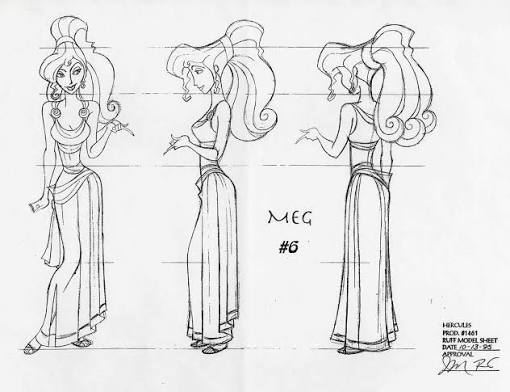
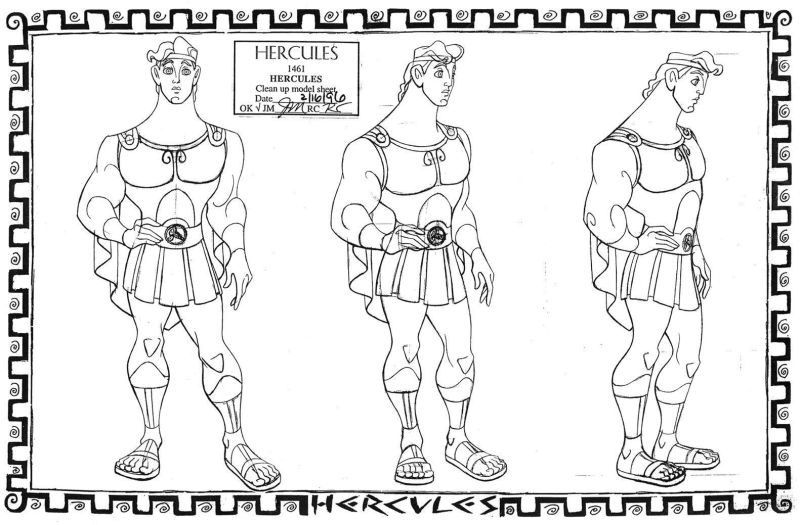
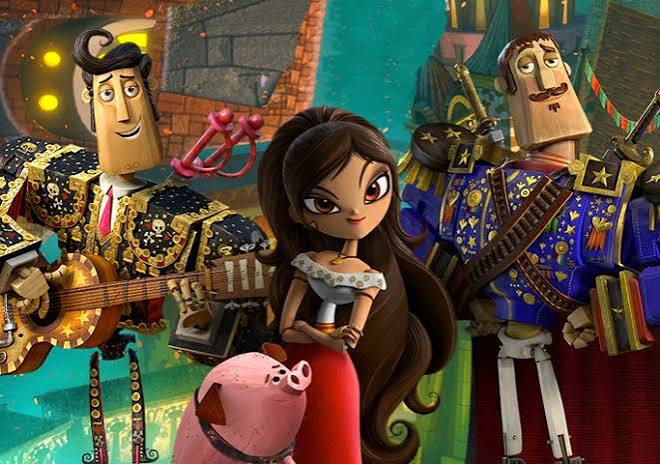
Of course, we can intuitively understand this without tricking small animals in laboratory settings, because we are animals ourselves. For example, a drawing of a woman with a dramatically high hip/waist ratio or a man with an implausibly pronounced shoulder/waist ratio will read as stronger and more obvious examples of each sex, even if those ratios go beyond what nature would naturally produce. Some examples:

Designs from Disney’s Hercules (1997) – exaggerated but legible:
Designs from The Book of Life (2014) – frighteningly extreme, still works:
Beyond human secondary sexual characteristics, we can experience it in pretty much everything. A giraffe with an extra long neck is extra giraffe-ey; a stretched limo is an even greater affluence signifier than a regular limo; a monster with an excessive number of impractically long and excessively sharp teeth is extra monstery.

Part 3: Fisherian runaway / Sensory Exploitation Hypothesis

Natural Selection just by itself is an incredibly powerful theory, but some things defy it – a classic example being peacock’s wildly impractical tails. Less often remembered is that Darwin also theorised about Sexual Selection: genes that produce traits that elicit sexual preference will have a reproductive advantage, even if they have no survival advantage. But this on its own doesn’t explain the peacock.

Fisher’s suggestion was that the earliest version of the ‘ornament’ (the surprising feature the species developed) initially signalled greater potential fitness in the natural-selection sense, which meant a preference for that ornament also had an advantage. If the ornament and the preference are correlated (I assume mainly because genes for both get passed on together) you can enter a feedback loop of ever-more exaggerated ornaments that are just barely constrained by natural selection.

The ‘sensory exploitation hypothesis’ proposes that preference for exaggerated traits arises from sensory biases such as the supernormal stimuli I mentioned above. It seems pretty intuitive to me that this will help drive the Fisherian runaway effect far beyond what natural selection would usually tolerate. It’s a bit like Goodhart’s law – when a measure becomes a target, it ceases to be a good measure.

So a male peacock with an even bigger, brighter, more saturated and more ornamented tail will look even more appealing to a female peacock, and both the tail and the appreciation for the tail get passed on. Thus the tail becomes ever more extreme, until it finally bumps against natural selection’s hard limits.

No points are awarded for this, but I did come up with the sensory exploitation hypothesis myself! Only after looking for research did I learn that all the above is well-established, and that point about ornament and preference being correlated is the deeper insight.

Part 4: Fisherian runaway in capitalism

I do think this same process applies to capitalism:

  • Consumers select products by their utility. Products with greater utility are more selected, more successful, and so are produced more. Natural selection at work. A Drosselmeyer nutcracker is incredibly good at cracking nuts, so it does well in objective comparisons, and people like me will recommend it to anyone that wants to crack nuts.
  • In many cases the consumer can’t perfectly assess the utility of the product before purchase, so they rely on other signals. This becomes more like sexual selection.
  • We can fall victim to a super-normal stimulus here – a thing that depicts outrageously exaggerated traits looks more appealing, even if it’s beyond all reason. A 13-in-1 tool must be better than a 3-in-1 tool. Drinking Tango gets you slapped by an orange man. This car looks so good, fireflies follow it. These two people love this product, and they are very attractive!
  • Then the Fisherian runaway can start – to compete, those products need to show the super-normal stimulus, and then the only way to stand out is to exaggerate it even further until you eventually run aground on actual utility / natural selection.

Perhaps you think I’m mad, but remember the burgers?

As a food, a burger is notable for being quite tall – it’s a stack of three (or more) things. A burger can also seem more appealing if it has more than just a plain burger inside. So what happens? Burgers that are taller and have more additional things inside look like even better burgers. Before you know it, restaurants are serving burgers that have to be held together with a skewer and cannot even fit in a conventional human mouth. It’s like eating a peacock’s tail. Metaphorically.

(I’m not sure about the correlation element… perhaps it comes in when chefs eat a taller burger at some other restaurant and conclude they should make their own burgers even taller?)

What about cars? Some people feel safer or more masculine if their car is bigger than others. In America where petrol is relatively cheap (so the natural selection pressure of miles-per-gallon is lower), this effect has reached peacock tail levels of madness as cars become ever larger. The correlation kind-of happens here because obtaining a bigger car means other people, whose cars seemed sufficiently big before, now see a need to get even bigger ones.

Thanks to Instagram and similar social media, we get a similar effect for a bunch of things:

  • Treats/drinks that look amazing go viral and drive more sales (and more social posts, driving the correlation) than those that actually taste good
  • Holiday destinations that make for good photo opportunities start to do better than those that are actually enjoyable
  • Getting more abstract: a video/post that has a very high number of views seems like it must be more worthy of our attention
  • Bit of a stretch: a famous person having an opinion seems more compelling than an expert in that domain’s opinion
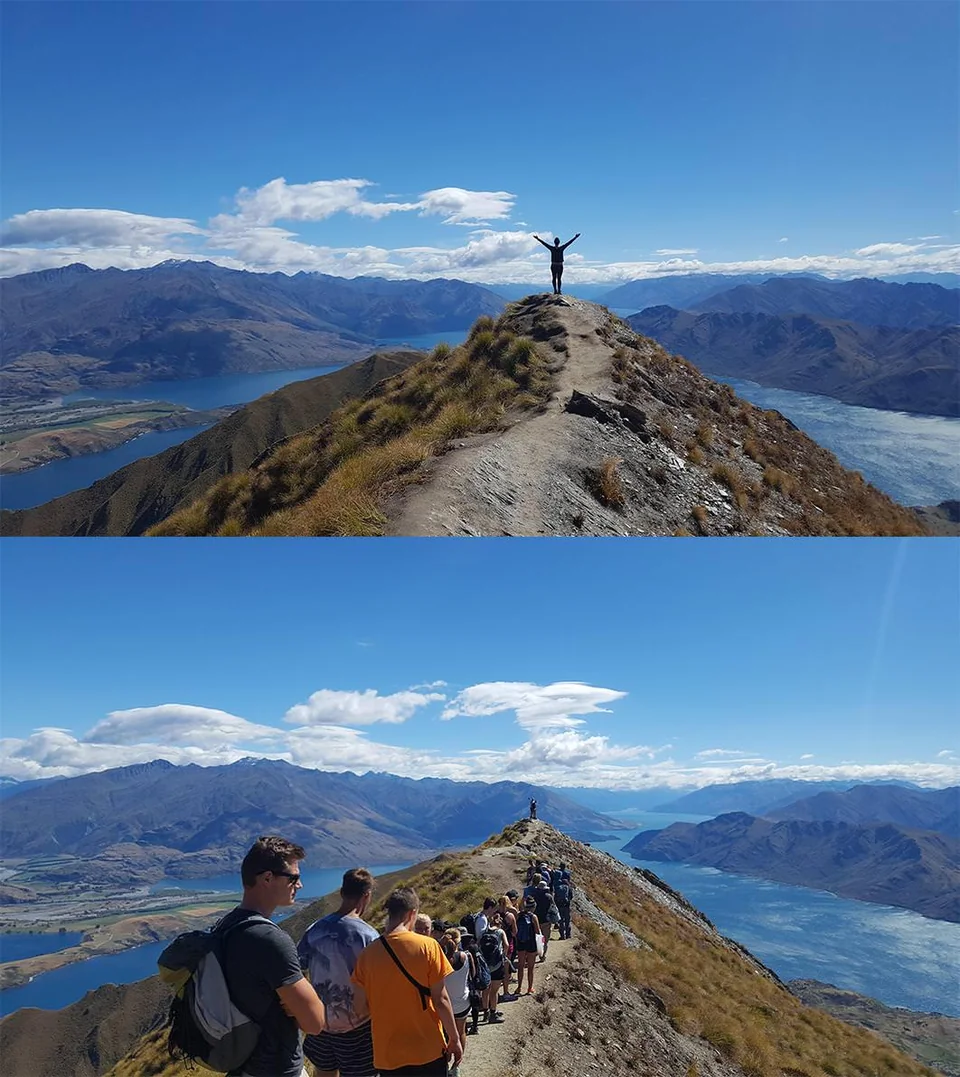
So as always… watch out for that.

Podcast – The Magnus Archives

The Magnus Archives is a supernatural horror fiction podcast that ran for 200 episodes across 5 seasons from 2016 to 2021.

I got into it essentially by the strength of the writing: I was at a craft fair and found a range of stickers with intriguing phrases like “The sky ate him” and “The world is always ending”.
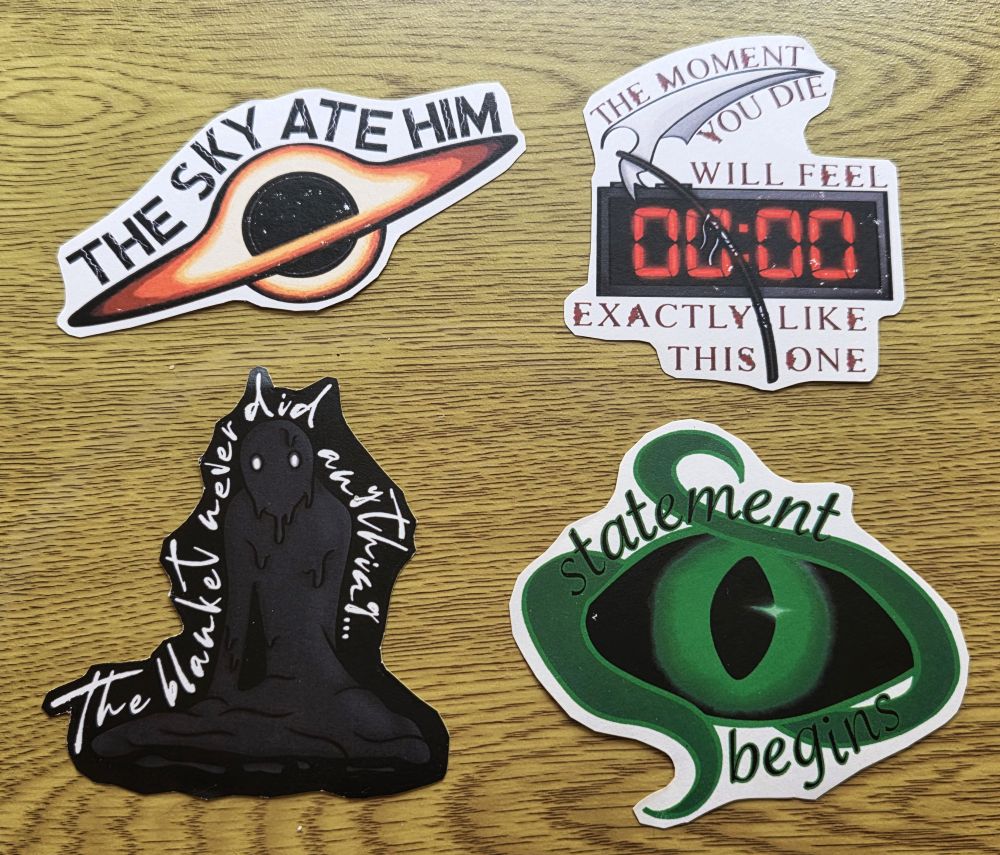
Unfortunately I didn’t note the artist and the work is not signed!

The framing premise is that the eponymous Magnus Archives takes statements from anyone that has experienced something supernatural, and the Head Archivist is recording these statements out loud to tape in order to log them. In this way it takes a classic “spook of the week” form.

I liked that a lot of the elements of the premise that don’t really make sense end up being narratively justified – with the exception of the very non-diegetic spooky music, which was still excellent (especially the “and then things got really spooky” musical cue in season 1).

The spook-of-the-week setup has two tightropes the author must walk, which author Jonathan Sims talks about explicitly in some of the Q&A episodes: the balance between the weekly spook and a greater narrative, and the balance between raising questions and and answering them. For me, neither one is walked perfectly throughout – but Sims (who is also the lead voice actor) does a much better job of both than I’ve seen before. Even though for me the series peaked around 75% of the way through, I still strongly recommend it if you like spooky business.

Some points to note before jumping in:

  • Episode 1 (styled MAG 1) did not do much for me, MAG 2 is a better bellwether for what the rest is like, so I recommend sampling at least up to that point
  • There is a dedicated subreddit, with a thread for each episode featuring discussion by fans and no spoilers about future content. This can be quite fun for a debrief and help spotting deeper connections between things. (Hub of most of these threads can be found here)
  • There is a dedicated wiki with plot summaries and full episode transcripts, but you need to be very careful because immediately after the plot summary you will see information that spoils future episodes
  • My very favourite bit begins with the word “Hello”. You’ll know it when you get there
  • My least favourite bit is recurring characters that are constantly angry and obstinate
  • Probably avoid if you’re averse to the “endless suffering” trope
  • There’s a follow-up called “The Magnus Protocol” which is still running and I have not yet sampled

The home page with various links is here, but it’s probably easiest to just search ‘magnus archives’ in the podcast service of your choice.

The Androids are Coming

Because I’ve been writing Things for almost 20 years, I can see how some of my posts serve as a marker of developing technology, or at least my awareness of it. For example, I posted in 2015 this Google Research post about neural networks generating images, which is I think the precursor to generative AI art as we now know it.

Back in 2009 I posted about Boston Dynamics’ ‘Big Dog’. Developments in robotics carried on, with bipedal models eventually roaming free of connecting cables and getting increasingly human-shaped. They now seem to be at something of a turning point.

Compare the performance of China’s androids in the 2025 new year show here:

… with the 2026 new year show:

My guess was that android promotional material would shy away from any implication of violence to avoid reminding people of films like Terminator. I hadn’t accounted for the fact that state propaganda might actively want to promote martial prowess, hence the above. At least we can look at what’s coming directly instead of guessing.

Terminator style threats to humanity are a natural fear but I suspect are a low-probability / high-impact event (perhaps more likely in the form of perfectly efficient and numerous state police facilitating a concentration of power into an ever smaller number of human hands, rather than a bona fide machine uprising). Warfare is also a sufficiently incentivised area that bespoke robots (rather than androids) are arising already, starting with drones.

We’ve spent centuries building specific machines to tackle specific tasks efficiently. Building an android to do similar things seems laughably inefficient – a sledgehammer to crack a nut, or supercomputer to play tic-tac-toe. But there is of course a massive efficiency: we have tools, workplaces and entire paradigms built around the human form-factor. Making an android to solve one physical task is inefficient; making one that can do any human task imaginable, with more accuracy / strength / reliability than a trained human, is incredibly efficient.

In December 2024, Citigroup published this forecast of robot numbers by type. Humanoid robots (which I’m referring to as androids) are the most notable leap, getting a foothold in 2030 before exploding by 20250:
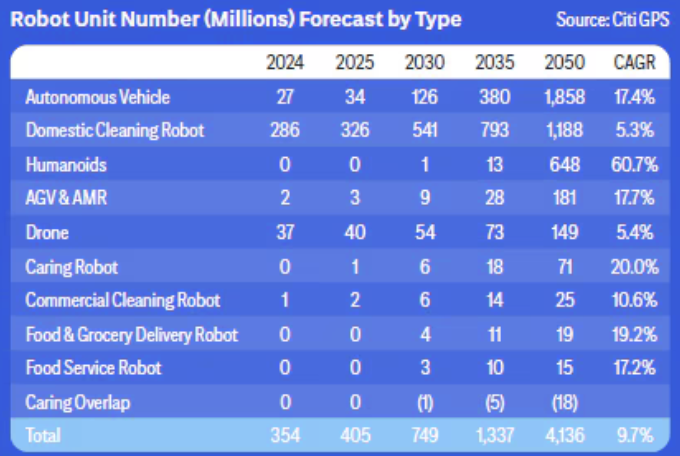
The leaps forward in AI, most notably visual processing, seem to have unlocked a major piece in this puzzle and make the above look more plausible to me. Here’s a couple more cases (like the Chinese New Year’s Show example above) that show the improvements in these models over recent years, and so gives an idea of the trajectory.

February 2025: Helix androids putting away shopping very slowly:

May 2026: Helix’s Figure 03 working a production line (and other things):

In a very direct test of a specific skill, there are contests in China in long-distance running for androids. In April 2025, one robot completed the half-marathon in 2 hours 40 minutes.

One year later, a robot completed the half-marathon in just over 50 minutes, beating the human record of 57 minutes (which immediately seems like a less relevant comparison).

I don’t expect this to be quick, so the slow initial commercial growth in the Citi forecast does look reasonable to me. I’m certain there will be massive bumps in the road as public perception and legal / insurance systems navigate around the inevitable accidents and abuses this technology will produce. But I now feel pretty confident that sci-fi visions of robot drivers, plant-pickers, and assistants are not at all fanciful.

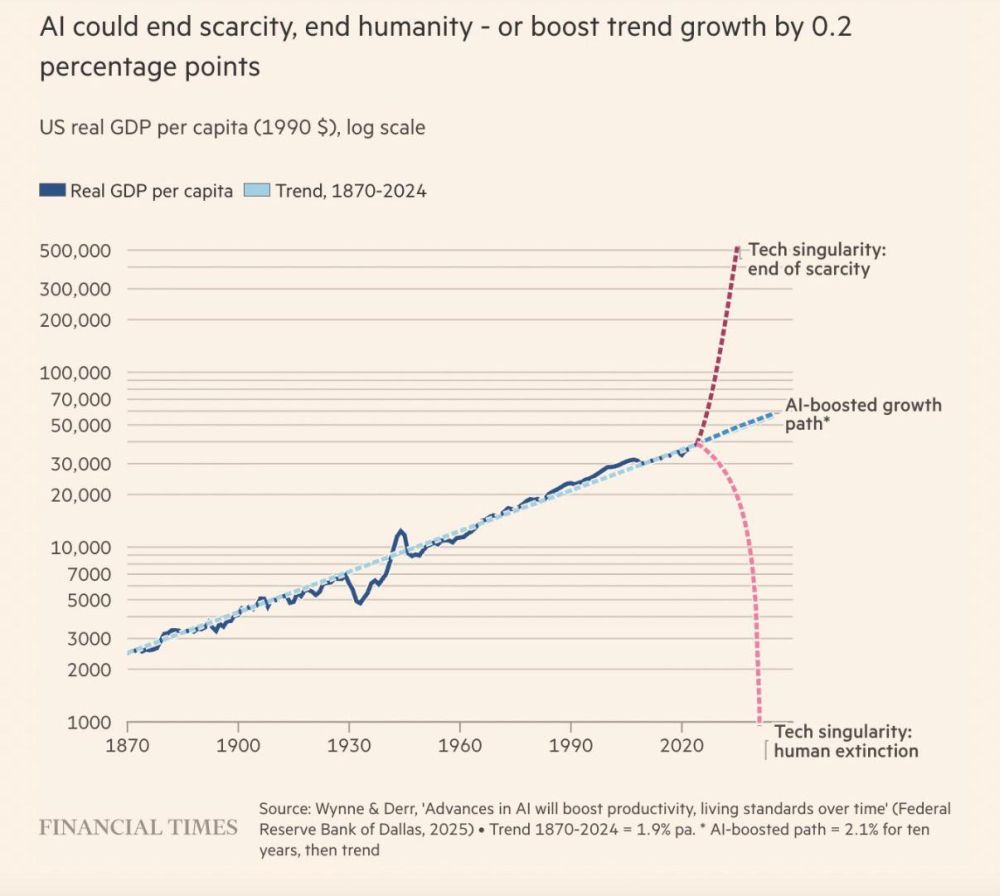
I’ve also been reading a lot about what people think will happen to the humans whose jobs have been replaced. To distil everything, the answer is that… the result will be a product of huge numbers of competing systems and feedback loops, and as such is impossible to predict. It’s a bit like this Financial Times prediction of GDP based on different AI scenarios, which is quite funny and frightening at the same time:
Music videos where effort is the trick

This Things is getting a bit heavy, so let’s look at some Music videos in which a beautiful visual effect is achieved, but the amount of effort that must have gone into it is tremendous.

Director: Michel Gondry
Artist: Kylie Minogue
Song: Come Into My World

Once again Gondry finds a way to visualise the repetition of the song in a video that just keeps getting more impressive:

How did he do it? Well, he explains it and the inspiration here

His explanation seems to take for granted an enormous amount of compositing work, all the more impressive given that this was in 2002 when computer-assisted tools were less well developed. That said, it’s Gondry – possibly he found an incredibly efficient way to do this that he’s not revealing here. Or he just takes that “enormous effort” part for granted because he does that regularly.

Director: Nick Goffey and Dominic Hawley
Artist: The Chemical Brothers (with vocals by Beck)
Song: Wide Open
Dancer: Sonoya Mizuno
Effects: The Mill

Starting with a close-up to assure you that you’re looking at a real human dancer, something impossible starts to happen. Make sure to stick around until 3:28 (or just skip there if you’re busy) in which the video casually does something even more impressive.

How did they do it? Surely to do that you would need some sort of motion-controlled camera or real-time movement tracking, re-render almost everything in CG and then carefully composite the live-action with the CG with pinpoint precision?! The answer is yes, that’s exactly what they did:

Director: Páraic Mc Gloughlin
Artist: Weval
Song: Someday

If you take carefully framed photos of everyday objects and architecture with repeating patterns and show them in sequence, you get a strange sort of stop-motion effect. I saw this trick first used in Michael Langan’s 3-minute video Dahlia (2008), then in Thomas Sauvin’s Recycled (2013) (seemingly no longer viewable but described here; a short snippet can be seen from 1’12” in this film festival trailer).  Páraic Mc Gloughlin pushes that idea even further with incredible smoothness, range and synaesthetic effect for Weval’s Someday (2019) music video (after about 21 seconds of build-up):

If you enjoyed that you could also try the video for IMANU – A Taste of Hope (Hallowvale) by Chris Takács and Kevin Rogerson; or enjoy spacelike slicing instead of timelike with the video for Max Cooper – Repetition by Kevin McGloughlin.

The AI Shovelware is here

Also in the category of marking developing technology, last time I wrote about the AI ‘trough of disillusionment’ referencing Mike Judge’s “Where’s the shovelware” article.

Well, true to how the Gartner hype cycle (sometimes) pans out, it turns out we were coming out of that trough.

The financial times looked back into those same trends (paywalled link) in February 2026 and found recent upticks in websites, iOS apps and GitHub repositories:
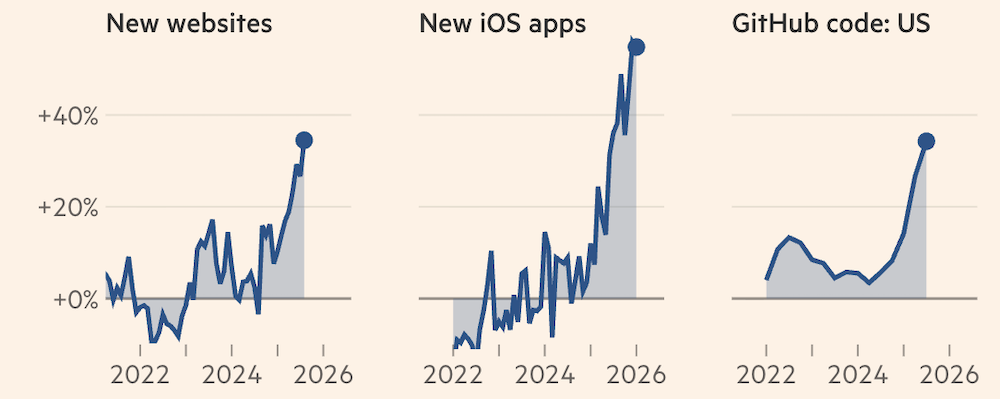
In April 2026, Naavik did a detailed overview of the topic just for games, showing not much effect on PC (although a rise in AI-discosed games), but a huge effect on mobile (especially on Android), showing the number of publishers is up, and the relative proportions of success have remained about the same.

That last point is particularly interesting because the feeling in games is that there are already way more games than the market can sustain (so the vast majority do essentially no business), so an AI-driven surge in new games could just dilute success and make it even harder for anyone to succeed at making games. The counter-argument would be that with a wider range of games, more niches are filled, so more people buy more games – for example, maybe I buy 6 games a year, but if there were twice as many that were twice as appealing to me maybe I would buy 9. If, as Naavik found, the relative proportions of success are about the same then these two effects perhaps cancel out. Or realistically, there’s lots of other effects and that data isn’t sensitive enough to detect them or their true net effect, and also not enough time has elapsed to feel the effects, so let’s just wait and see.

Still this does put more pressure on the question of ‘discovery’ – I can’t buy those amazing games if I don’t know they exist. Most people who work in video games seem to want discovery to get solved through some clever platform design, but I don’t think that’s very likely:

  • If I knew what I wanted and could find games that meet exactly that, just maybe we could solve it, but people do not know what they want! I would never have searched for something like Outer Wilds or Portal – in fact if I had searched for either of those accurately it would have effectively spoiled the game – but they were exactly what I wanted.
  • This type of problem is approximately solved in social media, where algorithms can serve content people are likely to enjoy (well enough that they keep scrolling, anyway) – but I don’t think people play enough games for you to run the kind of predictive models that work there
  • It might just about work if you took as input everything about you (social media consumption, books read, films watched etc on top of games played), but nobody holds all that data (yet)… and we feel uncomfortable with anyone holding all that data.

So in the absence of all that, we just get marketing.

Or some sort of procedural AI-generated game starts out as what you thought you wanted and evolves into what you actually needed based on your real-time reactions. That sounds a lot like a dream, or perhaps a nightmare, both figuratively and literally.

Perhaps more likely, in the future maybe your household android tracks all of that contextual data about you locally, and can then make perfect recommendations?

  • Transmission ends, stretching for a note of optimism

Categories
New

Things 2025 Q4: Podcasts, long titles, recursive knowledge

Podcasts

I’ve circled around podcasts without diving in for a long time, unsure of how to navigate the medium. With movies or video games, I’m already looking at places that tell me about new and interesting releases, and I know how to find out if something I’m considering might be good; with movies especially I’m aware of directors, writers or actors I like that will form part of the draw. With podcasts, I have none of that!

Despite that, I’ve found a few podcasts over the years that I liked, so it seemed a good time to round them up.

Blank Cheque

Blank Cheque is a podcast about films (apparently a very popular one but I’d never heard of it, I guess because of my distance from podcasts) specifically about the careers of directors who got ‘blank cheques’, i.e. enough power that they were able to make exactly the films they wanted. It takes the (apparently classic) form of two friends chatting about the subject matter, usually with a guest, but if there was ever a conversation I wanted to overhear about film, this is it. The friends are David Sims, a film critic who is often very funny, and Griffin Newman, an actor/comedian who is also incredibly insightful about films.

They came to my attention through their ‘stunt’ podcast that kicked the whole thing off: “The Phantom Podcast”, a long podcast series diving into Star Wars: Episode I – The Phantom Menace in forensic detail, under the conceit that this was the only Star Wars movie ever made and they are trying to make sense of it. They then ‘discover’ later Star Wars episodes one at a time and continue to analyse them as if nothing else existed. It’s quite incredibly niche and nerdy and there’s only one Things reader I would recommend it to, and I already have, so maybe don’t start with that. (I will say the full ~36 hours (!!) of material covering the prequel trilogy does go out on a pretty audacious high with a George Lucas impersonator defending the films against all criticism in front of a live audience).

I recommend picking a well-known director or film you like and searching the wiki to see if they have covered it (they have covered quite a lot of the big ones by now), then give that episode a listen. My favourite part is that they are often fantastic at drawing out ways in which the film’s meta-text resonates with the text. My least favourite part is that they will often talk over and interrupt their guests, especially women. That’s a pretty sharp down-side, so hopefully the fact I recommend them despite that shows how much I appreciate the good parts.

Link to Blank Cheque podcast

Designer Notes

Ok, I got into this one a while ago but didn’t mention it until now. A little like ‘Blank Cheque’, Designer Notes sees Soren Johnson interview game leads that have produced especially interesting games over their career. As an interviewer, he’s fantastic at drawing out the most interesting stories, with a knack for spotting when a fascinating nugget got skipped and asking the guest to dig into it.

Like Blank Cheque, if there’s a game series or game-maker you like, search (maybe like this) to see if they have been covered and start there.

Link to Designer Notes podcast

Gamecraft

Much shorter than any others mentioned here; if you have any interest in video games as a medium, a business, and in how it has adapted and grown over the past four decades, this is a fantastic listen. Mitch Lasky covers most of the material and is incredibly insightful since, through a lot of luck and some good judgement, he was somehow very close to the action at almost every major evolution the business has been through since the early 90’s. Blake Robins plays the ‘straight man’ role, standing in for the audience by asking the questions you’d naturally want to ask or pointing out context Mitch is sometimes too modest to state.

Link to Gamecraft podcast

Mindscape with Sean Carroll

Sean Carroll is a theoretical physicist with an interest in many different scientific fields, and in this podcast he interviews scientists of all kinds to get a better understanding of their area. He’s a great communicator, and by studying the published materials of his guests in advance he’s able to coax them into explaining it clearly even when they themselves are not quite as eloquent. (Okay, sometimes it doesn’t quite work and he ends up doing most of the explanatory lifting).

Here I recommend scrolling through his list of guests and topics and diving into whichever one you find interesting.

(Random bonus note: I like the way the little intro song has a melody that kind of matches Carroll’s intonation.)

Finally, as an aside, Sean Carroll appeared in Piers Morgan Uncensored to debate Eric Weinstein on the topic of theoretical physics. I’ve seen this characterised as “Jerry Springer for nerds”, notably including the following exchange (only missing a little context):

            Eric: If Sean had actually read my paper…

            Sean: I actually have read your paper! I have it right here!

            Eric: Well first of all, Sean, how dare you…

Someone like Eric is able to get the attention of ‘alternative media’ by sounding very smart and espousing a theory that ‘the establishment’ doesn’t agree with. You need to be incredibly knowledgeable and calm to reasonably debate with someone like this, and Sean pulls it off. I found it fascinating for that reason alone. I even give Piers a little bit of credit for attempting to end the discussion with some grace, given how little he understands the topic (by his own admission).

Link to Mindscape podcast

Useful memorisations

I’m sure a few of you have already done this, but here’s two simple things worth memorising.

First, the numeric position of each letter of the alphabet (a = 1, b = 2, c = 3 etc). In the summer of 2001 I once needed to walk a couple of miles alone and spontaneously decided to memorise this while I walked; I’m amazed how much this has paid off over the years. Admittedly I do move in circles where this sort of thing comes up more often than perhaps is normal.

Second, the ‘major system’ is a simple correspondence between the digits 0-9 and consonants (0 = s, 1 = t/d, 2 = n etc). Once you have memorised this, you can turn any number into a set of letters (e.g. 20251231 = N S N L T/D N M T/D), you then insert whichever vowels you need to make a word or words, which in turn are usually easier to memorise than the numbers because they are a bit weird. This does take a bit of skill, and I’m not very good at it but get by (e.g. NSNL.TN.MT = No SNaiL-eaTeN MuT). Great for PINs or a surprising number of other things. Admittedly sometimes the effort of translating the thing into words and then back again often means I end up memorising the numbers directly, but that’s still a win.

If you have similarly useful memorisations to recommend, let me know!

AI coding trough of disillusionment

In a fast-moving world, this article by Mike Judge, “Where’s the Shovelware? Why AI Coding Claims Don’t Add Up” is now a bit old (article date 3rd Sep 2025), but it was a pretty thorough look for signs of AI coding being transformative in terms of software / websites / apps / games and not finding any evidence:

  • The METR study found developers thought AI made them 20% faster but it actually made them 19% slower
  • Mike’s own mini-trial found nowhere near the powerful effect he had subjectively thought was happening
  • There is no evidence of increased releases of apps on iOS, Android or Steam
  • No increase in domain name registrations
  • No increase in new public Github repositories

Mike also then directly addresses the most obvious counterpoints that could be raised.

https://substack.com/inbox/post/172538377?=&aid=recKGiRdTrn0tC0OH

Now, to avoid oversimplifying, we should also consider the following:

  • Generating code is just one part of shipping a product, all the other parts can be quite difficult and annoying, so maybe that functions as a barrier
  • This doesn’t mean nobody sees any benefit from AI in any coding situation. People can be coding for personal use, or improving existing workflows
  • Even if there’s no effect on publishing rates, there could be other effects, such as different levels of quality or hiring patterns

There are also, of course, other ways in which generative AI has an impact – there’s dramatically more to this topic than I’m covering here. For example, it’s a great way to make social media spam, presentations everywhere are getting bespoke illustrations that would have otherwise been just text, and some have seen a decline in job roles for junior positions (for example), so there’s still lots to watch out for.

Films where they actually had to Do The Thing

With editing and special effects, movies can weave a lot of magic. However, sometimes the plot will require the film-makers to actually depict something incredibly impressive without any tricks.

I first encountered this as a theoretical example in the book (recommended to me by Will W), “Adventures in the screen trade” by William Goldman, screenwriter of All the President’s Men and The Princess Bride. In one chapter he writes a short story and then has experts in different aspects of film-making give him feedback on how the story might need to change to be realised on film. Of particular note was that the story hinged on a boy getting a transcendently incredible haircut of unknowable beauty; it is firmly pointed out to him that this is essentially impossible to portray on screen.

What I’m getting at here is skills specifically outside of those you expect for film-makers. An example of what I’m not counting: sometimes a character gives an inspiring speech to rouse people to action and it’s literally inspiring – difficult to write, but movies have professional writers. Or sometimes a film requires stunt work, especially a Jackie Chan film in which part of the appeal is he is performing difficult and dangerous stunts himself – but this is still a fairly normal part of film-making, with Jackie Chan being an apex example.

Where it can get harder is music.

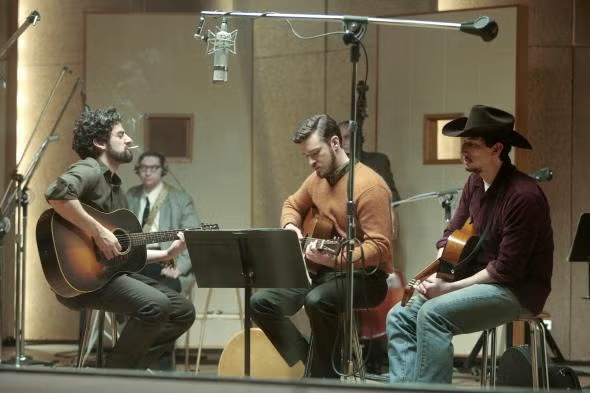
Inside Llewyn Davis (2013) is a film about a folk singer on the edge of musical success and (more often) disaster. They found Oscar Isaac for the lead, who is not only perfect for it but also a legitimately talented musician. At one point he is brought in to record a novelty song, “Please Mr Kennedy” (with Justin Timberlake as the song’s on-screen and off-screen writer; also with Adam Driver doing a silly voice), and Isaac’s character opts to take the session fee rather than any cut of the song’s profits. As an audience you should read this as a mistake, as the song will probably perform well. As a novelty song, and to the point of this section, it is legitimately good enough that you believe that’s a possibility. (It’s partly based on the original Please Mr Kennedy by Mickey Woods, and as @mooviedude141 notes in the comments on the film’s version, a different Kennedy did pretty much go on to send two of the performers into outer space).

There are plenty of other films in which a song needs to do a lot of lifting and they pull it off (“Remember Me” in Coco (2017); the Cloud Atlas Sextet in Cloud Atlas (2012); a central performance in Sinners (2025)), all of which are impressive, but I know of two examples that go the full distance.

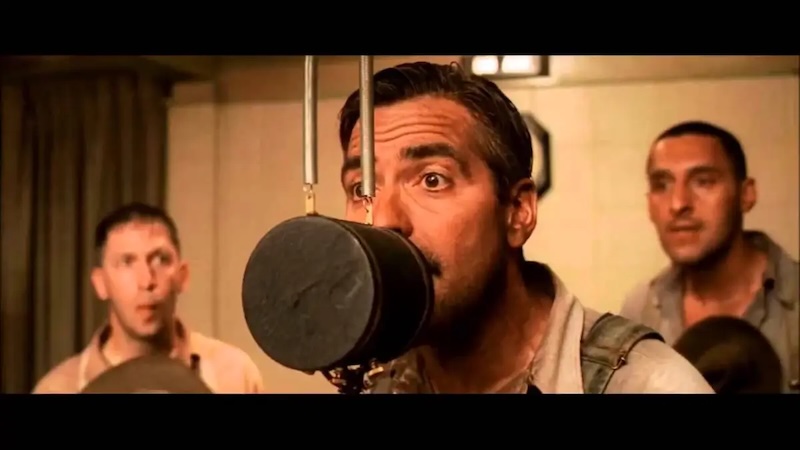
In O Brother, Where Art Thou? (2000), a surprising through-line is that the escaped convict protagonists end up recording “Man of Constant Sorrow”, and while their hijinks continue the song is becoming popular in the background, to pay off beautifully near the end. Meanwhile in real life, that song (and the film’s soundtrack) legitimately became extremely and surprisingly popular.

More recently Kpop Demon Hunters (2025) features several songs by the in-movie group HUNTR/X (performed mostly by genuine K-pop group Twice among other expert contributors), who are supposed to be extremely popular – and in real life, to quote from the Wikipedia summary, “it became the first film soundtrack on the Billboard Hot 100 to have four of its songs in the top ten, was certified double Platinum by the Recording Industry Association of America (RIAA) in October 2025, and received five Grammy Award nominations”.

What about non-music?

In The Ring (1998), a particular video will ‘curse’ anyone who watches it. Perhaps making such a video is arguably within the wheelhouse of a horror film director, but the execution of it really stands out. The video is semi-abstract but nonetheless legitimately creates a deeply cursed feeling, which is why I won’t embed it here and also is part of why that film haunted my nightmares for years, only resolving when I dressed as the main spook Sadako one Hallowe’en.

Very long titles of manga and anime that explain the whole premise

This trend has been running for some years in Japanese anime and manga. Some Examples:

  • The World’s Finest Assassin Gets Reincarnated In Another World as an Aristocrat
  • Banished from the Hero’s Party, I Decided to Live a Quiet Life in the Countryside
  • I Got a Cheat Skill in Another World and Became Unrivaled in the Real World, Too
  • The Magical Revolution of the Reincarnated Princess and the Genius Young Lady
  • The Guy She Was Interested in Wasn’t Really a Guy at All

I wonder if this becoming acceptable (or even appealing) makes some stories more marketable than they would have been in a short-title paradigm. Perhaps this is partly why the Isekai genre (protagonist goes to ‘another world’, a genre lately overrepresented in general and also in my above examples) has had such a boom in popularity.

We could consider how this might play for major Hollywood films. There have been a few examples with titles changing mid-marketing-push to get longer/shorter and more/less explicit about the premise:

  • “Birds of Prey (and the Fantabulous Emancipation of One Harley Quinn)” did not seem to work as a title and had a late pivot to “Birds of Prey”. I can’t help but feel just “Harley Quinn” would have worked better, but that’s a topic for another Things.
  • John Carter was previously to be titled John Carter of Mars, but seemingly Disney thought the ‘Mars’ bit would put people off, so hoped to just… sneak it in there?
  • Edge of Tomorrow sounds cool but tells you very little, so had a late pivot to the much clearer (but equally terse) Live. Die. Repeat.

Perhaps there’s something fundamentally different going on in the marketing strategy though – Hollywood films that aspire to be blockbusters will often signify their intended mass appeal with a very short title such as ‘Titanic’, ‘Frozen’, or ‘Sinners’. Meanwhile, a lot of anime and manga are trying to carve out a niche, and they can best do that by setting out the full premise up front so the people looking for that exact sort of thing will find it.

So, if there’s anywhere we might expect this trend to show up in Western media, perhaps it’s books?

Recursive Knowledge

Laurence once pointed out to me that “you have a vested interest in anyone that has a vested interest in someone you have a vested interest in”, and he remains correct.

In the second book of Cixin Liu’s Three Body Problem trilogy, the author dramatises the problem of insufficiently recursive trust. Two groups, who we can label Alice and Bob, have a problem: each of them has the capacity to annihilate the other before there is a chance to retaliate.

  • Alice trusts that Bob will not attack, and Bob trusts that Alice will not attack
  • But, Alice does not know that Bob trusts that will Alice not attack, and vice versa
  • If there’s a chance Bob does not trust Alice will not attack, probably he will attack
  • So to be safe they each should launch a pre-emptive strike

Unfortunately this keeps going even if you can add another level of trust. Consider just Alice’s side in the next level up (using close synonyms for trust/know to try to keep it manageable):

  • Alice trusts that Bob will not attack
  • Alice is also confident that Bob, in turn, trusts that Alice will not attack. Hooray!
  • But… Alice does not know if that meta-confidence is reciprocal. As far as she knows, even though Bob trusts that Alice will not attack, he might not know that she knows that
  • So Alice must consider the possibility that Bob does not know that Alice knows Bob trusts that Alice will not attack.
  • If that’s the case, Bob might be concerned that Alice is unaware that Bob trusts that Alice will not attack. Bob will consider the possibility that Alice does not believe Bob trusts Alice will not attack.
  • If Bob is considering that, it means he worries Alice thinks Bob does not trust that Alice will not attack – and if that was the case Alice, assuming Bob does not trust her, would launch a pre-emptive attack.
  • In this scenario that Alice is imagining, Bob would therefore launch a pre-emptive attack… so Alice had better launch her attack first.

You can see how this keeps going even if you layer on more meta levels of trust. The problem presumably caps out at our ability to compute much further. Unfortunately, if both sides entrust such decisions to AI then this will either become undecideable in the halting problem sense, or they will pre-emptively attack each other while trying to get to the bottom of the recursion just to be on the safe side.

How far can humans really think this sort of thing through? In the previous section I noted there is a manga titled “The Guy She Was Interested in Wasn’t Really a Guy at All”. As you would expect from the title, the drama hinges on the fact that Aya has a crush on Koga who she assumes is a boy, but Koga is in fact a girl in her class who dresses in a very male-presenting way outside of high school.

I don’t think it’s really a spoiler to say that eventually the secret comes out, because it’s very much about the journey rather than the destination (and at the time of writing the series is unfinished). That knowledge recursion is dramatized over a series of stages – Aya finds out about Koga, then Koga learns that Aya has found out but Aya doesn’t know that, and at a certain point Aya overhears that Koga has realised that Aya knows about Koga’s identity – but Koga does not know she knows that! That sounds pretty abstract, but in the moment of reading, the meaning and emotional significance of this highly meta revelation feels incredibly clear. I suppose as social animals, it makes sense that humans can grasp this stuff pretty well when it’s in the context of a story.

While I was thinking about all this I found out that Steven Pinker now has a book out called “When everyone knows that everyone knows”, which deals with ‘common knowledge’; when recursive knowledge operates at a population level.

I should note a slightly distant and dark irony there: we’re going through a kind of ‘common knowledge’ moment right now with the release of the Epstein files. In 2006 Pinker wrote a letter to his friend Alan Dershowitz, who was Epstein’s defence attorney at the time, on the the wording of the “internet luring statute”, and this apparently contributed to federal sex trafficking charges against Epstein being dropped. Pinker says he was unaware this was how it would be used and regrets sending it.

  • Transmission ends somewhat uncomfortably
Categories
New

Things 2025 Q1: Muji music, Russian disinformation, Reincarnation

Exercise for the reader, part 1

I found this very simple two-part thought exercise incredibly powerful. It’s more effective to separate the parts out, so I’ll post the first here and the second at the end, along with the source.

In your next life you can choose to be reborn as anyone, with any job, anywhere and any time – what do you choose?

I recommend giving this some thought! Feel free to think of a silly answer and a serious one, or just as many as come to mind.

Unused Muji soundtrack

In 1983 for the opening of their first store in Tokyo, Muji commissioned Japanese music legend Haruomi Hosono to create a soundtrack. As Jen Monro sums up in this excellent overview, the tracks he produced are “not as neutral, or even chipper, as one might expect for storefront use: they willfully stray into eerie, dissociative territory, suggesting hypnosis and foggy, dreamlike states.”

That’s great, but the cherry on the top is that a Youtube upload of these tracks has inspired a pattern of upvoted comments in which people provide whimsical descriptions of what the music (specifically the first track, I suspect) sounds like to them. Samples below, best read while listening to it:

“can only assume this is what it feels like to be a fungus”

fadesblue

“This is the music that plays when you get to the end of youtube.”

Carcosahead

“this is the music that plays as the credits roll on the movie of your entire life, the theater is dark and empty except for you and you know you’re going to have to get up and leave soon and you’re okay with that but you want to sit and watch all those familiar names scroll past for just a little longer.”

midnightcthulhu5551

Use-cases for text-based AI

I remember back when Wolfram Alpha was released in 2009, I tried to figure out how to fit it into my mental model of online tools. For example, as well as conveniently solving some maths problems, you can also just ask it “How old was Mark Hamill when Star Wars came out” rather than go to IMDb/Wikipedia and do some maths yourself. Well, I didn’t manage to adapt to it very well and hardly ever remember to use it in practice.

Now we have a dramatic increase in capability with AI tools of many different kinds, and once again we need to work out how best to use these new tools. (There’s also a huge rabbit-hole of data-source ethics and workforce implications which I am putting to one side for now; if you want a blog that gets more into AI stuff John B recommended Interconnected, so try that!). I feel like I’m being quite slow at picking this up, so I thought I’d share my pretty basic use-cases and ask you, the Things readers – what do you use AI for? Let’s just focus on text for now.

Examples:

  • Answering vague queries, like “what was that film from the 80’s where there was a portal and weird monsters came out of it”
  • Summarising long text (although I’ve found the compromises in accurate insight too great to rely on this)
  • Generating a terse summary of leads on a research topic that you can then follow up via more reliable means (e.g. what are some considerations for building an interstellar spaceship)
  • Code (taught to me by Beinn): Use Windsurf to get some quick game prototypes up and running – in practice I am still so far out of my depth on this that even incredibly helpful AI can’t really help me make what I want!
  • Weirdly, technical help (e.g. I was struggling to find a certain system option on my Macbook, and even Google’s AI had the solution better covered than regular Google search which surfaced irrelevant answers for different make/model/OSes)

Examples I know of others using that I can’t quite get my head around:

  • Using AI to coach you on challenging conversations
  • Giving AI several complicated documents (e.g. small print of different insurance options) and asking it to make a decision for you that relies on understanding the full contents of the documents

So, how do you use text AI?

Animated film sequels: getting worse, doing better

I remember the old rule-of-thumb for sequels was that they would make about 2/3 the box office of the original. This might have been a bit of a self-fulfilling prophecy as studios might invest less in the sequel given how reliable that revenue could be regardless.

In recent times, with franchises making so much money, some of that calculus has changed, and my sense is the success of a sequel is much less predictable.

Most notably though I realised animated sequels seemed to almost always make more money than the original. To test out that hunch, I charted the difference in global box office for each of the top grossing animations with sequels, and put it against the difference in IMDb rating. The results are pretty dramatic:

Sure enough, every animated sequel made more money than the original – and with exception of wild outlier Ne Zha and also Spiderverse, was also worse based on IMDb ratings!

It feels like animated films in particular are being chosen by parents who have a strong desire to find something reliably entertaining for their children. The fact a film got a sequel is an endorsement (Ian’s suggestion), and I think children can also show a very strong interest in the orginal in home media, and that gives parents more confidence to take them to the cinema for the sequel. These effects may even artificially reduce box office of animated originals!

The largely consistent decline in IMDb rating of sequels could be covered by the effects I wrote about in Paradoxic Fandom.

Russian Disinformation

I read a long time ago that Russia had state-funded ‘troll farms’ generating content on social media with the intent to manipulate the Western audience towards their own ends. Having worked in marketing, I was doubtful about how effective this could be as I knew how hard it is to shift anyone’s opinion.

But first, a weird tangent before we go on:

  • Web analytics tools will frequently use extra text in a link in order to report information about it, for example adding something like “source=potatoes” to indicate a link came from this blog
  • By default this data is not sanitised, so you can manually edit the text of a URL (for example change ‘potatoes’ to ‘hello-world’), and when you then follow that URL, you can pass through a fake campaign name which an analyst may then see. For example, when I worked at Skype and looked at the web site visitors by source, I saw 1(one) visit from a campaign called “i-hate-bill-gates”!
  • On my own websites, I would routinely see clicks from these manually-faked campaigns where the text they have added is for some kind of website they want me to purchase things from – it’s a spam vector!
  • This problem got so bad I even started to see spam links selling the ability to stop this from happening (meta-spam!)
  • … but to return to the original point, in 2016 I got a wave of these fake campaigns all saying words to the effect of ‘elect Trump’
  • The fact someone somewhere was doing that to such an extent that even my tiny websites were caught up in it tends to make me believe a larger operation was at work, but of course I can’t infer who.

End tangent

The idea that Russia’s online efforts might actually be effective gains credibility for me when I recall two things:

  • Social media has a strong pareto effect: a very small number of people account for a very large number of posts.
  • We often form our ideas about what is happening not by careful consideration of credible sources, but by what we tend to see evidence of repeatedly (e.g. a newspaper repeatedly reporting on a particular type of crime makes people think it’s a big deal, rather than a careful consideration of crime statistics)

If you then combine that with social media’s built-in tendency of pushing inflammatory content (because algorithms prioritise engagement and this is one of the easiest ways to get it), it suddenly becomes much more credible to me that this sort of campaign could help drive the kind of increasing polarisation we’ve seen in the West.

Despite all of that, it still felt a little bit like a conspiracy-theory to me, which is why this Reddit post is very helpful to substantiate the idea – it gives a long sequence of examples and credible citations for each, making the primary contention, “You’re being targeted by disinformation networks”, very credible:

Even having read that, I think it’s still easy to forget. For example, I saw a Reddit post by someone saying they worked for the US Government and will soon be fired; their Republican-voting parents’ response was that “there are plenty of jobs at McDonalds”. How heartless! Their own child!! These Republicans!!!

Now, it remains possible that this is a true story (actually because of this very problem), but it does also seem like exactly the kind of thing you might fabricate if you wanted to further polarise things.

At minimum we should remember that this sort of content is anecdotal evidence of behaviour at best, so should be considered relatively low in terms of how much it shapes your opinion on what is really going on.

(Of course, this is just one aspect of Russia’s grey-zone aggression, this Observer summary of interference in democracy in Moldova is quite salutary and has this excellent quote:”Moscow wants to show that it can use all measures short of outright invasion to keep nations it sees in its “zone of influence” chronically destabilised.”)

An ethical interaction with Sugar Gliders

I found this promotional flyer for ‘Cuddly Colony’ in Brighton. I just really love the way they promote this thing – looking at cute animals in a very serious and carefully considered way:

Do note that it’s about £45 for this ethical interaction and I can’t vouch for it personally.

Exercise for the reader, part 2

As a reminder, part 1 was as follows:

In your next life you can choose to be reborn as anyone, with any job, anywhere and any time – what do you choose?

Do you have something in mind? If not, just think of something now! The first thing that pops in to your mind may well be springing from your subconscious!

With that fresh in your mind, here is the second part:

Given you desire that alternative life on some level, and that reincarnation is not real*, what could you do in your own life to get some way towards that desire?

For example, if you imagined being a cowboy, could you at least go horse-riding? If you wanted to be an astronaut, perhaps you could get a telescope? If you want to be an author, could you just write a short story?

The world is so full of incredible possibility (as a random example, you could go to Asda and buy an item for each letter of the alphabet), that it can be very hard to work out what to do, especially over the long run. I found this exercise extremely helpful.

I encountered it in Julia Cameron’s The Artist’s Way, a book that Clare got me and I found very inspirational. It is based on Cameron’s long-running workshops to help people be more creative, and to overcome creative block (or really anything that acts as a block to creativity). Like Alcoholics Anonymous, it is a 12-step program, and also like AA weirdly involves God – but Cameron helpfully outlines how the process can be made useful even for an atheist. For example, she might say it’s helpful to have as a mantra “Great Creator, I will take care of the quantity. You take care of the quality”, but instead of God/Creator you can just make it a general trust in the process, or a faith in your subconscious, and the effect is much the same.

I highly recommend the whole book, to everyone, but if you were to just take 3 things from it, one is the above exercise, and the other are these two simple habits that facilitate the creative process:

  1. Morning Pages
    Each morning, write three sides of hand-written text. There is no goal of what to write about, and you should not re-read it or share it afterwards. You just write and see what comes out. My experience is this kind of cleans out your preoccupations that cloud your mind, often turning them into concrete actions for a to do list, and this then leaves space for more creative thoughts. (In practice I only make time for this 2 times a week, but it is still useful!)
  2. The ‘Artist’s Date’
    Cameron’s mental model is that you have an ‘inner artist’ which is very childlike and needs pampering before it can create. To do this, you should take your inner artist (i.e. yourself) on a ‘date’: 2 hours each week doing something nice – something that appeals to you intuitively, something that do on your own, that can be inspirational, or just expose you to new things, to distract you just enough that ideas can come to you naturally. This could be watching a film, going for a walk where you haven’t been before, going to an art gallery – or (I think) a lot of things you might do while listening to a podcast, just without the podcast so you are free to think. This better enables the inner artist / subconscious to create moments of inspiration.


So, when being reincarnated, what do I want to do? A lot of things, but notably I really want to write stories and make weird games. I do already do a little bit of both, but I should do more!

*Reincarnation without memory is indistinguishable from no reincarnation in the life we lead today. Reasons to doubt reincarnation in general are left as an exercise for the reader.

  • Transmission ends
Categories
New

Things February 2024: Naming, AI, Sarcastic songs

Aspirational Naming

Philosophy is a battle against bewitchment of our intelligence by language

Wittgenstein

Language is a strange thing. There are words with multiple meanings, in some cases even words with opposite meanings to themselves: contronyms, such as sanction, oversight, dust. Despite this we are generally pretty good at figuring out the meaning of even these words by context.

It becomes trickier when words have close but distinct meanings. Names in particular have power, and sometimes a name can exploit ‘adjacent’ meanings of a word, or bake in an assumption. Here’s some examples I’ve collected over the years.

Social Media. John B highlighted this to me back in 2008. As Web 2.0 was becoming a thing and the mainstream started to find ways to be social online, ‘social media’ became the term of choice. This baked in the assumption that social content could function as a new ‘media’ in the sense that it was a kind of content that you could put adverts in, like TV or newspapers. It took quite a few years to make that work financially, but that is exactly what happened. I do think it’s unlikely it would have gone a different way if we had called it something else – but sometimes I wonder.

Influencers. In a similar way, as the power-law curve kicked in for social media, some people became a lot more visible than others. That meant they could be used to sell stuff in a different way! By terming them ‘influencers’, the message is that the main thing they do is influence their viewers/readers – most probably to buy products that they just happen to mention. But is this really the best way to think about them?

Web 3. Somehow in all the hype and froth of the crypto frenzy, the idea was fomented that this represented a paradigm shift similar to Web 2.0, and the end result would be a collection of services and algorithms we should call Web 3. But the parallels are strange – in particular blockchain technology, while clever in many ways, does not naturally have the kind of scaling properties we would want for anything that looks like the web as we know it. What’s fun here is that the number ‘3’ has now been effectively reserved, so assuming blockchain doesn’t live up to the name ‘web 3’, the next big internet thing will have to find another way to go – my money is on ‘Internet 3.1’.

Crypto Winter. Speaking of blockchain, this is perhaps the most obvious example of a name with an assumption baked in. The metaphor of seasons is completely assumed: a winter will naturally be followed by a spring, and eventually a summer just as glorious as the last. But that’s not how it always goes – sometimes things just die! A more apt framing here is probably the ‘trough of disillusionment’ from the Gartner hype cycle – but that’s certainly less catchy. (Side-note, the value of bitcoin itself is having a bit of a ‘spring’ right now, but I’m less sure about the wider blockchain paradigm).

Fan Service. Moving out of tech, in manga/anime and now beyond, the term “fan service” arose to describe… let’s say moments in which the sexual gaze of the (usually presumed hetro male) reader/viewer is titillated by a particular choice of camera angle or staging of action. I suspect this term generally spread half-ironically, but the way it bakes in an assumption of who a fan is and what they want is not ideal, and can reinforce the implied gatekeeping of communities discussing this sort of content.

(There’s another meaning which is just ‘give the fans what they want’ in the sense of “see the cool super-powered person use their powers to the max!!”, which is a bit less problematic)

Statistical Significance. In statistics the term ‘significance’ has a very specific meaning; it tends to mean that the results of some sort of test ‘signify’ that two test populations are different in some way. But in everyday language, if we describe a difference or change as ‘significant’, we usually mean that it is large! Two things that have a ‘statistically significant difference’ may not be very different at all, or different in a way that is very unimportant, but the term’s connotations say otherwise. I think it may even be plausible that this ‘bug’ was viewed as a feature by the founders of these sorts of statistics, as it turns out they were a bunch of eugenics enthusiasts very keen to find ways to show that one group of people is different to another, as this long article quite fascinatingly lays out.

Smart Anything. Emergently, describing an object as ‘smart’ now means that it is connected to the internet. That isn’t always going to be a good idea, but the connotations of ‘smart’ suggest that it is.

Artificial Intelligence. The temptation with computers or even simple algorithms is to think of them like our own brains: taking some input, evaluating it, and taking an action as a result. We consider ourselves intelligent (arguably homo sapiens could also be on this list as a biased name), so it feels natural to describe a process that looks like this as some kind of intelligence. But like the two meanings of ‘significance’, intelligence can span a spectrum of behaviour (from low intelligence to high intelligence), but if we describe someone as ‘intelligent’ we mean they are at the higher end. So while it is arguably fair to describe even fairly simple algorithms as some form of ‘intelligence’, the term AI has the connotation of high intelligence. Great for anyone who wants to impress people – perhaps to gain funding – about some sort of tech endeavour. More on that later.

Natural Gas. Moving outside of digital technology, describing methane as ‘natural gas’ is a great piece of propaganda. It exploits the fact that ‘natural’ has positive connotations, while technically also being anything that occurs in nature – which includes a lot of things that aren’t nice at all. Looking it up, it does not seem as if the term was coined for this reason, but those connotations have more recently been leveraged to encourage use of gas instead of renewable energy.

This is all very well, but can I come up with better names for these things? Honestly, probably not. But here’s my suggestions anyway:

  • Social Media -> Digital socialisation
  • Influencers -> Social hubs
  • Web 3 -> On-chain paradigm
  • Crypto Winter -> Crypto disillusionment
  • Fan Service -> Titillation
  • Statistical Significance -> Statistically Signified
  • Smart anything -> Online anything
  • Natural gas -> Methane gas (technically there are impurities so it isn’t just methane, but you get the idea)

Turning Test reductio ad absurdam

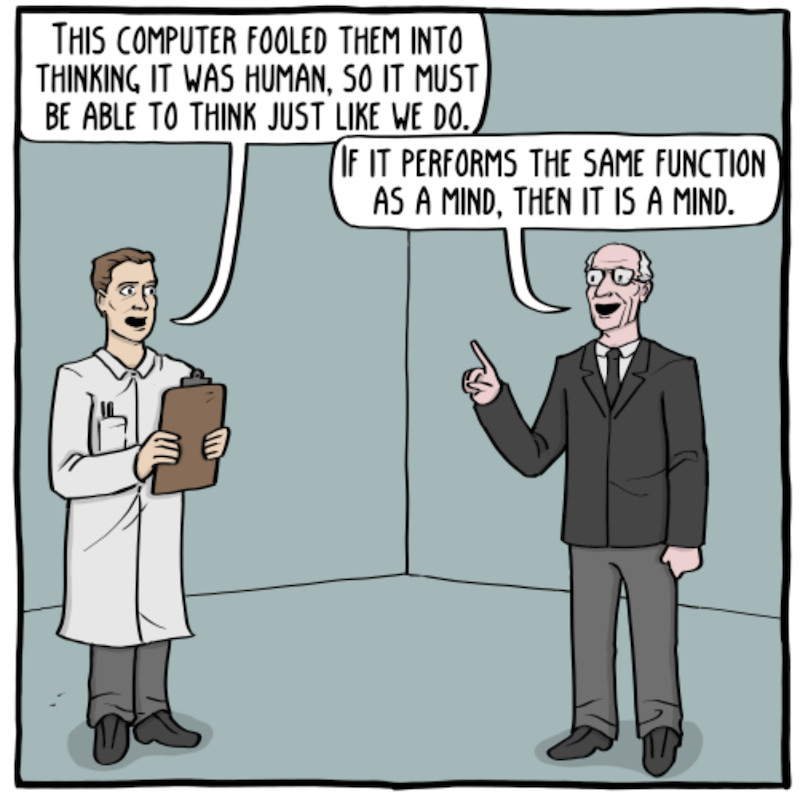
In pondering an approach to the question of whether machines could ‘think’, Turing proposed a test that eventually took his name: can a machine convince a human interacting with it through text that it is actually human?

Some extrapolate this rather too far and conclude that if a machine can do this, it proves that it can “think” or is “intelligent” (in the colloquial sense). Existential comics deploys a beautiful reductio ad absurdam to this argument that you should definitely read in full here.

(I tweeted this a long time ago but it’s well worth re-visiting, especially in the age of generative AI!)

Generative AI

As I’m certain Things readers will have noticed, AI became the new hot thing after crypto.

The ability to generate surprisingly plausible images from a text prompt surprised a lot of people, and the advances in that tech since have also been rapid and impressive. At first it was easy to laugh at how the ‘machine’ struggled to understand how hands worked or render scenes with multiple people in them convincingly, and then very quickly that became a solved problem (for the better models, anyway).

Just as that was happening, Large Language Models took hold, through ChatGPT in the most mainstream case. John B (him again, 15 years later!) pointed me at this purported ‘leaked Google memo’ on the topic which concludes with an excellent timeline of events describing how this came about.

This brought the ambiguity of ‘Intelligence’ and the Turing Test quite suddenly to the fore. LLMs solve some of the obvious weaknesses of previous language-generating-algorithms in that they can hold a pretty convincing thread of conversation. With a few guidance prompts and a less obviously superhuman typing speed, it could very likely pass the Turing Test in many cases. But it is a big mistake to consider it ‘intelligent’ or to actually be ‘thinking’.

First there are what is called ‘hallucinations’. (Note again the bias of the word – the most common use of the term is something that humans experience, tacitly encouraging us to think of an LLM as a mind). These are cases where the output says something completely fictional. I asked ChatGPT to list the solstices and equinoxes of all the planets in the solar system, and while it did a beautiful job of laying out the answers (much better than a Google search), it got quite a few of the answers completely wrong. I wouldn’t be too surprised if the most egregious examples of this can be fixed, but this problem will run deep because ultimately there is no algorithm for truth. It doesn’t necessarily show something isn’t ‘thinking’, but it can very quickly undermine an impression of high intelligence.

Second and more significantly there is no actual reasoning. It’s just a language model! It’s just producing words that look plausible in context! The fact it can give smart answers to some difficult questions does not mean any thinking is taking place. This can be tested by proposing simple riddles. My colleague Ben H challenged ChatGPT to figure out how someone could reach an object given some restrictions and a few objects to use (including a pencil and chair), and got a response of a sequence of steps that included “straighten the pencil by placing it between two sturdy objects such as the legs of the chair and gently pushing down on the middle of the pencil until it is straight”. There are layers of problems there: pencils are straight; you only need one sturdy object to straighten something; if you did need two they would presumably be close together in a way that chair legs are not.

It has taken me so long to finish this issue of Things that it feels like the generative AI hype has settled into a – perhaps shallow – trough of disillusionment, and generally the above concerns are I think widely recognised. The use-case of someone already being adequate at writing code and using ChatGPT to help you seems pretty strong.

Generative AI + Metcalfe’s law = massively expanded collaboration

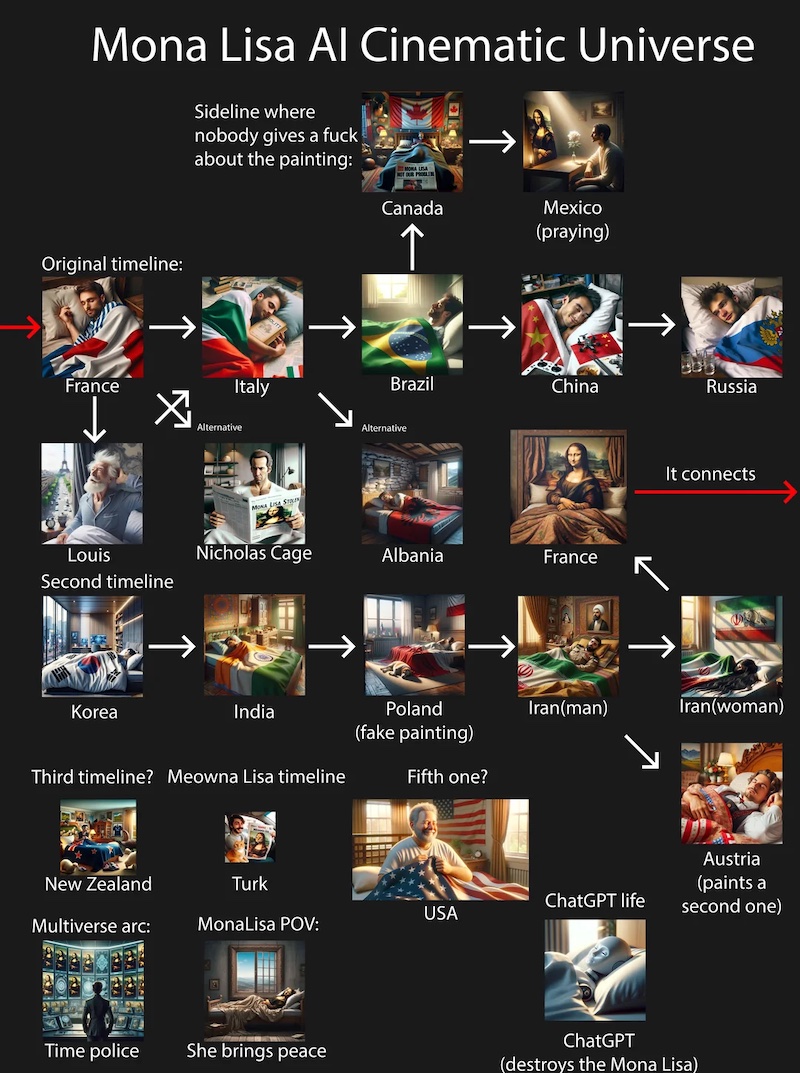
In terms of interesting new paradigms that are unlocked, this is quite frivolous but may be a sign: the Mona Lisa AI Cinematic Universe.

First, an emergent format in the ChatGPT Reddit is to generate an image with a prompt and generate more in sequence incrementing something each time (e.g. A cool dude who gets cooler each time, a marshmallow that gets angrier each time).

Then people subvert that format by deviating from the stated rubric to give a twist ending of some sort. Someone did “Average day in France“, so the increment is time – but the man ends up stealing the Mona Lisa. People then started expanding on that story with a day in the life of different nations, and the whole thing spiralled out – see the diagram above.

What I think is interesting here is you have a collaborative silly comic, but many more people than usual can contribute much faster, because anyone can write a prompt. It’s not a terribly amazing new emergent art form, at least not yet, but it’s something I think is categorically new!

Recommended Media

Video Games: Superliminal

Superliminal has a bit of a tough time because the closest reference game is Portal: a fairly short, linear, mind-boggling puzzle experience with a cute narrative framing. But Portal was a ludicrously good game, setting the bar very high. Superliminal unsurprisingly can’t reach that bar, and felt to me like it took a little while to find its feet, but it gets close enough that I think it’s well worth the time.

It takes perhaps just 3 hours to playthrough, which I found to be ideal. I recommend diving into it knowing nothing else, but if you need more convincing you can watch this trailer that lets you know what kind of approach it takes to puzzles.

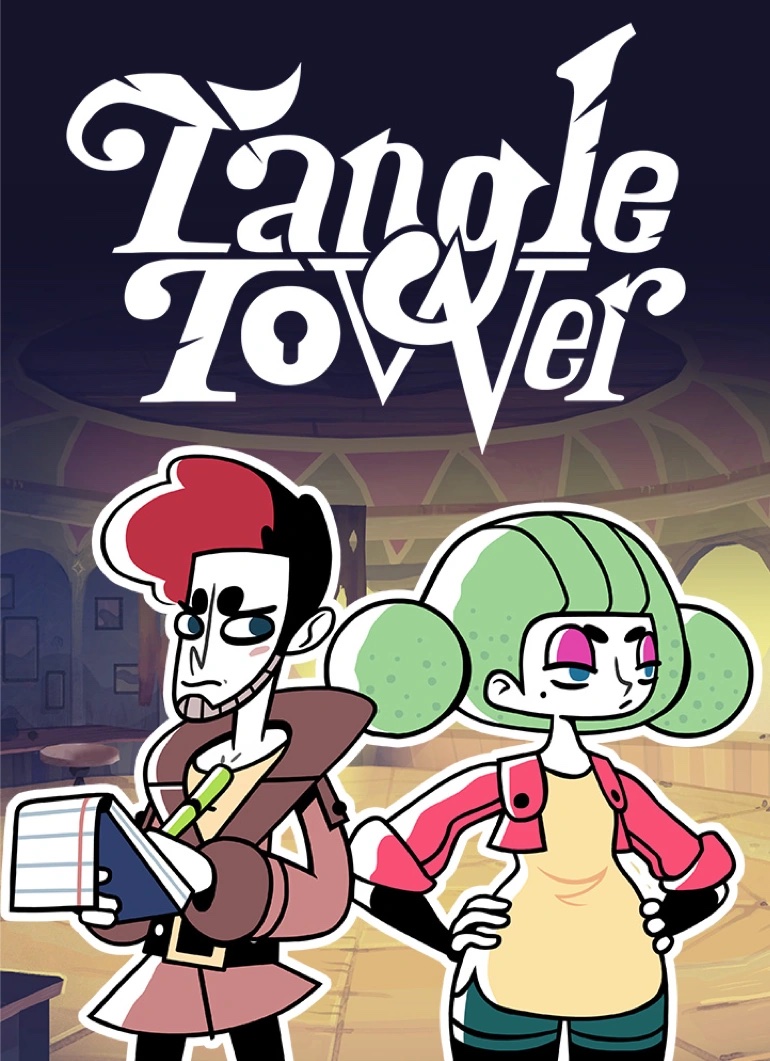
Video Games: Tangle Tower

I much prefer media that is outstanding in a few areas with a few flaws to anything that is uniformly good (but not great). I also love to see innovation in what a video game can be. This is exactly what I found in Tangle Tower.

Superficially the game most closely resembles a point-and-click adventure, but with a locked-room murder mystery framing. The ‘real’ game, though, is finding various clues, and talking to the nine suspects. You can talk to any suspect about any clue or any other suspect. That possibility space multiplies pretty quickly, and this is what enables you to try to be a ‘proper’ detective: by asking the most meaningful questions out of the very wide possible range. That can still get a bit overwhelming, but there’s a nice in-game hint system if you find yourself baffled or overwhelmed at any point.

What really sets the game apart is that even though the above design makes it dialogue heavy, every line is voiced, and the writing is great and the voice acting is brilliant, and the art and animation of the characters is stylised and fantastic! This completely elevates what could easily have been a slog (I have seen a lot of bad writing in games) to something I found consistently entertaining.

The ending was a bit disappointing, but I did not mind this at all as the journey was far more important than the destination. At around 6 hours to get through, I found this another highly enjoyable and reasonably short indie game.

TV series: Star Wars – Andor (Disney+)

Although I don’t have it in writing, I’ll always let people know that I anticipated the Star Wars universe as ripe for TV series from around the release of Episode I in 1999. It’s such a rich playground for stories of all kinds. What I didn’t properly understand then was that the budgets required to pull that off were not reasonable until the last few years, when the streaming wars pushed budgets up and advances in technology pushed the cost of special effects down to actually meet in the middle.

That said, despite being a weirdly huge fan of all of the Star Wars films (aaalllll of them!!!), I didn’t understand the hype around The Mandalorian, I found The Book of Boba Fett infantile (even for the kid-focussed Star Wars universe), and Obi-Wan astonishingly non-compelling. I was about ready to give up on the whole concept until people started saying how great Andor was.

It took a few episodes to get there but those people were absolutely right. Andor does what some of the best TV series manage to do (going right back to The Wire), introducing interesting characters on all sides of a conflict and playing things out in a compelling way.

I really hope the upcoming seemingly endless stream of Star Wars TV series continue to explore new tones and themes, as my original optimism for the whole endeavour is now fully reignited.

[Update: this Things has been so long in the writing that another series came and went: Ahsoka. It was… okay.]

Film: Spider-Man: Across the Spider-verse (2023)

Back in 2018, Spider-Man: Into the Spider-verse finally broke the mould in feature-length animation, introducing some brilliant stylistic innovation that has since been widely copied. I wasn’t sure how they could up the ante in a sequel, but they found a way – actually multiple ways. Anyone at all interested in animation, or superhero stories with a bit of a meta theme should seek it out:

Film: The Adventures of Buckaroo Banzai Across the 8th Dimension (1984)

This is something I can only recommend if you like weird/cult 80’s films and want an amazing example of how not to tell a story and introduce a world. Stand-out features:

  • Peter Weller (Robocop) as Buckaroo, a does-it-all hero (musician, brain surgeon, scientist…), like a nicer but more violent Dr Who
  • Also stars Christopher Lloyd and Jeff Goldblum!
  • Had a budget similar to Star Wars (1977)… not all of which shows up on screen, but allows it to be a lot weirder than other bad films
  • Features a sci-fi car accelerating to break a law of physics, and came out around 5 months before Back to the Future started filming. Interesting!

If that sounds at all interesting to you then do check it out. And if you do, I highly recommend following it up with the 7th episode of Guillermo del Toro’s Cabinet of Curiosities, ‘The Viewing’. Directed by Panos Cosmatos, this is similarly quite weird (although a lot more stylish and competently put together), but more importantly stars Peter Weller again, nearly 40 years on, in a role I enjoyed imagining as a much older Buckaroo Banzai after decades of weird adventures and a bit of time travel.

Podcast: The Sound: Mystery of Havana Syndrome

I’ve not got much into podcasts but this one was well worth seeking out. Nicky Woolf gets quite seriously investigative into exactly what is going on with the Anomalous Health Incidents (AHI) widely termed ‘Havana Syndrome’, with interviews with a very impressive range of relevant folks.

AHI have been variously attributed to sonic or electro-magnetic weapons, or psychogenic effects triggered by the sound of particularly loud crickets. I was left with the strong impression that, quite amazingly, all of those explanations are probably true to different degrees (although it’s EM rather than sonic weaponry that looks most likely).

The documentary also features some excellent original music, and while it occasionally veers into an overhyped sense of “what a dramatic new twist to this mystery!! This overturns everything we thought we knew!!!” it’s overall as clear and thorough as you could reasonably hope for in such a complicated topic.

Check it out here. (The name is not sufficiently distinct to just say ‘find it wherever you get your podcasts’)

Book: The Vegan Baking Bible

This book was not named lightly. Karolina Tegelaar is extremely intense on the subject of vegan baking, and from what I’ve seen of it so far the book lives up to the name. I particularly enjoyed her foreword, which Clare pointed out to me, and which reads like a mission statement carved into a stone tablet – as likely to scare someone off as it is to convince them to buy the book! Here’s an abridged version of it:

I hate the low standards that are so common in vegan baking. I have hated them ever since I became a vegan over a decade ago, when I realized what people would accept and what was served as vegan. The whole point of baking is that it should be luxurious and decadent. My feeling is that anything you bake that doesn’t taste really good is pointless. Therefore, this book is not just one baking book among many. It is not just about feel-good baking, it is packed with information. It does not just want you to bake cakes, it wants you to learn a new way of baking and make the world a better place at the same time. […]

There has never been a basic book about vegan baking, but one like this couldn’t have been written before as the methods needed to succeed did not exist until now. […]

I have developed and test baked all the recipes in this book many times so that you can succeed when using them. However, as I also discovered and developed many of the methods used, it is important that you read the instructions at the beginning of the book so that you understand how they work. Particularly important is the section on the different stages of whisking aquafaba, as otherwise it is easy to overwhip the aquafaba and the sugar, which produces poor results.

Wow! That’s really how it ends too. Aquafaba is critical.

Awful abbreviated aphorisms

Language is determined by usage, and the same thing is true of sayings or aphorisms. But what I find particularly fascinating is when that usage turns a saying completely on its head. When this happens, it tells us something about human nature.

Here’s the examples I have collected so far.

Build it and they will come

People think this is a line from Field of Dreams, and it is used as a short-hand for the idea that if you make or build something great, the world will notice and appreciate it. But in the film, nobody says this – the line is actually “If you build it, he will come”, referring to the ghost of Kostner’s characters father. Still, the idea of it does sort-of happen in the movie.

I think as humans we love the idea of this meritocracy. The problem is it’s just not true. My favourite example of this is the game Among Us, which is wildly popular, but existed for 2 years before it actually got picked up among streamers and became popularised. If the saying was true, the game would have taken off much sooner.


One bad apple…

The original “one bad apple spoils the bunch” gets shortened to “one bad apple” or “a few bad apples”… and in so doing completely loses the original meaning. When an organisation is found to have a few corrupt members, those in leadership like to characterise that the problem is not pervasive. It seems unintentionally revealing that this is the phrase that they fall back on, describing the problem as limited to “a few bad apples”. By invoking this expression they inadvertently invite us to consider that the actions of the corrupt few will spread to the rest.

Hell hath no fury like a woman scorn’d

From William Congreve’s 1697 play, the original phrasing is “Heav’n has no Rage, like Love to Hatred turn’d, Nor Hell a Fury, like a Woman scorn’d”. By adopting a fragment, the quote seems to be about women specifically, and takes on a vaguely derogatory and perhaps misogynistic tone. But if we remember the quotation in full we actually have a much greater and more important truth that tells us something about the kind of toxic fandom we see today.

Great minds think alike

Many aphorisms are not so much great truths as they are short-hand for an idea. For example, “Many hands make light work” sounds good but if you want to argue the opposite you say “Too many cooks spoil the broth”. In this particular example, the aphorism and counter-aphorism are wrapped up in one when given in full, the full thing being “great minds think alike, but fools seldom differ”. Taken as a whole, it tells us that agreement does not imply rightness or wrongness. But it seems we like the idea of social proof so much that we only keep the first half.

Sarcastic songs

Last time I listed some songs where the motif of repetition implied endorsement, sometimes to weird effect. More generally, it’s easy to assume any topic sung about is an implied endorsement of whatever the lyrics are saying. This doesn’t work if a singer is being sarcastic or satirical.

Randy Newman wrote a song that was very mean about Short People (sample lyrics: “They got little cars that go beep, beep, beep; they got little voices goin’ peep, peep, peep”). The song is of course meant to be a satire about prejudice, and indeed has lyrics in the bridge running against this prejudice, but some people still took it seriously and he even received threats about it.

(People don’t notice the countervailing bridge lyrics in much the same way as they don’t notice Meat Loaf giving the exact list of things he won’t do for love: the lyrics are simply less audibly / catchily delivered)

Janelle Monae’s “Americans” swings between two very different viewpoints, which will confuse an uncautious listener, including things you wouldn’t expect her to say such as “I like my woman in the kitchen, I teach my children superstitions”. In her case, I think her general vibe makes it pretty clear these statements are not intended sincerely.

Dire Straits ‘Money for Nothing’ has some very catchy turns of phrase intended to denigrate rock stars: they get “money for nothing, and chicks for free”, and so on. Mark Knopfler has described how he was inspired by a man working in an appliance store commenting on the music videos playing on MTV on the display televisions. It seems that from Knopfler’s position these remarks were amusing since they are pithlily expressed but untrue, coming ultimately from a place of envy. However, if this is the ‘joke’ it certainly looks like an example of ‘punching down’, and I would say… that ain’t working.

  • Transmission ends