Quotes
Here’s some nice quotes that all draw out aspects of the Dunning-Kruger bias:
Idealism increases in direct proportion to one’s distance from the problem
– John Galsworthy
Ignorance more frequently begets confidence than does knowledge
– Charles Darwin
Everything looks simple when you don’t know the first thing about it
– Kevin Williamson
Having established that, I now return to confidently holding forth on things I’m not an expert in, probably annoying Darwin in particular. I leave you to judge how sensible that is.
Super-normal stimuli and Fisherian runaway
Bear with me on this one as I invoke the principles of sexual selection to explain burgers that are too tall to bite.
Part 1: Gestalt Perception
Perception usually feels effortless, but the process that makes it work is strange and subtle. Dozens of contextual clues (sight/sound/smell, movement/light/texture, size/silhouette/colour, and many more) are all subconsciously processed, usually based on previously observed patterns, and our conscious attention is directed to whatever that process deems the most salient aspect. For example, you might see a poster you’ve never seen before, but it has a picture of an actor you know, some words in an elaborate font, a release date and some small print, and without effort you recognise it as a film poster, as well as a good guess for the genre and if it’s likely to be worth paying more attention to.
The way many parts contribute subconsciously to our overall perception is summed up by the slang term ‘vibes’, but over the decades other terms have approximated this idea – ‘vibrations’ of course, but also in different contexts bag, energy, flavour, and more recently aura or “x-coded” (for something with various signifiers of x). Similarly people say an idea ‘doesn’t pass the sniff test’, not because they can smell abstract concepts, but because of how it comes across in almost every other way.
Part 2: Supernormal stimulus
Certain aspects of perception have clear dimensions to them. Most obviously things like bigger/taller/longer but also brighter/more-textured/more-saturated, and beyond. If we recognise an object based on it being notable in some dimension, an object with a stronger version of that attribute can register more quickly and more strongly as a signifier of that object. Further, I think that obviousness biases us to rate it as a ‘better’ example of that object in some way. If it has an unnaturally pronounced example of that attribute it can become a supernormal stimulus.
Wikipedia gathers some examples from the natural world here, for example:
- Birds will nurture fake eggs over their own if they are larger or more saturated (and Cuckoos exploit this fact)
- Butterflies that select mates by bright colour markings will prefer orange paper model butterflies over receptive real mates
- Herring gull chicks seeking a parental beak for food will choose a red stick with yellow markings over a faithfully reproduced yellow-beak-with-red-dot replica gull head
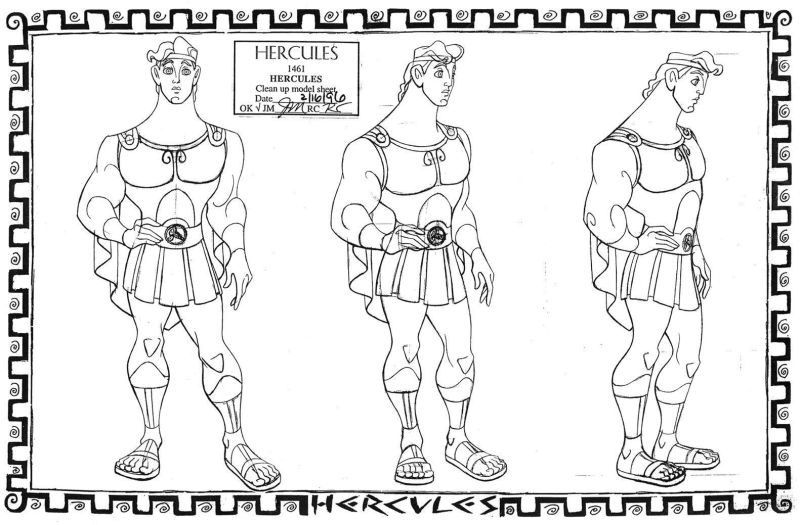
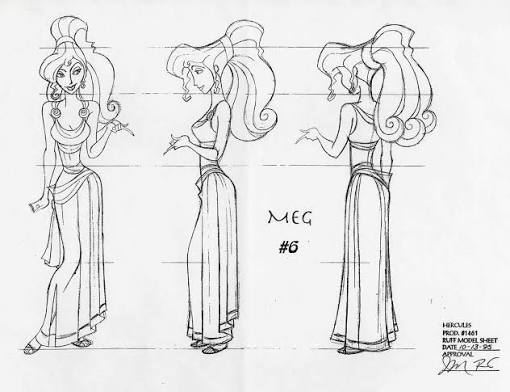
Of course, we can intuitively understand this without tricking small animals in laboratory settings, because we are animals ourselves. For example, a drawing of a woman with a dramatically high hip/waist ratio or a man with an implausibly pronounced shoulder/waist ratio will read as stronger and more obvious examples of each sex, even if those ratios go beyond what nature would naturally produce. Some examples:
Designs from Disney’s Hercules (1997) – exaggerated but legible:
Designs from The Book of Life (2014) – frighteningly extreme, still works:

Beyond human secondary sexual characteristics, we can experience it in pretty much everything. A giraffe with an extra long neck is extra giraffe-ey; a stretched limo is an even greater affluence signifier than a regular limo; a monster with an excessive number of impractically long and excessively sharp teeth is extra monstery.
Part 3: Fisherian runaway / Sensory Exploitation Hypothesis
Natural Selection just by itself is an incredibly powerful theory, but some things defy it – a classic example being peacock’s wildly impractical tails. Less often remembered is that Darwin also theorised about Sexual Selection: genes that produce traits that elicit sexual preference will have a reproductive advantage, even if they have no survival advantage. But this on its own doesn’t explain the peacock.
Fisher’s suggestion was that the earliest version of the ‘ornament’ (the surprising feature the species developed) initially signalled greater potential fitness in the natural-selection sense, which meant a preference for that ornament also had an advantage. If the ornament and the preference are correlated (I assume mainly because genes for both get passed on together) you can enter a feedback loop of ever-more exaggerated ornaments that are just barely constrained by natural selection.
The ‘sensory exploitation hypothesis’ proposes that preference for exaggerated traits arises from sensory biases such as the supernormal stimuli I mentioned above. It seems pretty intuitive to me that this will help drive the Fisherian runaway effect far beyond what natural selection would usually tolerate. It’s a bit like Goodhart’s law – when a measure becomes a target, it ceases to be a good measure.
So a male peacock with an even bigger, brighter, more saturated and more ornamented tail will look even more appealing to a female peacock, and both the tail and the appreciation for the tail get passed on. Thus the tail becomes ever more extreme, until it finally bumps against natural selection’s hard limits.
No points are awarded for this, but I did come up with the sensory exploitation hypothesis myself! Only after looking for research did I learn that all the above is well-established, and that point about ornament and preference being correlated is the deeper insight.
Part 4: Fisherian runaway in capitalism
I do think this same process applies to capitalism:
- Consumers select products by their utility. Products with greater utility are more selected, more successful, and so are produced more. Natural selection at work. A Drosselmeyer nutcracker is incredibly good at cracking nuts, so it does well in objective comparisons, and people like me will recommend it to anyone that wants to crack nuts.
- In many cases the consumer can’t perfectly assess the utility of the product before purchase, so they rely on other signals. This becomes more like sexual selection.
- We can fall victim to a super-normal stimulus here – a thing that depicts outrageously exaggerated traits looks more appealing, even if it’s beyond all reason. A 13-in-1 tool must be better than a 3-in-1 tool. Drinking Tango gets you slapped by an orange man. This car looks so good, fireflies follow it. These two people love this product, and they are very attractive!
- Then the Fisherian runaway can start – to compete, those products need to show the super-normal stimulus, and then the only way to stand out is to exaggerate it even further until you eventually run aground on actual utility / natural selection.
Perhaps you think I’m mad, but remember the burgers?
As a food, a burger is notable for being quite tall – it’s a stack of three (or more) things. A burger can also seem more appealing if it has more than just a plain burger inside. So what happens? Burgers that are taller and have more additional things inside look like even better burgers. Before you know it, restaurants are serving burgers that have to be held together with a skewer and cannot even fit in a conventional human mouth. It’s like eating a peacock’s tail. Metaphorically.
(I’m not sure about the correlation element… perhaps it comes in when chefs eat a taller burger at some other restaurant and conclude they should make their own burgers even taller?)
What about cars? Some people feel safer or more masculine if their car is bigger than others. In America where petrol is relatively cheap (so the natural selection pressure of miles-per-gallon is lower), this effect has reached peacock tail levels of madness as cars become ever larger. The correlation kind-of happens here because obtaining a bigger car means other people, whose cars seemed sufficiently big before, now see a need to get even bigger ones.
Thanks to Instagram and similar social media, we get a similar effect for a bunch of things:
- Treats/drinks that look amazing go viral and drive more sales (and more social posts, driving the correlation) than those that actually taste good
- Holiday destinations that make for good photo opportunities start to do better than those that are actually enjoyable
- Getting more abstract: a video/post that has a very high number of views seems like it must be more worthy of our attention
- Bit of a stretch: a famous person having an opinion seems more compelling than an expert in that domain’s opinion

So as always… watch out for that.
Podcast – The Magnus Archives
The Magnus Archives is a supernatural horror fiction podcast that ran for 200 episodes across 5 seasons from 2016 to 2021.
I got into it essentially by the strength of the writing: I was at a craft fair and found a range of stickers with intriguing phrases like “The sky ate him” and “The world is always ending”.
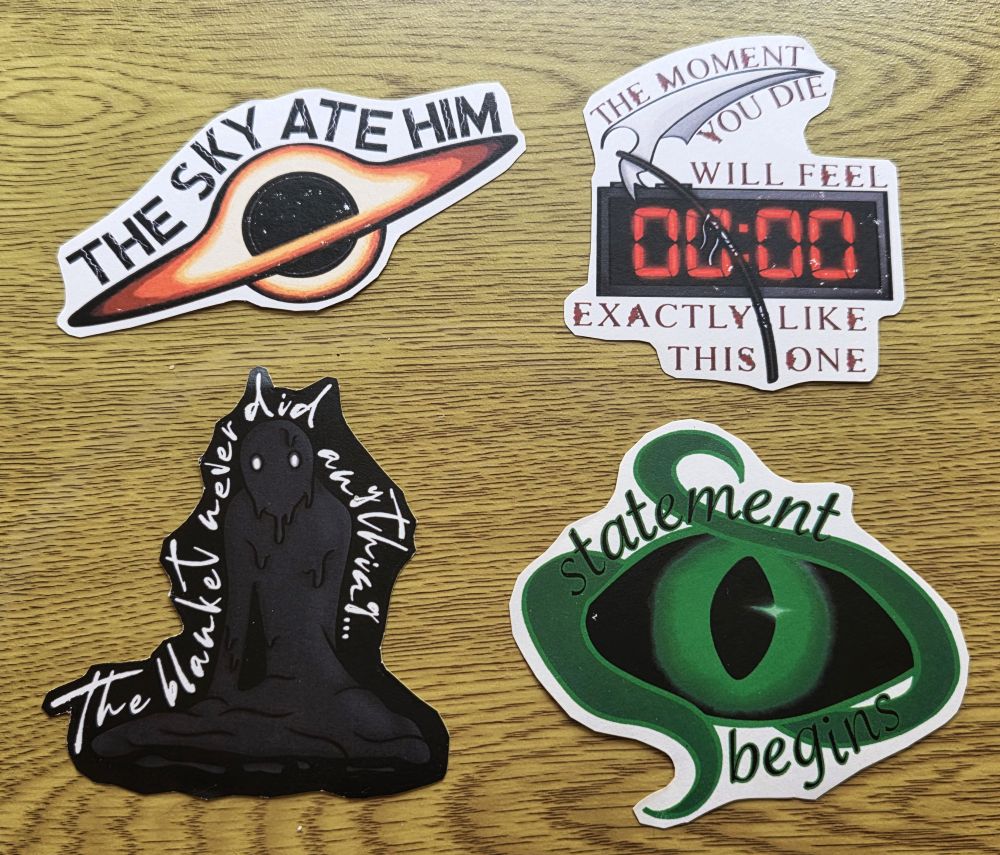
The framing premise is that the eponymous Magnus Archives takes statements from anyone that has experienced something supernatural, and the Head Archivist is recording these statements out loud to tape in order to log them. In this way it takes a classic “spook of the week” form.
I liked that a lot of the elements of the premise that don’t really make sense end up being narratively justified – with the exception of the very non-diegetic spooky music, which was still excellent (especially the “and then things got really spooky” musical cue in season 1).
The spook-of-the-week setup has two tightropes the author must walk, which author Jonathan Sims talks about explicitly in some of the Q&A episodes: the balance between the weekly spook and a greater narrative, and the balance between raising questions and and answering them. For me, neither one is walked perfectly throughout – but Sims (who is also the lead voice actor) does a much better job of both than I’ve seen before. Even though for me the series peaked around 75% of the way through, I still strongly recommend it if you like spooky business.
Some points to note before jumping in:
- Episode 1 (styled MAG 1) did not do much for me, MAG 2 is a better bellwether for what the rest is like, so I recommend sampling at least up to that point
- There is a dedicated subreddit, with a thread for each episode featuring discussion by fans and no spoilers about future content. This can be quite fun for a debrief and help spotting deeper connections between things. (Hub of most of these threads can be found here)
- There is a dedicated wiki with plot summaries and full episode transcripts, but you need to be very careful because immediately after the plot summary you will see information that spoils future episodes
- My very favourite bit begins with the word “Hello”. You’ll know it when you get there
- My least favourite bit is recurring characters that are constantly angry and obstinate
- Probably avoid if you’re averse to the “endless suffering” trope
- There’s a follow-up called “The Magnus Protocol” which is still running and I have not yet sampled
The home page with various links is here, but it’s probably easiest to just search ‘magnus archives’ in the podcast service of your choice.
The Androids are Coming
Because I’ve been writing Things for almost 20 years, I can see how some of my posts serve as a marker of developing technology, or at least my awareness of it. For example, I posted in 2015 this Google Research post about neural networks generating images, which is I think the precursor to generative AI art as we now know it.
Back in 2009 I posted about Boston Dynamics’ ‘Big Dog’. Developments in robotics carried on, with bipedal models eventually roaming free of connecting cables and getting increasingly human-shaped. They now seem to be at something of a turning point.
Compare the performance of China’s androids in the 2025 new year show here:
… with the 2026 new year show:
My guess was that android promotional material would shy away from any implication of violence to avoid reminding people of films like Terminator. I hadn’t accounted for the fact that state propaganda might actively want to promote martial prowess, hence the above. At least we can look at what’s coming directly instead of guessing.
Terminator style threats to humanity are a natural fear but I suspect are a low-probability / high-impact event (perhaps more likely in the form of perfectly efficient and numerous state police facilitating a concentration of power into an ever smaller number of human hands, rather than a bona fide machine uprising). Warfare is also a sufficiently incentivised area that bespoke robots (rather than androids) are arising already, starting with drones.
We’ve spent centuries building specific machines to tackle specific tasks efficiently. Building an android to do similar things seems laughably inefficient – a sledgehammer to crack a nut, or supercomputer to play tic-tac-toe. But there is of course a massive efficiency: we have tools, workplaces and entire paradigms built around the human form-factor. Making an android to solve one physical task is inefficient; making one that can do any human task imaginable, with more accuracy / strength / reliability than a trained human, is incredibly efficient.
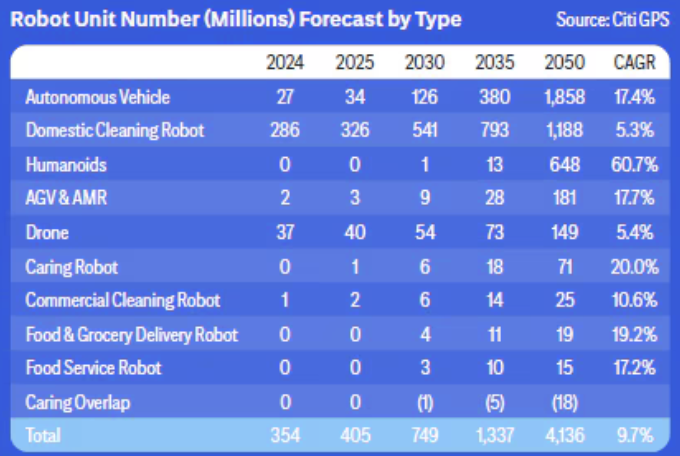
In December 2024, Citigroup published this forecast of robot numbers by type. Humanoid robots (which I’m referring to as androids) are the most notable leap, getting a foothold in 2030 before exploding by 20250:
The leaps forward in AI, most notably visual processing, seem to have unlocked a major piece in this puzzle and make the above look more plausible to me. Here’s a couple more cases (like the Chinese New Year’s Show example above) that show the improvements in these models over recent years, and so gives an idea of the trajectory.
February 2025: Helix androids putting away shopping very slowly:
May 2026: Helix’s Figure 03 working a production line (and other things):
In a very direct test of a specific skill, there are contests in China in long-distance running for androids. In April 2025, one robot completed the half-marathon in 2 hours 40 minutes.
One year later, a robot completed the half-marathon in just over 50 minutes, beating the human record of 57 minutes (which immediately seems like a less relevant comparison).
I don’t expect this to be quick, so the slow initial commercial growth in the Citi forecast does look reasonable to me. I’m certain there will be massive bumps in the road as public perception and legal / insurance systems navigate around the inevitable accidents and abuses this technology will produce. But I now feel pretty confident that sci-fi visions of robot drivers, plant-pickers, and assistants are not at all fanciful.
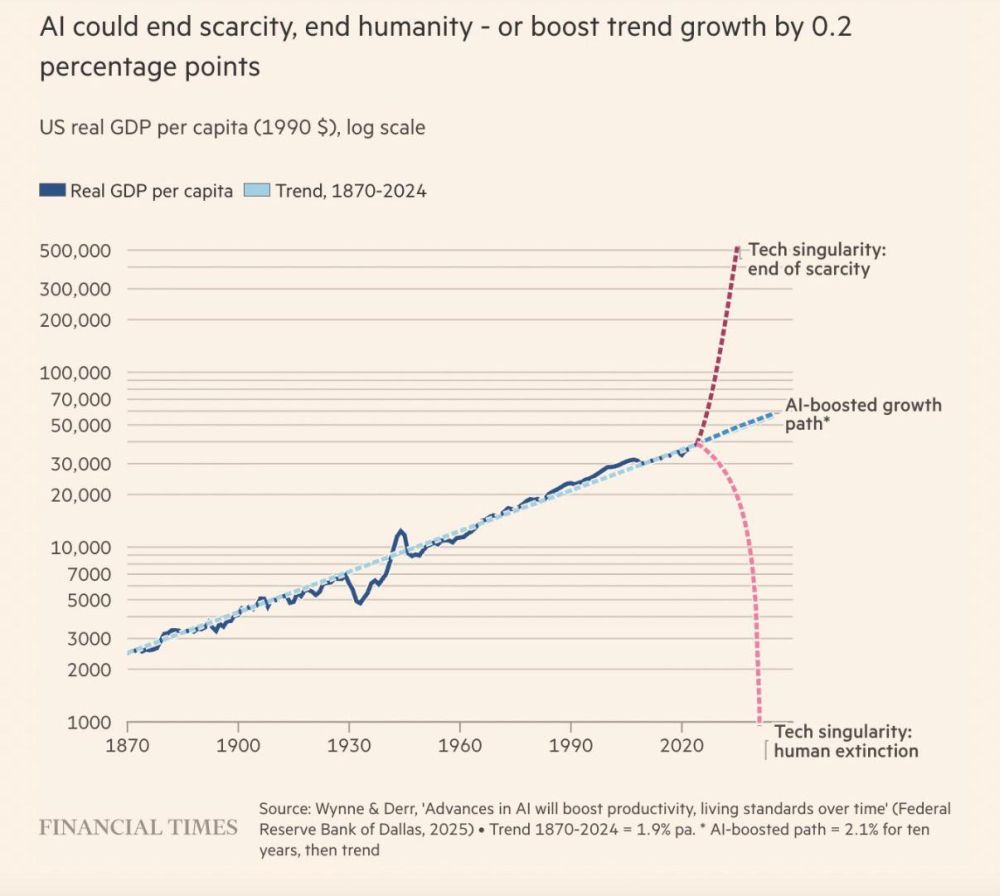
I’ve also been reading a lot about what people think will happen to the humans whose jobs have been replaced. To distil everything, the answer is that… the result will be a product of huge numbers of competing systems and feedback loops, and as such is impossible to predict. It’s a bit like this Financial Times prediction of GDP based on different AI scenarios, which is quite funny and frightening at the same time:
Music videos where effort is the trick
This Things is getting a bit heavy, so let’s look at some Music videos in which a beautiful visual effect is achieved, but the amount of effort that must have gone into it is tremendous.
Director: Michel Gondry
Artist: Kylie Minogue
Song: Come Into My World
Once again Gondry finds a way to visualise the repetition of the song in a video that just keeps getting more impressive:
How did he do it? Well, he explains it and the inspiration here
His explanation seems to take for granted an enormous amount of compositing work, all the more impressive given that this was in 2002 when computer-assisted tools were less well developed. That said, it’s Gondry – possibly he found an incredibly efficient way to do this that he’s not revealing here. Or he just takes that “enormous effort” part for granted because he does that regularly.
Director: Nick Goffey and Dominic Hawley
Artist: The Chemical Brothers (with vocals by Beck)
Song: Wide Open
Dancer: Sonoya Mizuno
Effects: The Mill
Starting with a close-up to assure you that you’re looking at a real human dancer, something impossible starts to happen. Make sure to stick around until 3:28 (or just skip there if you’re busy) in which the video casually does something even more impressive.
How did they do it? Surely to do that you would need some sort of motion-controlled camera or real-time movement tracking, re-render almost everything in CG and then carefully composite the live-action with the CG with pinpoint precision?! The answer is yes, that’s exactly what they did:
Director: Páraic Mc Gloughlin
Artist: Weval
Song: Someday
If you take carefully framed photos of everyday objects and architecture with repeating patterns and show them in sequence, you get a strange sort of stop-motion effect. I saw this trick first used in Michael Langan’s 3-minute video Dahlia (2008), then in Thomas Sauvin’s Recycled (2013) (seemingly no longer viewable but described here; a short snippet can be seen from 1’12” in this film festival trailer). Páraic Mc Gloughlin pushes that idea even further with incredible smoothness, range and synaesthetic effect for Weval’s Someday (2019) music video (after about 21 seconds of build-up):
If you enjoyed that you could also try the video for IMANU – A Taste of Hope (Hallowvale) by Chris Takács and Kevin Rogerson; or enjoy spacelike slicing instead of timelike with the video for Max Cooper – Repetition by Kevin McGloughlin.
The AI Shovelware is here
Also in the category of marking developing technology, last time I wrote about the AI ‘trough of disillusionment’ referencing Mike Judge’s “Where’s the shovelware” article.
Well, true to how the Gartner hype cycle (sometimes) pans out, it turns out we were coming out of that trough.
The financial times looked back into those same trends (paywalled link) in February 2026 and found recent upticks in websites, iOS apps and GitHub repositories:
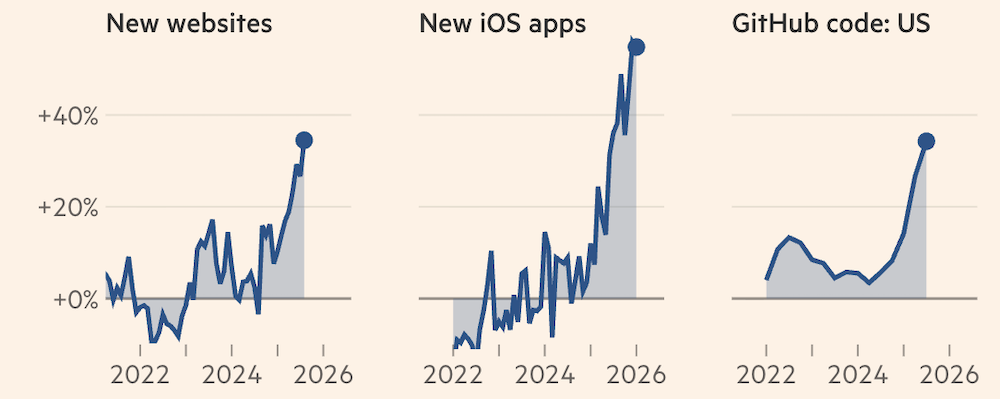
In April 2026, Naavik did a detailed overview of the topic just for games, showing not much effect on PC (although a rise in AI-discosed games), but a huge effect on mobile (especially on Android), showing the number of publishers is up, and the relative proportions of success have remained about the same.
That last point is particularly interesting because the feeling in games is that there are already way more games than the market can sustain (so the vast majority do essentially no business), so an AI-driven surge in new games could just dilute success and make it even harder for anyone to succeed at making games. The counter-argument would be that with a wider range of games, more niches are filled, so more people buy more games – for example, maybe I buy 6 games a year, but if there were twice as many that were twice as appealing to me maybe I would buy 9. If, as Naavik found, the relative proportions of success are about the same then these two effects perhaps cancel out. Or realistically, there’s lots of other effects and that data isn’t sensitive enough to detect them or their true net effect, and also not enough time has elapsed to feel the effects, so let’s just wait and see.
Still this does put more pressure on the question of ‘discovery’ – I can’t buy those amazing games if I don’t know they exist. Most people who work in video games seem to want discovery to get solved through some clever platform design, but I don’t think that’s very likely:
- If I knew what I wanted and could find games that meet exactly that, just maybe we could solve it, but people do not know what they want! I would never have searched for something like Outer Wilds or Portal – in fact if I had searched for either of those accurately it would have effectively spoiled the game – but they were exactly what I wanted.
- This type of problem is approximately solved in social media, where algorithms can serve content people are likely to enjoy (well enough that they keep scrolling, anyway) – but I don’t think people play enough games for you to run the kind of predictive models that work there
- It might just about work if you took as input everything about you (social media consumption, books read, films watched etc on top of games played), but nobody holds all that data (yet)… and we feel uncomfortable with anyone holding all that data.
So in the absence of all that, we just get marketing.
Or some sort of procedural AI-generated game starts out as what you thought you wanted and evolves into what you actually needed based on your real-time reactions. That sounds a lot like a dream, or perhaps a nightmare, both figuratively and literally.
Perhaps more likely, in the future maybe your household android tracks all of that contextual data about you locally, and can then make perfect recommendations?
- Transmission ends, stretching for a note of optimism