Categories
New

Things 2026 Q2: Fisherian runaway, Androids, effortful music videos

Quotes

Here’s some nice quotes that all draw out aspects of the Dunning-Kruger bias:

Idealism increases in direct proportion to one’s distance from the problem

– John Galsworthy

Ignorance more frequently begets confidence than does knowledge

– Charles Darwin

Everything looks simple when you don’t know the first thing about it

– Kevin Williamson

Having established that, I now return to confidently holding forth on things I’m not an expert in, probably annoying Darwin in particular. I leave you to judge how sensible that is.

Super-normal stimuli and Fisherian runaway

Bear with me on this one as I invoke the principles of sexual selection to explain burgers that are too tall to bite.

Part 1: Gestalt Perception

Perception usually feels effortless, but the process that makes it work is strange and subtle. Dozens of contextual clues (sight/sound/smell, movement/light/texture, size/silhouette/colour, and many more) are all subconsciously processed, usually based on previously observed patterns, and our conscious attention is directed to whatever that process deems the most salient aspect. For example, you might see a poster you’ve never seen before, but it has a picture of an actor you know, some words in an elaborate font, a release date and some small print, and without effort you recognise it as a film poster, as well as a good guess for the genre and if it’s likely to be worth paying more attention to.

The way many parts contribute subconsciously to our overall perception is summed up by the slang term ‘vibes’, but over the decades other terms have approximated this idea – ‘vibrations’ of course, but also in different contexts bag, energy, flavour, and more recently aura or “x-coded” (for something with various signifiers of x). Similarly people say an idea ‘doesn’t pass the sniff test’, not because they can smell abstract concepts, but because of how it comes across in almost every other way.

Part 2: Supernormal stimulus

Certain aspects of perception have clear dimensions to them. Most obviously things like bigger/taller/longer but also brighter/more-textured/more-saturated, and beyond. If we recognise an object based on it being notable in some dimension, an object with a stronger version of that attribute can register more quickly and more strongly as a signifier of that object. Further, I think that obviousness biases us to rate it as a ‘better’ example of that object in some way. If it has an unnaturally pronounced example of that attribute it can become a supernormal stimulus.

Wikipedia gathers some examples from the natural world here, for example:

  • Birds will nurture fake eggs over their own if they are larger or more saturated (and Cuckoos exploit this fact)
  • Butterflies that select mates by bright colour markings will prefer orange paper model butterflies over receptive real mates
  • Herring gull chicks seeking a parental beak for food will choose a red stick with yellow markings over a faithfully reproduced yellow-beak-with-red-dot replica gull head

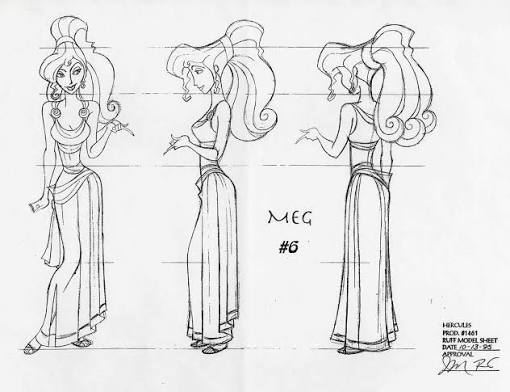
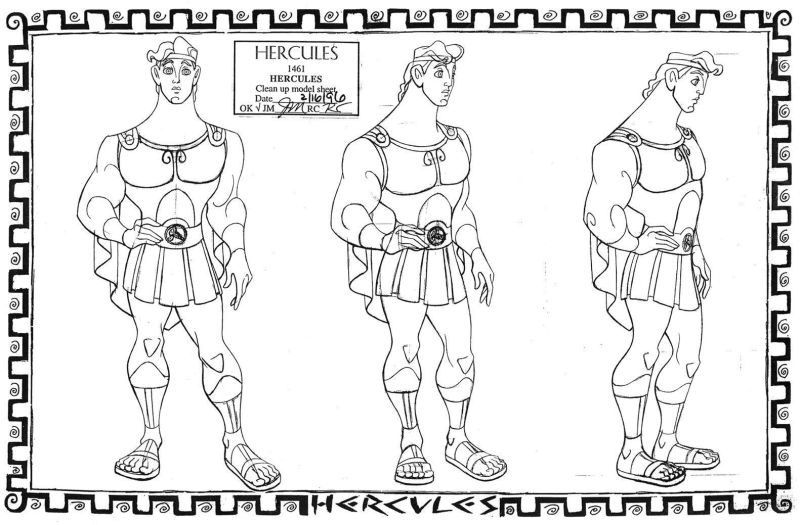
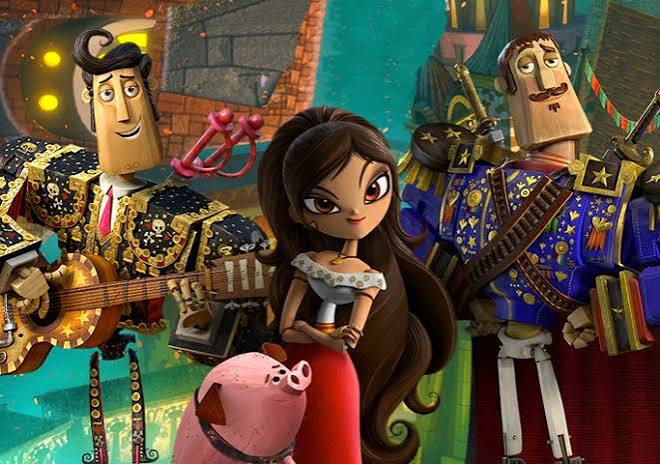
Of course, we can intuitively understand this without tricking small animals in laboratory settings, because we are animals ourselves. For example, a drawing of a woman with a dramatically high hip/waist ratio or a man with an implausibly pronounced shoulder/waist ratio will read as stronger and more obvious examples of each sex, even if those ratios go beyond what nature would naturally produce. Some examples:

Designs from Disney’s Hercules (1997) – exaggerated but legible:
Designs from The Book of Life (2014) – frighteningly extreme, still works:
Beyond human secondary sexual characteristics, we can experience it in pretty much everything. A giraffe with an extra long neck is extra giraffe-ey; a stretched limo is an even greater affluence signifier than a regular limo; a monster with an excessive number of impractically long and excessively sharp teeth is extra monstery.

Part 3: Fisherian runaway / Sensory Exploitation Hypothesis

Natural Selection just by itself is an incredibly powerful theory, but some things defy it – a classic example being peacock’s wildly impractical tails. Less often remembered is that Darwin also theorised about Sexual Selection: genes that produce traits that elicit sexual preference will have a reproductive advantage, even if they have no survival advantage. But this on its own doesn’t explain the peacock.

Fisher’s suggestion was that the earliest version of the ‘ornament’ (the surprising feature the species developed) initially signalled greater potential fitness in the natural-selection sense, which meant a preference for that ornament also had an advantage. If the ornament and the preference are correlated (I assume mainly because genes for both get passed on together) you can enter a feedback loop of ever-more exaggerated ornaments that are just barely constrained by natural selection.

The ‘sensory exploitation hypothesis’ proposes that preference for exaggerated traits arises from sensory biases such as the supernormal stimuli I mentioned above. It seems pretty intuitive to me that this will help drive the Fisherian runaway effect far beyond what natural selection would usually tolerate. It’s a bit like Goodhart’s law – when a measure becomes a target, it ceases to be a good measure.

So a male peacock with an even bigger, brighter, more saturated and more ornamented tail will look even more appealing to a female peacock, and both the tail and the appreciation for the tail get passed on. Thus the tail becomes ever more extreme, until it finally bumps against natural selection’s hard limits.

No points are awarded for this, but I did come up with the sensory exploitation hypothesis myself! Only after looking for research did I learn that all the above is well-established, and that point about ornament and preference being correlated is the deeper insight.

Part 4: Fisherian runaway in capitalism

I do think this same process applies to capitalism:

  • Consumers select products by their utility. Products with greater utility are more selected, more successful, and so are produced more. Natural selection at work. A Drosselmeyer nutcracker is incredibly good at cracking nuts, so it does well in objective comparisons, and people like me will recommend it to anyone that wants to crack nuts.
  • In many cases the consumer can’t perfectly assess the utility of the product before purchase, so they rely on other signals. This becomes more like sexual selection.
  • We can fall victim to a super-normal stimulus here – a thing that depicts outrageously exaggerated traits looks more appealing, even if it’s beyond all reason. A 13-in-1 tool must be better than a 3-in-1 tool. Drinking Tango gets you slapped by an orange man. This car looks so good, fireflies follow it. These two people love this product, and they are very attractive!
  • Then the Fisherian runaway can start – to compete, those products need to show the super-normal stimulus, and then the only way to stand out is to exaggerate it even further until you eventually run aground on actual utility / natural selection.

Perhaps you think I’m mad, but remember the burgers?

As a food, a burger is notable for being quite tall – it’s a stack of three (or more) things. A burger can also seem more appealing if it has more than just a plain burger inside. So what happens? Burgers that are taller and have more additional things inside look like even better burgers. Before you know it, restaurants are serving burgers that have to be held together with a skewer and cannot even fit in a conventional human mouth. It’s like eating a peacock’s tail. Metaphorically.

(I’m not sure about the correlation element… perhaps it comes in when chefs eat a taller burger at some other restaurant and conclude they should make their own burgers even taller?)

What about cars? Some people feel safer or more masculine if their car is bigger than others. In America where petrol is relatively cheap (so the natural selection pressure of miles-per-gallon is lower), this effect has reached peacock tail levels of madness as cars become ever larger. The correlation kind-of happens here because obtaining a bigger car means other people, whose cars seemed sufficiently big before, now see a need to get even bigger ones.

Thanks to Instagram and similar social media, we get a similar effect for a bunch of things:

  • Treats/drinks that look amazing go viral and drive more sales (and more social posts, driving the correlation) than those that actually taste good
  • Holiday destinations that make for good photo opportunities start to do better than those that are actually enjoyable
  • Getting more abstract: a video/post that has a very high number of views seems like it must be more worthy of our attention
  • Bit of a stretch: a famous person having an opinion seems more compelling than an expert in that domain’s opinion
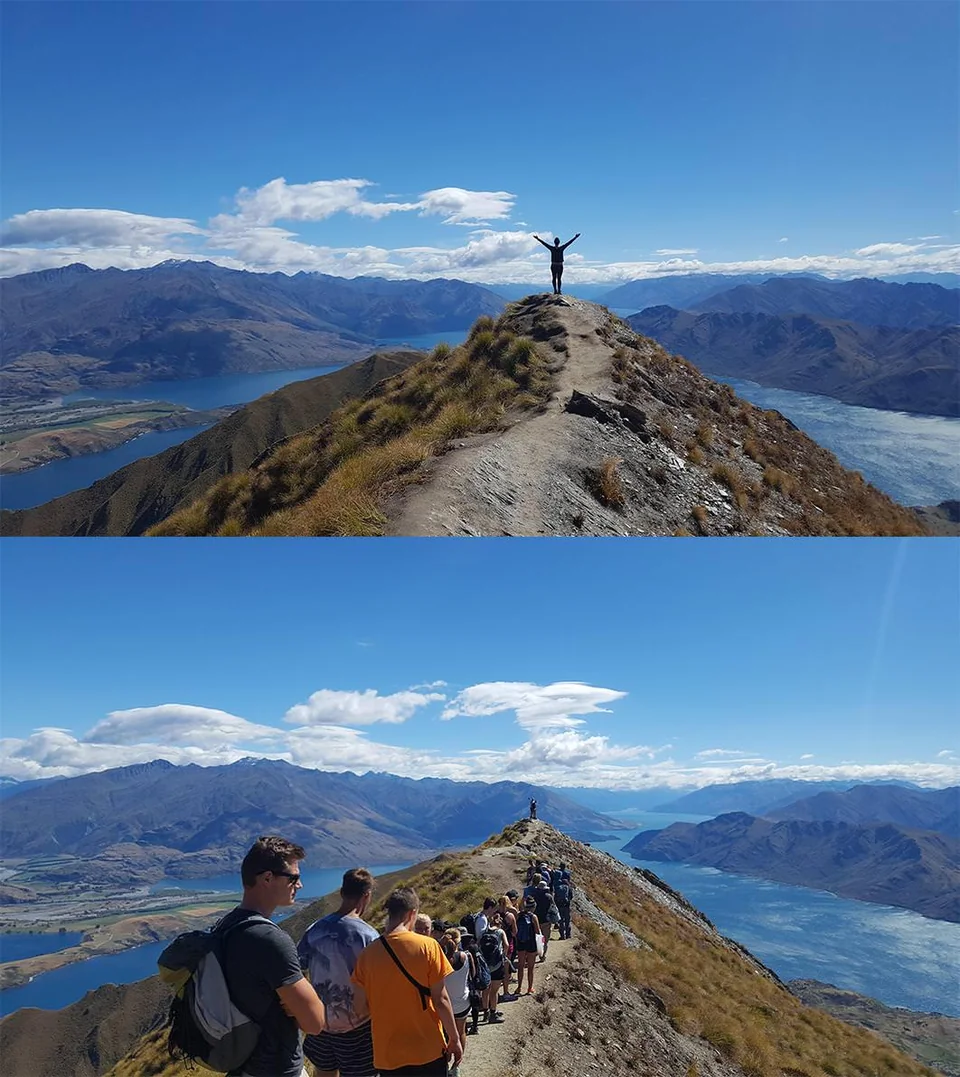
So as always… watch out for that.

Podcast – The Magnus Archives

The Magnus Archives is a supernatural horror fiction podcast that ran for 200 episodes across 5 seasons from 2016 to 2021.

I got into it essentially by the strength of the writing: I was at a craft fair and found a range of stickers with intriguing phrases like “The sky ate him” and “The world is always ending”.
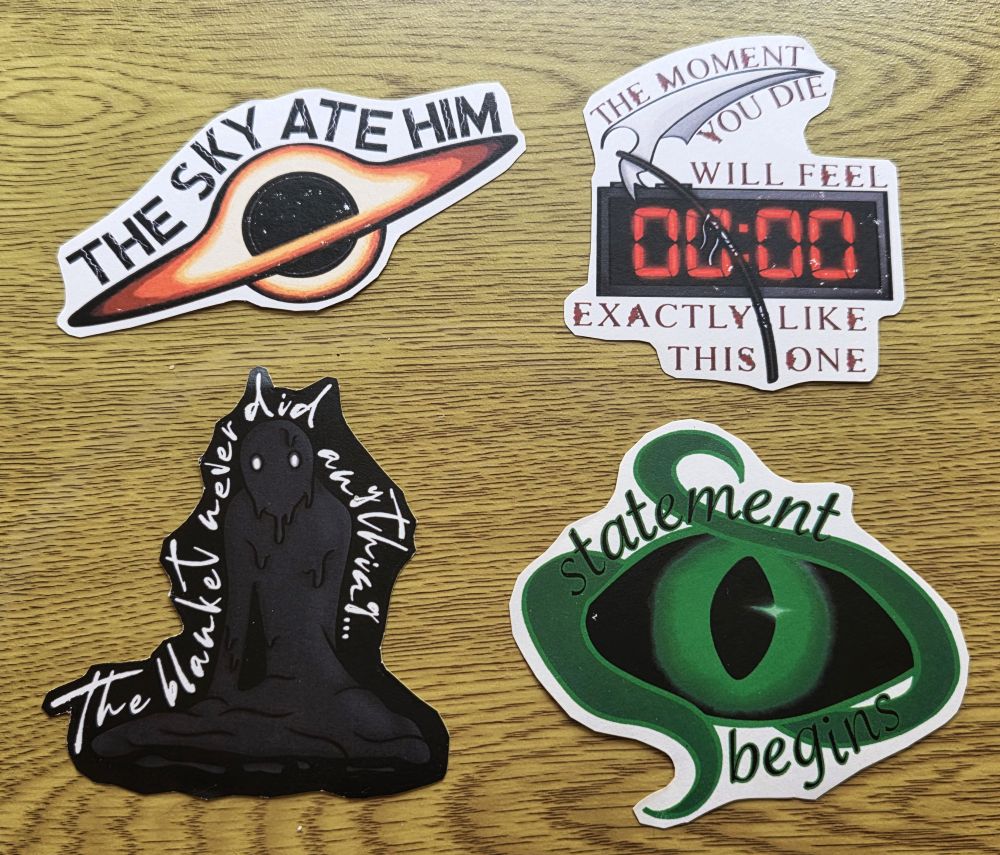
Unfortunately I didn’t note the artist and the work is not signed!

The framing premise is that the eponymous Magnus Archives takes statements from anyone that has experienced something supernatural, and the Head Archivist is recording these statements out loud to tape in order to log them. In this way it takes a classic “spook of the week” form.

I liked that a lot of the elements of the premise that don’t really make sense end up being narratively justified – with the exception of the very non-diegetic spooky music, which was still excellent (especially the “and then things got really spooky” musical cue in season 1).

The spook-of-the-week setup has two tightropes the author must walk, which author Jonathan Sims talks about explicitly in some of the Q&A episodes: the balance between the weekly spook and a greater narrative, and the balance between raising questions and and answering them. For me, neither one is walked perfectly throughout – but Sims (who is also the lead voice actor) does a much better job of both than I’ve seen before. Even though for me the series peaked around 75% of the way through, I still strongly recommend it if you like spooky business.

Some points to note before jumping in:

  • Episode 1 (styled MAG 1) did not do much for me, MAG 2 is a better bellwether for what the rest is like, so I recommend sampling at least up to that point
  • There is a dedicated subreddit, with a thread for each episode featuring discussion by fans and no spoilers about future content. This can be quite fun for a debrief and help spotting deeper connections between things. (Hub of most of these threads can be found here)
  • There is a dedicated wiki with plot summaries and full episode transcripts, but you need to be very careful because immediately after the plot summary you will see information that spoils future episodes
  • My very favourite bit begins with the word “Hello”. You’ll know it when you get there
  • My least favourite bit is recurring characters that are constantly angry and obstinate
  • Probably avoid if you’re averse to the “endless suffering” trope
  • There’s a follow-up called “The Magnus Protocol” which is still running and I have not yet sampled

The home page with various links is here, but it’s probably easiest to just search ‘magnus archives’ in the podcast service of your choice.

The Androids are Coming

Because I’ve been writing Things for almost 20 years, I can see how some of my posts serve as a marker of developing technology, or at least my awareness of it. For example, I posted in 2015 this Google Research post about neural networks generating images, which is I think the precursor to generative AI art as we now know it.

Back in 2009 I posted about Boston Dynamics’ ‘Big Dog’. Developments in robotics carried on, with bipedal models eventually roaming free of connecting cables and getting increasingly human-shaped. They now seem to be at something of a turning point.

Compare the performance of China’s androids in the 2025 new year show here:

… with the 2026 new year show:

My guess was that android promotional material would shy away from any implication of violence to avoid reminding people of films like Terminator. I hadn’t accounted for the fact that state propaganda might actively want to promote martial prowess, hence the above. At least we can look at what’s coming directly instead of guessing.

Terminator style threats to humanity are a natural fear but I suspect are a low-probability / high-impact event (perhaps more likely in the form of perfectly efficient and numerous state police facilitating a concentration of power into an ever smaller number of human hands, rather than a bona fide machine uprising). Warfare is also a sufficiently incentivised area that bespoke robots (rather than androids) are arising already, starting with drones.

We’ve spent centuries building specific machines to tackle specific tasks efficiently. Building an android to do similar things seems laughably inefficient – a sledgehammer to crack a nut, or supercomputer to play tic-tac-toe. But there is of course a massive efficiency: we have tools, workplaces and entire paradigms built around the human form-factor. Making an android to solve one physical task is inefficient; making one that can do any human task imaginable, with more accuracy / strength / reliability than a trained human, is incredibly efficient.

In December 2024, Citigroup published this forecast of robot numbers by type. Humanoid robots (which I’m referring to as androids) are the most notable leap, getting a foothold in 2030 before exploding by 20250:
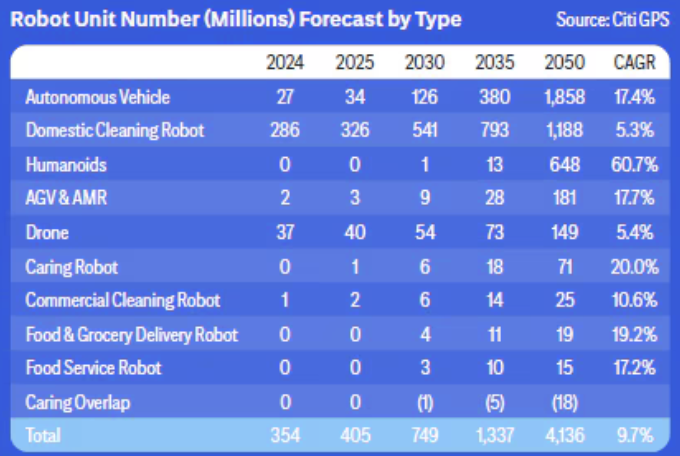
The leaps forward in AI, most notably visual processing, seem to have unlocked a major piece in this puzzle and make the above look more plausible to me. Here’s a couple more cases (like the Chinese New Year’s Show example above) that show the improvements in these models over recent years, and so gives an idea of the trajectory.

February 2025: Helix androids putting away shopping very slowly:

May 2026: Helix’s Figure 03 working a production line (and other things):

In a very direct test of a specific skill, there are contests in China in long-distance running for androids. In April 2025, one robot completed the half-marathon in 2 hours 40 minutes.

One year later, a robot completed the half-marathon in just over 50 minutes, beating the human record of 57 minutes (which immediately seems like a less relevant comparison).

I don’t expect this to be quick, so the slow initial commercial growth in the Citi forecast does look reasonable to me. I’m certain there will be massive bumps in the road as public perception and legal / insurance systems navigate around the inevitable accidents and abuses this technology will produce. But I now feel pretty confident that sci-fi visions of robot drivers, plant-pickers, and assistants are not at all fanciful.

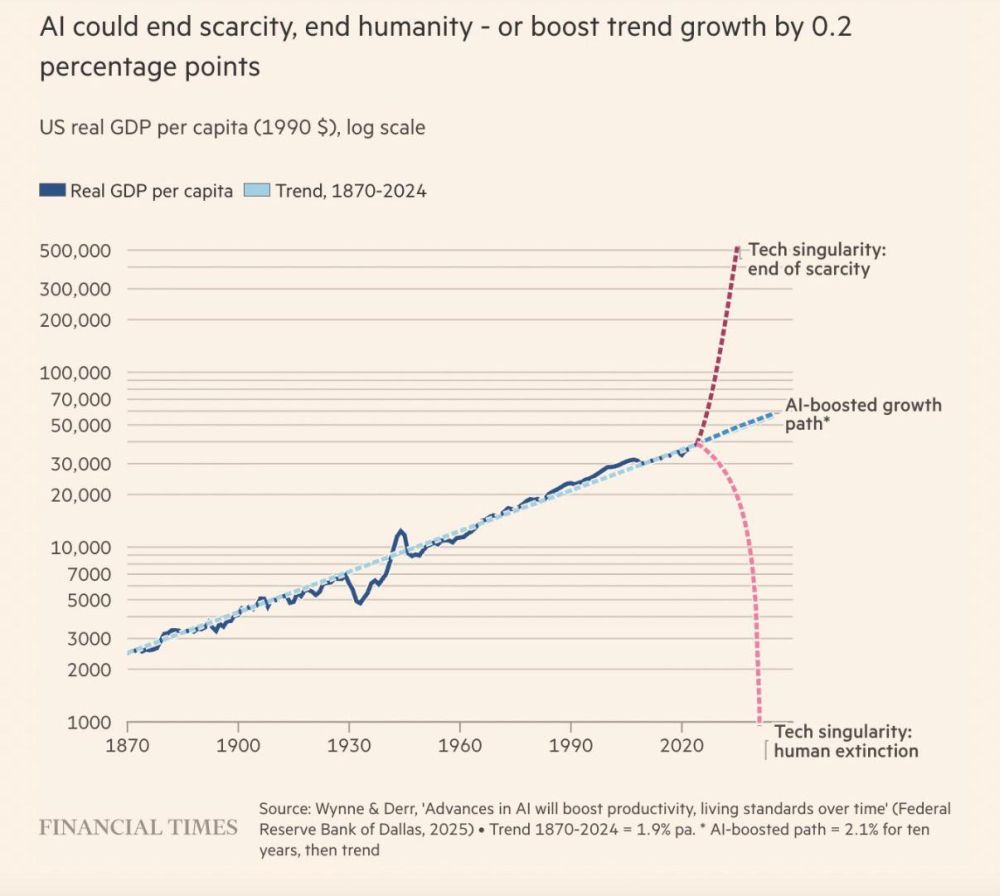
I’ve also been reading a lot about what people think will happen to the humans whose jobs have been replaced. To distil everything, the answer is that… the result will be a product of huge numbers of competing systems and feedback loops, and as such is impossible to predict. It’s a bit like this Financial Times prediction of GDP based on different AI scenarios, which is quite funny and frightening at the same time:
Music videos where effort is the trick

This Things is getting a bit heavy, so let’s look at some Music videos in which a beautiful visual effect is achieved, but the amount of effort that must have gone into it is tremendous.

Director: Michel Gondry
Artist: Kylie Minogue
Song: Come Into My World

Once again Gondry finds a way to visualise the repetition of the song in a video that just keeps getting more impressive:

How did he do it? Well, he explains it and the inspiration here

His explanation seems to take for granted an enormous amount of compositing work, all the more impressive given that this was in 2002 when computer-assisted tools were less well developed. That said, it’s Gondry – possibly he found an incredibly efficient way to do this that he’s not revealing here. Or he just takes that “enormous effort” part for granted because he does that regularly.

Director: Nick Goffey and Dominic Hawley
Artist: The Chemical Brothers (with vocals by Beck)
Song: Wide Open
Dancer: Sonoya Mizuno
Effects: The Mill

Starting with a close-up to assure you that you’re looking at a real human dancer, something impossible starts to happen. Make sure to stick around until 3:28 (or just skip there if you’re busy) in which the video casually does something even more impressive.

How did they do it? Surely to do that you would need some sort of motion-controlled camera or real-time movement tracking, re-render almost everything in CG and then carefully composite the live-action with the CG with pinpoint precision?! The answer is yes, that’s exactly what they did:

Director: Páraic Mc Gloughlin
Artist: Weval
Song: Someday

If you take carefully framed photos of everyday objects and architecture with repeating patterns and show them in sequence, you get a strange sort of stop-motion effect. I saw this trick first used in Michael Langan’s 3-minute video Dahlia (2008), then in Thomas Sauvin’s Recycled (2013) (seemingly no longer viewable but described here; a short snippet can be seen from 1’12” in this film festival trailer).  Páraic Mc Gloughlin pushes that idea even further with incredible smoothness, range and synaesthetic effect for Weval’s Someday (2019) music video (after about 21 seconds of build-up):

If you enjoyed that you could also try the video for IMANU – A Taste of Hope (Hallowvale) by Chris Takács and Kevin Rogerson; or enjoy spacelike slicing instead of timelike with the video for Max Cooper – Repetition by Kevin McGloughlin.

The AI Shovelware is here

Also in the category of marking developing technology, last time I wrote about the AI ‘trough of disillusionment’ referencing Mike Judge’s “Where’s the shovelware” article.

Well, true to how the Gartner hype cycle (sometimes) pans out, it turns out we were coming out of that trough.

The financial times looked back into those same trends (paywalled link) in February 2026 and found recent upticks in websites, iOS apps and GitHub repositories:
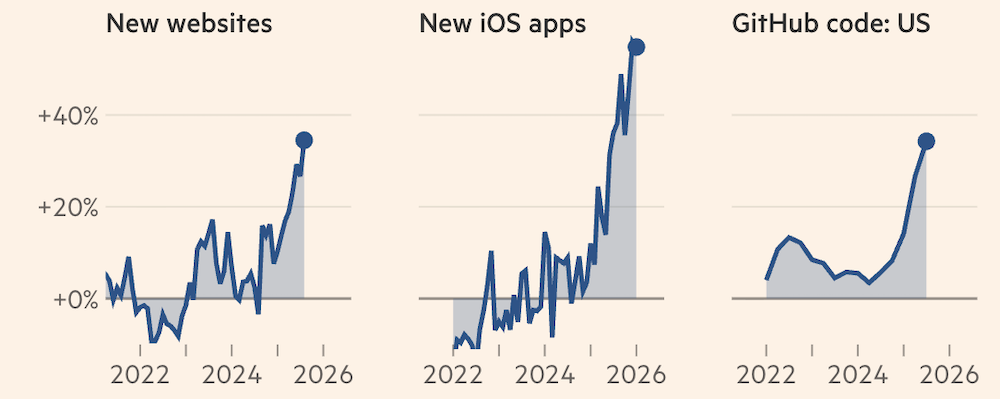
In April 2026, Naavik did a detailed overview of the topic just for games, showing not much effect on PC (although a rise in AI-discosed games), but a huge effect on mobile (especially on Android), showing the number of publishers is up, and the relative proportions of success have remained about the same.

That last point is particularly interesting because the feeling in games is that there are already way more games than the market can sustain (so the vast majority do essentially no business), so an AI-driven surge in new games could just dilute success and make it even harder for anyone to succeed at making games. The counter-argument would be that with a wider range of games, more niches are filled, so more people buy more games – for example, maybe I buy 6 games a year, but if there were twice as many that were twice as appealing to me maybe I would buy 9. If, as Naavik found, the relative proportions of success are about the same then these two effects perhaps cancel out. Or realistically, there’s lots of other effects and that data isn’t sensitive enough to detect them or their true net effect, and also not enough time has elapsed to feel the effects, so let’s just wait and see.

Still this does put more pressure on the question of ‘discovery’ – I can’t buy those amazing games if I don’t know they exist. Most people who work in video games seem to want discovery to get solved through some clever platform design, but I don’t think that’s very likely:

  • If I knew what I wanted and could find games that meet exactly that, just maybe we could solve it, but people do not know what they want! I would never have searched for something like Outer Wilds or Portal – in fact if I had searched for either of those accurately it would have effectively spoiled the game – but they were exactly what I wanted.
  • This type of problem is approximately solved in social media, where algorithms can serve content people are likely to enjoy (well enough that they keep scrolling, anyway) – but I don’t think people play enough games for you to run the kind of predictive models that work there
  • It might just about work if you took as input everything about you (social media consumption, books read, films watched etc on top of games played), but nobody holds all that data (yet)… and we feel uncomfortable with anyone holding all that data.

So in the absence of all that, we just get marketing.

Or some sort of procedural AI-generated game starts out as what you thought you wanted and evolves into what you actually needed based on your real-time reactions. That sounds a lot like a dream, or perhaps a nightmare, both figuratively and literally.

Perhaps more likely, in the future maybe your household android tracks all of that contextual data about you locally, and can then make perfect recommendations?

  • Transmission ends, stretching for a note of optimism
Categories
New

Things 2025 Q3: Neuromancer, Expertise, Consciousness

Brian David Gilbert (BDG)

BDG makes the kind of weird videos I wish I had my act together enough to make. Here’s two examples that show his range.

A short song about hats:

A slightly spooky promotional video about get-rich-quick schemes:

I think we need more of this kind of thing, so please go watch all of his videos and even consider his Patreon.

(Side-note: BDG reminds me of Spike Jonze both as a person and for his creative output.)

Neuromancer and the Prism of Hindsight

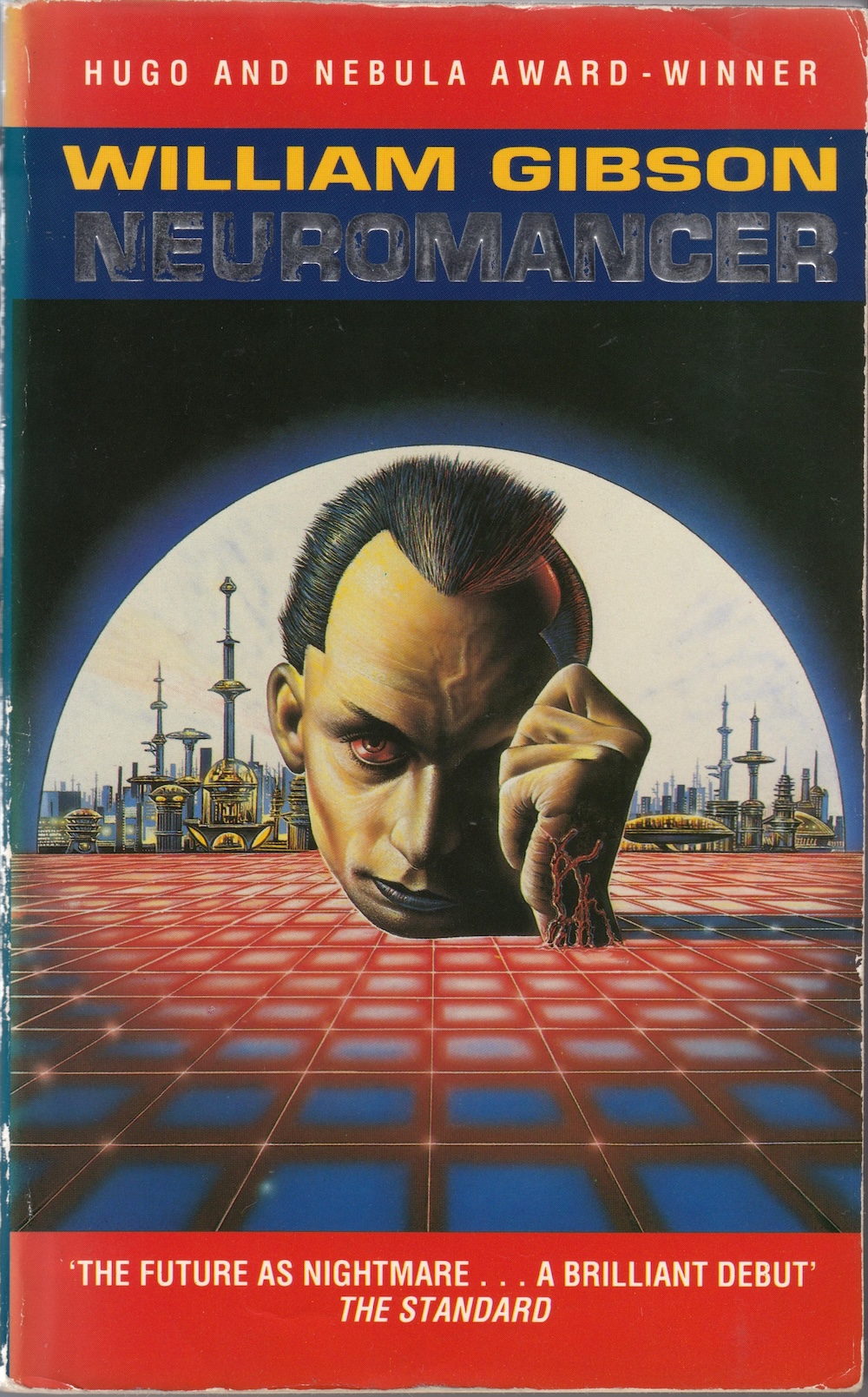
I recently read William Gibson’s 1984 debut novel, foundational cyberpunk text ‘Neuromancer’.

It projects ahead to an unspecified time in which everything is online, and hackers enter some sort of cyberspace ‘matrix’ to conduct various shenanigans. It’s also very much about cybernetic enhancement, with some consideration of AI and some space business. It’s noirish and fast-paced but also dense and intense. There’s a lot going on.

My first thought was that being written in 1984, it seems astoundingly prescient about the future online world.

Then I read that Gibson didn’t really know much about computers or networks, he just liked the language of it. So my second thought was perhaps you need to be far enough removed from a thing, like he was, to see where it will lead.

Then I paid attention to the cover of the copy I had been lent (by Nick H), and realised something strange: it seemed to have some of the hallmarks of an AI-generated image.

Examples:

  • The core composition is a bit odd
  • The shape of the hairline is dramatically and weirdly asymmetrical
  • There’s a strange artefact on the hand that doesn’t seem specific or prominent enough to represent anything
  • The cityscape in the background has some repeating patterns that a human artist would probably try to avoid
  • Some of the domes in the cityscape seem unintentionally asymmetrical

Of course, this thing was published in 1984, and this art is by a human (Steve Crisp). I’m looking at something from the past through the prism of hindsight; in the context of a “futuristic” image, I’m primed to look for AI signifiers.

So comes my third thought: my thoughts on the book being astoundingly prescient also come through the prism of hindsight.
– I’m discounting everything that doesn’t really add up (the 3D visual interface isn’t realistic or sensible; there’s an eye-hacking thing (I think?) that doesn’t really make sense; the stuff in space seems very fanciful)
– I’m over-reading the things that were prescient (the everything-is-online aspect, the ability to leverage that fact to achieve powerful feats with ‘hacking’
– I’m under-reading the parts that really weren’t prescient, at least so far (the cyber-business and simulation aspects mostly).

This doesn’t really diminish the book – it’s a fascinating and impressive work, building out its own strange reality, and inspiring The Matrix (1999) even more directly than I had assumed. You just have to be a bit careful when judging prescience.

Very Short Animal Videos

Thanks to the Reddit algorithm for serving me these tasty and very short animal videos. They are optimised for portrait though and I use YouTube videos to embed things, so I’m not sure how well this will work:

“My cat will eat anything”:

Eating anything
byu/TheHenanigans inUnexpected

“Cat tries ice-cream for the first time”

he tried ice cream for the first time
byu/tuanusser inholdmycatnip

Sound needed for these:

Surprise:

Trying out a new de-corker when..
byu/fpotw infunny

The Paradox of Expertise

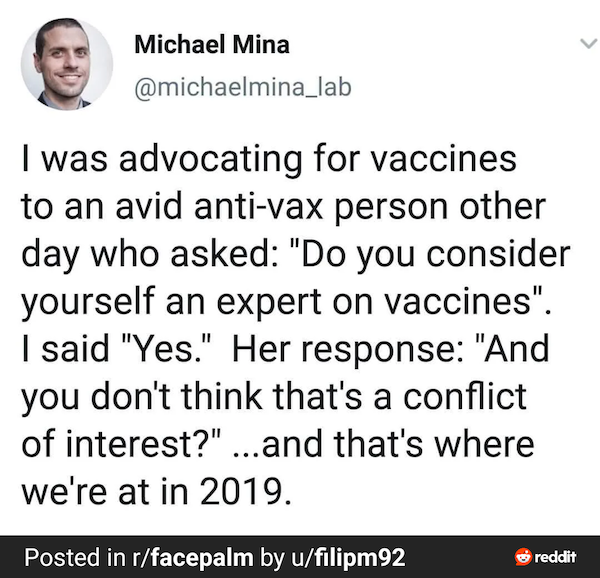
An exchange I saw recounted online and can no longer find went something like this:

A: Oh, do you consider yourself some sort of expert in vaccines then?

B: Well yes, I studied medicine and specialise in vaccines

A: Don’t you think that makes you biased?

[Edit – I found it! Added below. T.M. 02-07-2026]

Humans are prone to confirmation bias. We tend to give heavier weight to things that support what we already believe, and lighter weight – or none at all – to those that contradict it.

What I find even more insidious is a kind of second-degree confirmation bias: we discount someone’s remarks as being due to their confirmation bias… due to our own confirmation bias. For example, someone might doubt a particular bit of well-evidenced medicine, but when they hear a medical expert defend that thing, they assume the expert is only defending it due to the expert’s own confirmation bias.

Without getting deep into the concept of hierarchical trust networks, this is quite difficult to cleanly dissect, because confirmation bias is a real thing.

For example, you may recall that Researcher Bias exists*: a researcher who believes that an experiment will yield a certain outcome is more likely to end up getting that outcome, even if they are not intentionally manipulating the experiment to that end.

*But aren’t the studies looking into Researcher Bias suspect? As I wrote about in Things 133, a meta-analysis and even a meta-meta-analysis cannot satisfyingly answer this question.

You also see this in Planck’s principle: “A new scientific truth does not triumph by convincing its opponents and making them see the light, but rather because its opponents eventually die and a new generation grows up that is familiar with it” – colloquially and bleakly paraphrased as: Science progresses one funeral at a time.

Or the Upton Sinclair quote:

It is difficult to get a man to understand something, when his salary depends on his not understanding it

If all this sounds a little vague and theoretical, I recently faced it head-on: a small stand of bamboo began to spread in my small garden. I know that some particular species of bamboo can spread very aggressively and do real damage. So what I need is an expert who can identify what kind of bamboo it is, and then I’ll know if I need to pay for some other expert to help get rid of it.

The trouble is those two experts are the same company. They will assess the bamboo for you, and then if they think it needs to be removed they will offer you the (quite expensive) service of removing it. The obvious question is: can I trust them to diagnose it correctly, if they know they can make money from one particular diagnosis? (My best guess for this was to at least consider the opinions of two different experts).

The same can be said of any product you buy in which the amount of it you should use is unclear. How many Aspirin should you take, how much sunscreen to put on how often, what collection of skincare products? The people who make these things should really know the answer, but they also make more money if they can convince you to use more than you need.

Infamously, Alka-Seltzer increased sales by normalising the use of two tablets instead of one through their advertising (and tagline, ‘plop plop, fizz fizz’, or ‘plink plink fizz’ in the UK). Still, the origin story (Snopes link) does at least suggest this did originate with a doctor suggesting two would work better than one.

This also runs the other way – a product could offer a legitimate advantage, but by default we don’t believe it when they tell us. I recall the story of a certain battery manufacturer having a significant research breakthrough making their batteries as much as 20% more efficient, an advantage they kept for a few years. Unfortunately from the consumer perspective, all batteries are claiming some kind of mysteriously special efficacy, so it’s hard to trust any one of them as being particularly meaningful. (I wish I could remember who this actually was!)

One possible answer here is Which?, who try to assess consumer product effectiveness with scientific tests. Of course, when they find a product doesn’t do what it should, the manufacturer will usually counter that they didn’t test it properly, and claim that they have a better understanding and more accurate test of their own product. Depending on the product in question I tend to find this more or less compelling.

So what, really, should we do about this?

In some cases, as I alluded to earlier, there are ‘trust networks’. I don’t need to trust a single vaccine expert on their effectiveness, because they are endorsed by thousands of disparate experts, and disparaged by a small number of non-experts (who can also have their own biases, if for example they are selling an alternative).

In other cases the direct incentive structure seems to run very strongly one way – it doesn’t seem to me that climate scientists finding evidence for climate change benefit from that conclusion anywhere near as much as climate-deniers trying to sell you an online course about their views benefit from people believing their denial.

For substances such as sun-screen and painkillers, the proper quantity to use tends to be endorsed by professional bodies, not just the people who sell them. In the case of painkillers you are of course free to experiment with a lower dose and judge the results for yourself.

When it comes to academic research, you can often look into the funding source. If a study casting doubt on climate change is funded by a big oil company, maybe it’s worth looking for other studies.

It feels like I’ve climbed all the way up a mountain of concern only to climb all the way back down again, so, er, maybe it’s fine???

Emel – the Man Who Sold the World

I enjoy David Bowie much more as an actor (Labyrinth, The Prestige) than as a musician, but this cover of ‘The Man Who Sold the World’ stopped me in my tracks. Emel’s delivery seems much more suitable for the slightly spooky lyrics than Bowie’s, and the extended glissando vocal at the end was so compelling I bought a Theremin (this one) in an ultimately misguided attempt to find a way to make a similar sound.

The Science of Consciousness

Here’s the ‘hard problem of consciousness’ as David Chalmers puts it:

It is widely agreed that experience arises from a physical basis, but we have no good explanation of why and how it so arises. Why should physical processing give rise to such a rich inner life at all? It seems objectively unreasonable that it should, and yet it does.

I had previously thought there was nothing interesting here. We only have our own experience of consciousness to go on, so it seems unjustified to consider it “objectively unreasonable”; this is just how it turns out and there’s nothing more to say. (Previously I wrote about Chalmers’ other formulation, the meta-hard problem of consciousness, although perhaps I misread his intent).

I read the book “Being You: a new science of consciousness” by Anil Seth, and I’m excited to have slightly changed my mind as a result!

An argument against there being anything about consciousness to dig into is the ‘philosophical zombie’: a creature that in every way resembles and reacts like a normal human but lacks consciousness. This is easy to imagine, and suggests there’s nothing you can “do science on” because there’s no way to distinguish the zombie from a human that does have consciousness.

Seth makes this counter-argument: “Can you imagine an A380 flying backwards?” In one sense, this is easy – just picture a large plane in the air moving backwards. But “the more you know about aerodynamics and aeronautical engineering, the less conceivable it becomes”. The plausibility of the argument is “inversely related to the amount of knowledge one has”.

One could imagine the same thing applies to consciousness – it does seem like if you deeply understood the way in which consciousness arises, “imagining” a philosophical zombie would be a lot harder. That does seem fair to me!

But still, how do you find a way in to this topic?

Seth’s answer is what he calls the ‘real problem of consciousness’: to explain, predict and control the phenomenological properties of conscious experience. Still difficult, but at least something specific to aim for.

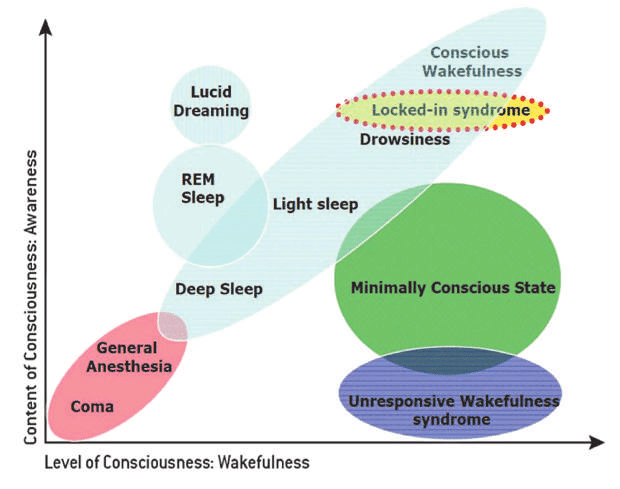
His first way in is to consider how we might measure how conscious someone is – specifically the level of awareness rather than wakefulness. The diagram below shows how different states sit across these two axes.

So we’re looking for some kind of measurement that would show regular conscious wakefulness as having a similar level to lucid dreaming, for example.

He talks about some interesting research showing that a measure of the complexity of electrical signals in the brain seems to correlate well with what we think of as consciousness. Even better, there are tests that can distinguish someone with ‘locked-in syndrome’ (conscious and aware but unable to move any part of the body) from someone in a ‘vegetative state’.

A simpler precedent to the complexity model is this: simply imagining playing tennis produces a detectably different pattern of brain activity to imagining navigating a house. These two kinds of thoughts can therefore be mapped to ‘yes’ and ‘no’, enabling someone with locked-in syndrome to communicate. This dramatically debunks my thought that there was nothing useful to look into here!

Unfortunately, the rest of the book gets quite a bit heavier and less compelling.

First there is Giulio Tononi’s “Integrated Information Theory” (IIT) of consciousness. Put tersely it posits that consciousness is integrated information – kind of a huge claim as it arguably means even atoms are perhaps a ‘little bit’ conscious. It suggests a very specific measure of consciousness: Φ (Phi), essentially how much an information system is more than the sum of its parts.

This theory doesn’t seem to go very far just yet. Seth’s summary of where it is at:

…some predictions of IIT may be testable […] there are alternative interpretations of IIT, more closely aligned with the real problem than the hard problem, which are driving the development of new measures of conscious level that are both theoretically principled and practically applicable.

So it seems we just have to wait to hear a bit more about that.

Next is the Karl Friston’s “Free Energy Principle”. In this, the term ‘free energy’ can be thought of as a quantity that approximates sensory entropy. The clearest summary Seth makes is this:

Following the FEP, we can now say that organisms maintain themselves in the low-entropy states that ensure their continued existence by actively minimising this measurable quantity called free energy. But what is free energy from the perspective of the organism? It turns out, after some mathematical juggling, that free energy is basically the same thing as sensory prediction error. When an organism is minimising sensory prediction error, as in schemes like predictive processing and active inference, it is also minimising this theoretically more profound quantity of free energy.

This is not really a theory of consciousness but, Seth considers, something that will help explain consciousness eventually. I get the impression Seth understands this enough to see how it might be of value, but not well enough to explain it so others can see that – at least not me.

Finally Seth considers the possibilities of animal and machine consciousness, and largely concludes it’s very hard to say anything about these, which is a bit disappointing but is also quite fair.

To summarise, I thought there was nothing useful to say or do about consciousness, but after reading ‘Being You’ I now think that’s wrong; it seems like there is something to dig into here, but so far our theories are only just scratching the surface of it.

(If you want a more detailed recounting of the book with added commentary, not all of which I agree with, you can read this long review by ‘Alexander’ on LessWrong)

  • Transmission ends
Categories
New

Things November 2022: Spooky

This edition of things accidentally gained a spooky theme and almost came out in October! Almost.

Learning from the best vs. the worst

You can learn how to do something from a good example, or how not to do something from a bad one. Each method of learning has its advantages, and some things lend themselves much more to one than the other. You might learn good rock-climbing technique by watching an expert; you might learn film-making by seeing a bad film and noting what doesn’t work.

Games of all kinds are arguably about learning, and the same question comes up: how should a player be taught to play?

In board games one should in theory read the instructions; in practice this is wildly more difficult than it seems (a subject I will return to in depth one day). The usual approach is for someone else to demonstrate – i.e. you learn from a good example.

In video games, the default approach is trial-and-error; generally you won’t be told in advance that, say, a certain enemy fires projectiles or the best way to evade them; you’ll be expected to figure it out. While designing with this type of learning in mind can be done thoughtfully and well, it can also be punishingly slow to learn and achieve mastery. This was my experience in Star Wars Jedi: Fallen Order, where a boss might dispatch me in 20 seconds and I then had to spend a few minutes of traversal to get back to them and have another 20 seconds to learn how to do better.

In contrast, a nice design trick in video games is to take the lead from the way people learn board games mentioned above: the player can learn the basics by seeing another character, similar to the one they control, make mistakes and suffer the consequences. The player understands the rules of the game world quickly but doesn’t feel like they’ve suffered from the mistakes themselves. Then when it comes to mastery, watching experts play – usually on streaming services or in an eSport – can be very efficient.

The distinction of learning by example vs. counter-example was brought to my attention by Charlie Stross’ framing of the two types of reality TV: those that centre on competence vs. those that are fundamentally about incompetence. When we consume stories, we again have the chance to learn from good or bad examples; incompetence-based reality TV (e.g. Love Island, Big Brother) is an example of the latter, and is the opposite of competence-based TV (e.g. The Repair Shop, Queer Eye).

When it comes to horror films (we finally arrive at the spooky point!), there’s a very natural lean towards ‘learning from incompetence’: characters in danger take inadvisable risks, split up etc. and we learn how the consequences of these decisions play out. Criticising characters for making these bad decisions misses the point of story type.

More usefully, being annoyed at those bad decisions is perhaps a sign that you have mastered the basics of “not dying”, and now you’re interested in mastery. Just like in games, you now want to find competence-based fiction instead. This is where the SCP Foundation comes in!

SCP Foundation and competence-horror

The SCP Foundation is a really fascinating work of collaborative fiction that Laurence introduced me to a couple of years ago. While the writing varies in style and quality (as you’d expect for something open and collaborative), I find it most notable for the entries that do the rare thing of combining (usually) supernatural horror with competence. Faced with an extremely dangerous threat, what would extremely competent and well-resourced people do?

To back up a bit, I’ll quickly recap the history of the SCP Foundation.

On 9th June 2007 the best Doctor Who episode of all time, ‘Blink’ was broadcast. This featured ‘weeping angels’, beings that have the appearance of statues that can’t move when observed, but if you so much as blink they can move and attack tremendously quickly.

Shortly after this, a post appeared on 4chan (link to lostmediawiki particle) pairing the image of slightly scary humanoid sculpture with a text description of what it can do – essentially the same as the weeping angels. But the really interesting part was the framing: the text was written in the form of a slightly bureaucratic set of instructions for safely ‘containing’ the entity, labeling it ‘Item SCP-173’. This immediately implied that hundreds of other things are somehow being contained by some kind of organisation, and competency is inherently part of the concept since a reasonably precise set of safety procedures are outlined. (You can read the article in its current form here).

The SCP Foundation is the logical follow-up to this intriguing idea: a collaborative wiki about the ‘Foundation’, some sort of organisation with a mission to ‘contain’ supernatural threats. Various individuals contribute different entries, each with their own SCP number.

At this point, I recommend you read a few of the shorter entries:
SCP-173, the original, as described above
SCP-055, a nice example of how some entries give more questions than answers
SCP-____-J, possibly the shortest, essentially a joke

SCP-●●|●●●●●|●●|●, entirely image based, having read the above you should have the context needed to understand most of it (and as you get deeper into the Foundation more of it makes sense).

Laurence’s recommendation was to read some of the entries tagged as cognitohazard/infohazard/memetic, and THEN look up the Antimemetics Division. A more mainstream approach would be to go straight to the top-rated articles list and work your way down, although this method of ranking has an inherent bias towards older articles.

Either of these could be a good introduction to some stuff Things-readers would enjoy, and I recommend them – but if you’re not sure and/or don’t have much time, I suggest jumping straight into ‘We need to talk about Fifty-Five’ which is a neat little introduction to how clever (and also a bit silly) these things can be.

One warning: a lot of SCP entries tip quite steeply into horror, and in particular there’s a tendency towards ‘supernaturally unending suffering’, so readers with high degrees of empathy may wish to stay away. On the other hand, if that’s exactly what you’re looking for then I suggest SCP-2718 as perhaps the best/worst of that subgenre.

Video Game: Control

Most (all?) of the SCP Foundation wiki is distributed under a Creative Commons license (CC BY-SA 3.0), which means anyone is free to adapt and even exploit the material commercially as long as they give credit, link to the license, and indicate if changes were made.

There have been a few spin-offs, but the most successful seems to be Control (available on PSN, Xbox, Switch, Steam).

While technically not a direct reference, Control is clearly very heavily inspired by the SCP Foundation. The game is set in a vast and windowless building run by the ‘Bureau of Control’ which attempts to contain dangerous supernatural things in much the same way.

A particularly neat twist is that the building itself has some strange properties, and makes fantastic use of brutalist design. When you join all these concepts together, I would describe the result as extremely my jam.

I really enjoyed the game and did essentially all the things you can do in it. If any of the above sounds cool to you I would recommend it… but there are some fairly heavy caveats!

  • Unfortunately this is one of the many video games where the majority of your time is spent killing what are essentially aggressive zombies. I don’t mind a bit of shooting, but this is not the best example of it.
  • Getting confused and lost seems to be part of the design. You are given a 2D map which is only partially useful in a 3D space.
  • Weirdly spiky difficulty is also – I think – part of the design. You never know what kind of horror awaits you, and the fact that some of them can kill you very fast helps to create a feeling of ambient dread (and makes the end-game, once you are fully powered up, all the more satisfying). But often this can create a feeling of frustration, which is weirdly much less pleasant than good-old dread.

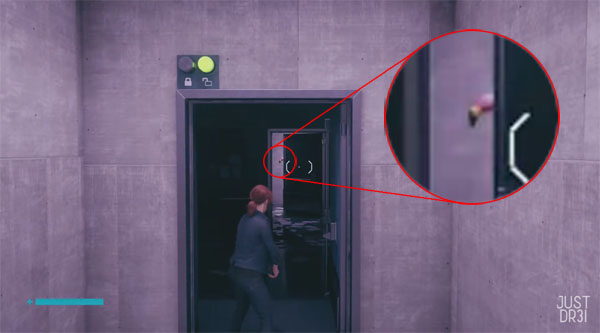
To go back to selling the idea a bit more, I’ll give an example of how this all comes together. In this moment (below) you catch sight of a plastic flamingo, which you know almost nothing about, and it is genuinely terrifying:

Control is available on PC, Playstation, xBox, and the Switch.

Consensus or Death

After some discussion in my work’s politics Slack channel, I came up with the following thought experiment:

Aliens arrive on earth and announce a challenge. After some time to prepare, all humans will be asked to vote either red or blue. If more than 62% vote for the same thing (regardless of which one it is), humanity will survive; if it’s any less, humanity will be destroyed. Can we manage it?

You can immediately see what I’m getting at: considering the partisan debates on elections, referenda, or climate change, could humanity come to even moderate agreement if you stripped out the issue being debated entirely?

To answer that question I wrote a short story about it: Consensus or Death (reading time ~15 minutes). You may be able to tell that the style is influenced by the SCP Foundation!

(Also in the dry-article-style sci-fi genre, I highly recommend Lena by qntm, which takes the form of an article about the history of the first mind upload).

Spooky unrecommendations and recommendations

I usually like to stay on the positive, but after some disappointing spooky TV experiences I figured I should at least share these with Things readers as a warning.

Dark

So Dark is a German TV series that is very difficult to describe without spoilers. The marketing material shows serious-looking characters looking small in large spooky environments with some sort of kaleidoscope effect. I don’t think it’s a spoiler to say that this is an effective graphic shorthand for what the series is: a bit spooky and mysterious, with elements of horror and possibly some sort of sci-fi/genre business going on.

As the series gradually (very gradually) unfolds its mysteries, it becomes clear that it is tackling a fascinating setup that is very rarely attempted in fiction. That is worthy of respect and is the reason I kept watching.

Unfortunately, in trying to carefully work through its central concept, many aspects of good storytelling are sacrificed. Characters don’t ask questions when they should, take advice that they wouldn’t, and generally all behave like weird automata. The tone is resolutely bleak. The complexity ratchets up very rapidly.

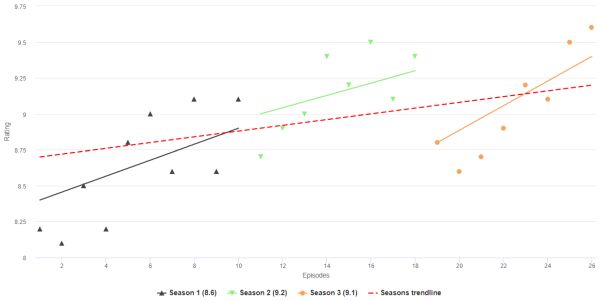
A big part of ‘mystery TV’ is how satisfyingly things are tied up by the end. To get a view on that without spoilers I like to check RatingGraph to see the IMDb ratings of each episode. There’s self-selection at work but it can at least tell you if the kind of person who perseveres to the end is happy with it, and the answer appears to be yes:

Well, unfortunately this did not hold true for me. My suspicion is that as a Things-reader you likely value consistency and cleverness; in my opinion Dark doesn’t manage either of those by the end, and as such was disappointing.

The Chilling Adventures of Sabrina

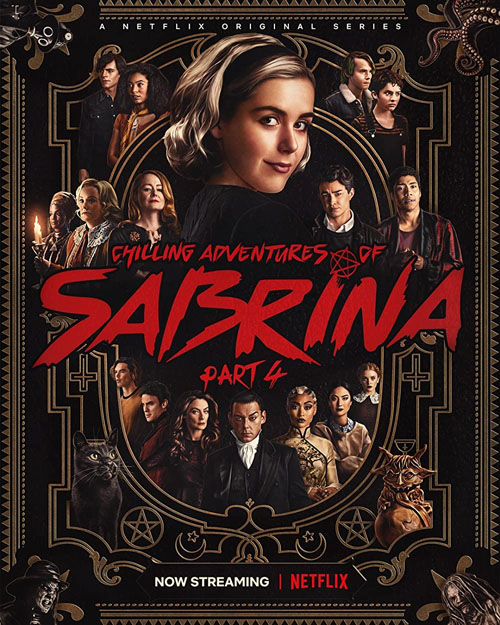
A modern, darker update of Sabrina the Teenage Witch, CAOS had a lot of promise. In particular it has some fun world-building with various magic rules that at least kind-of make sense, and it sets out a general ‘witches vs patriarchy’ theme which is very appealing.

I was particularly interested in the ambiguity of the protagonist: is Sabrina good or evil? Chaotic neutral perhaps? Are we supposed to start out rooting for her and then realise we were wrong to do so? Will she gradually become the antagonist instead of the protagonist? Unfortunately it seems the series isn’t interested in those questions at all. That’s about all I can say without spoilers.

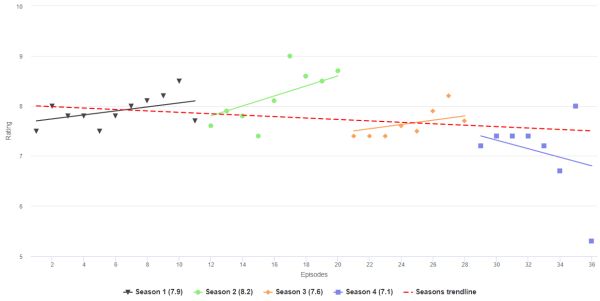
Once again Rating Graph was a useful guide here, and unfortunately I checked it when only 3 seasons of data were available; you can now see that the final ending was (in contrast to Dark) widely seen as a disappointment.

Oxenfree (video game)

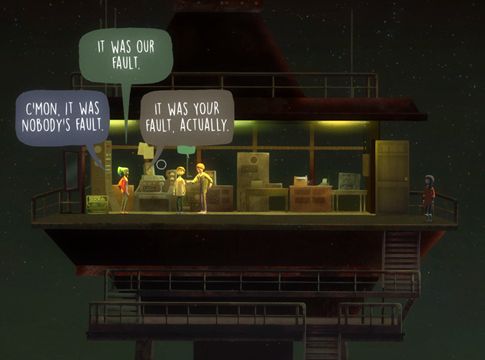
Oxenfree is a short spooky point-and-click adventure where the primary innovation is the conversation system. The gambit is that at various points you are given a few choices of what to say – as in the above screenshot – but (unlike other games) conversations continue to proceed naturally, so you have to choose when to interrupt to get your remark in, or miss the moment so you don’t say anything!

This is the primary way you make choices in the game and is quite effective.

It does have the classic problem in dialogue selection: to make the choice manageable, the options are terse summaries of what the character will say – particularly important here because you need to read and comprehend your choices while simultaneously listening to the ongoing conversation. Unfortunately, sometimes the full version of your remark will add a slant or tone that is really not what you intended, which can make the choice feel a bit unfair.

A tiny example: Jonas suggests splitting up, and you have the option to say ‘Let’s keep together’. But if you choose that, your character actually says ‘C’mon, Jonas, this is… let’s just all go up. I don’t wanna send Ren away like a… deer hound.’ Which is a bit snippier than I expected.

(Side note, I found Horizon Zero Dawn really excellent in this regard, where each terse choice unfolded to a really great full-length expression preserving the tone).

Here’s ProZD illustrating the point in 6 seconds (with NSFW language):

So anyway, the down-side of Oxenfree is that it’s mostly about some teenagers who are a bit silly and grumpy with each other, but the up-side is that it has some really well-realised spooks and some excellent ‘genre business’ (I’m avoiding spoilers) going on. As I tweeted after first finishing it, one moment of the game was so creepy that I felt physically nauseous – which I found really awesome!

So if you’re interested in narrative video games and/or spooks and/or ‘genre business’ then I highly recommend it, especially as it’s relatively short at around ~5 hours. (A sequel is due in 2023).

Oxenfree is available on Steam, Switch (how I played it), PS4, Xbox One, iOS and Android (as part of Netflix subscription)

Marvel Snap

Okay, this isn’t really spooky, but it’s worth noting. I work in mobile games, so I think I can authoritatively say that Marvel Snap (iOS, Android) the first game in a long time to do something really new, interesting, and widely appealing. (I guess the last one was Pokemon Go).

It takes the genre of a tactical card game (like Magic or Hearthstone), but radically distills it down so a match only takes 2-3 minutes. It’s like a simplified version of the card game Smash Up, and is similar in the way it can be a bit strategic but also chaotic and delightful. Notably it adds a very light ‘raise the stakes’ mechanic (the ‘Snap’ of the title) that gives you some strategic control over the randomness.

Now the game is free, and makes money from in-app-purchases, but if you’re not a fan of how those games tend to go I should point out that this is one of the least aggressively monetised high-quality games out there, with money primarily being used purely for aesthetics. So if any of the above sounds appealing, give it a go! (iOS, Android)

[Edit: a subsequent update added the ability to buy specific cards you don’t own from a rotating shop, with a currency that you earn very slowly, while offering an expensive bundle that gives you that currency. While I do think the game deserves more money than it was asking for before, and this tactic will almost certainly better ensure it’s longevity, I can no longer describe it as being one of the ‘least aggressively monetised’ games. You can absolutely have a huge amount of fun without spending though. – T.M. 16/12/22]

Music Video Video Mysteries

My current music discovery/collection method is as follows:

  1. Listen to the world’s-best-radio-station, Fip
  2. Shazam any interesting tracks to identify them
  3. Later, look those tracks up on Youtube
  4. If I still like the song, I add it to a playlist for that year

(If you’re interested you can check out my playlists from 2019, 2020, 2021)

During the Youtube review stage I’m usually not paying much attention to the video, but occasionally it will suck me in, and my very favourite videos produce a profound sense of mystery that feels like there is something going on here and I don’t know what it is.

So, here are my top 3 of those. I highly recommend watching the video before reading the explanation so you get the authentic “what is going on?” experience. To that end, I’ll post all three videos first and the explanations after, and also note that this is the last Thing so you can drop out here if you need to make time for video watching.

(Side note, I recommend using the Youtube ‘watch it later’ button that looks like a little clock as a shortcut to making a playlist for exactly that purpose).

ALA.NI – Le Diplomate, video by Ira Rokka

Noga Erez – You So Done, video by Indy Hait

Jamie xx – Gosh, video by Romain Gavras

Music Video Explanations

Watching Le Diplomate I experienced surprise in three parts: there’s something weird going on with this diplomat character, we have Iggy Pop speaking French, and finally there’s some satire/political commentary and I’m curious about where it’s coming from. Conveniently, all of these questions are answered in this interview with ALA.NI.

You So Done similarly has some layers to it: I was first impressed by the strange musical aesthetic (which Ellie informed me is very similar to Billie Eilish, particularly Bad Guy, which I had somehow never heard before); then the strange not-quite-violence of the video, and the only-slightly-indirect lyrics speak to some core emotional truth behind the whole thing. Once again, the artist herself directly answers these implied questions.

Jamie xx’s Gosh is a little different, in that there isn’t a mysterious lyric component, but the visuals are a whole other thing: what are we seeing? Is it real? Where is it? How did it come about? It seems like it means something… but what? Happily, once again, almost all of these questions are answered in an article here.

Transmission spookily cuts to static

Categories
New

Things 119: Journey, Tree Record, Climb and Descent

Game: Journey
If you’re a gamer, you’ve probably heard about Journey. If you’re not a gamer, then you should have heard about it anyway, because it’s quite beautiful and amazing, and only takes 2-3 hours to play through, which means you could visit a friend that has a PS3 and play it in one sitting.

But why would you want to do that?

In this interview, Jenova Chen, the game’s creative director, says:

“Augustine wrote: ‘People will venture out to the height of the mountain to seek for wonder. They will stand and stare at the width of the ocean to be filled with wonder. But they will pass one another in the street and feel nothing. Yet every individual is a miracle. How strange that nobody sees the wonder in one another.’

“There’s this assumption in video games that if you run into a random player over the Internet, it’s going to be a bad experience. You think that they will be an asshole, right? But listen: none of us was born to be an asshole. […] It is the system that made the player cruel, not the player themselves. So if I get the system correct, the players are human and their humanity will be drawn out. I want to bring the human value into a game and change the player’s assumption.”

The reason I say the game is amazing is that it succeeds at this seemingly impossible aim. I’ve played through it a few times now, and each time I’ve had at least one incredibly positive and sustained play experience with a complete stranger.

http://www.youtube.com/watch?v=_mF8KkDiIdk

[Video not working, try this search – metatim, 02/08/15]

Film: The Cabin in the Woods
If you like horror films, you really should watch The Cabin in the Woods. I don’t think it quite succeeds at Joss Whedon’s stated aim (which you shouldn’t look up until after you’ve seen it), but it’s worth it for the wonderfully insane final half hour or so, which, impressively, the trailer largely resists showing any of:

http://www.youtube.com/watch?v=7ENUBUdFswM

[Video not working, try this search – metatim, 02/08/15]

Video: Tree Record / Years
The technology to turn wistful ideas into a reality is in our hands. Look at this device and imagine what you want it to do:

Now check out the video, where it does exactly that:

Read a bit about it here.

Puzzle: Climb and Descent
Tarim recently introduced me to levels 1 and 2 of a puzzle I’d only ever previously heard set at level 3. This week: level 1.

On Day 1, Joss Whedon hikes his way up a mountain, starting at the bottom at midday, and reaching the top (with a few rest stops along the way) 12 hours later, at midnight. He basks in the glory of his achievement for 12 hours, then at midday on Day 2 sets off back down the mountain, reaching the the bottom 12 hours later again, at midnight.

The question: is there a particular time at which he passed through exactly the same altitude on both his Days 1 ascent and Day 2 descent?

Answer: Voice recognition
A long time ago I asked what one could do to improve the chances of having your words understood by one of the many would-be voice-recognition services we find around us today.

After a bunch of googling around, the answers seem to be:

  • Reduce ambient noise where possible
  • Don’t speak too loudly and close to the microphone
  • Leave longer gaps between words than you might in natural speech
  • Speak with the accent the device was tested for

That last point is the one I’m most interested in. The question is, what accent should you use?

It seems the various companies offering this service (Apple/Siri, Google voice search, Xbox Kinect) do have to release different versions for different parts of the English-speaking world (I don’t have a good source for that, but it’s the impression I get from their staged releases, people’s reported experiences, and common sense).

My next plan is to carry out a small personal test in which I try putting on different accents. Results will of course be reported here.

@metatim