One Year Game
I’m really fascinated by the space of things that aren’t quite games, so I was excited to find this write up of a Japanese games festival called “Is this a game?”. From that description, one game stood out to me: Nilgiri’s “One Year Game”
- Each player takes a box
- The box contains instructions
- The instructions tell the player to write down 3 quests that could be done over the course of the next year
- These can be 1 point quests (which can be repeated 100 times over the year), 10 point quests (10 times) or a 100 point quest (which only scores once), for a total possible score of 300 points
- You then put the box down and take a box somebody else left, and do those quests
- You track your quest completion on a mini calendar in the box
- Points for completing quests go to the person who wrote the quests
- You meet back up a year later
(Caveat, this is my read of the rules from the above description, a Twitter thread, and Nilgiri’s write-up passed through Google translate, so almost certainly some nuance has been lost)
As a pure game, it looks broken: you just write down as your quests: “breathe, eat and sleep”, and you guarantee yourself 300 points; and of course you don’t do any quests yourself, to deny someone else getting the points; and then actually everyone else does the same, so you all have boring quests and score zero points. But there’s clearly more going on, and that’s the part I love.
First in pure game terms you might observe the following:
- If the quests are too boring or inevitable, the player might just forget they are even ‘playing’ and not mark them on the calendar or bother to show up a year later, so you get no points. Slightly interesting quests might be strictly better…
- No winning condition is defined!
Then we get into the really interesting human-behaviour bit:
- It feels intrinsically good to be assigned a quest and then complete that quest, as long as it is at least a little bit challenging
- In life there are sometimes things we would like to do, but other obligations or priorities stop us from doing them – but having that thing as a quest could change that!
- Both of these then pass through a lens of reciprocity / golden-ruleism: what sort of quest would I want someone to set me? Maybe I should set that sort of quest…
- Then on top of that you have human variability: some people want do be funny, some people like the idea of controlling someone’s actions a bit too much; some people just really want to make someone as happy as they can…
So I ran a version of the game myself, with two key differences:
- The original was among strangers at a games festival and they could optionally attend a party a year later to discover their scores; mine was at an annual event that tends to have the same people turn up so the debrief stage is built-in.
- I think the original gives the quest-setter freedom to pick any of the three quest types three times (e.g. they could pick three of the 100-point quests); I chose to restrict it to one quest of each type.
I now need to wait a year to see what happened, but from the quests I heard about, a whole delightful variety have been set, and it didn’t seem like anyone was “playing to win” (while assuming a win condition exists).
I made a printable Google doc of my version here if you want to run your own – Christmas / New Year is probably a convenient time to do this for some people! If you want to run it starting in a different month you can edit the start date in this Google sheet and the calendar will update, so you can paste that into the doc instead. As an organiser, you will need to make sure in the exchange process nobody gets their own quests, and that you track who got their quests from whom. Or rather, you might want to do that; it could still be quite interesting without those framing rules.
Podcast: Going Rogue
Disney bought Lucasfilm in 2012 and very quickly planned to release one Star Wars film every year starting in 2015. Then things got a bit complicated:
- Rogue One (2016) had rumours of directorial difficulties and some significant trailer scenes that never appeared – although the film came out largely okay in the end…
- Solo (2018) was originally being directed by Lord & Miller but they were quite quickly replaced with Ron Howard…
- In the main saga, Episode IX was to be directed by Colin Trevorrow, but then with quite short notice he was replaced by JJ Abrams
- Episode IX itself was quite notable for trying to please everybody and then disappointing pretty much everybody
Tansy Gardam’s podcast Going Rogue has no special access or secrets, but she takes a forensic approach to everything on the public record to try to reconstruct what happened on these films (and others). Most notable for me is her ability to dig out great details that were later revealed in interviews on various podcasts.
Distilling many fascinating hours of podcast into very brief summaries:
- On Rogue One, Tony Gilroy did a substantial and incredibly late re-write after main photography was complete, which successfully brought the film together and established a new ‘grown-up’ tone for Star Wars that he later built on in Andor – but this came at the cost of Jyn’s agency as a character. Also director Gareth Edwards set aside an ‘indie hour’ on set to take the time to discover fascinating, unscripted shots; these turn out to be pretty useless for the film but absolutely great to include in a trailer.
- I think a lot of people assumed Lord & Miller were replaced on Solo as they were going too broad with the humour, but it really seems that was not the case. The bigger problem was their extremely collaborative discovery-based approach to film-making, which is tremendously expensive and difficult to do on a live-action Star Wars film
- For Episode IX Gardam quite convincingly shows that writers JJ Abrams and Chris Terrio left too many key decisions to be ‘discovered’ while making the film, meaning that some key beats (the parentage question; the details of the final confrontation) had not been finalised while other parts of the film were already shot – making them ultimately feel unmotivated and arbitrary.
At the most zoomed out level it appeared as if Disney embarked on a new Star Wars trilogy without a clear over-arching plan. But Gardam shows this isn’t entirely the case – scripts for VIII and IX were being written at the same time, and indeed VIII (Rian Johnson’s The Last Jedi) was finished in very good time. The problem was that Trevorrow’s script for IX didn’t seem great, they pivoted to Abrams very late, and in general I suppose Disney’s creative leadership were very distracted trying to get Rogue One and Solo on track while this was happening.
As a side note, Gardam is great with the direct quotes, facts and inferences, but whenever she strays over into opinion she has some pretty wild takes – but that’s all part of the fun! I highly recommend the podcast if you’re at all interested in what happened in these films.
The trap of Survivorship Bias
Survivorship bias is where we draw conclusions from a set of entities without accounting for a selection process that shaped the set. I think it’s very close to Saliency Bias in which we pay attention to things that are more noticeable.
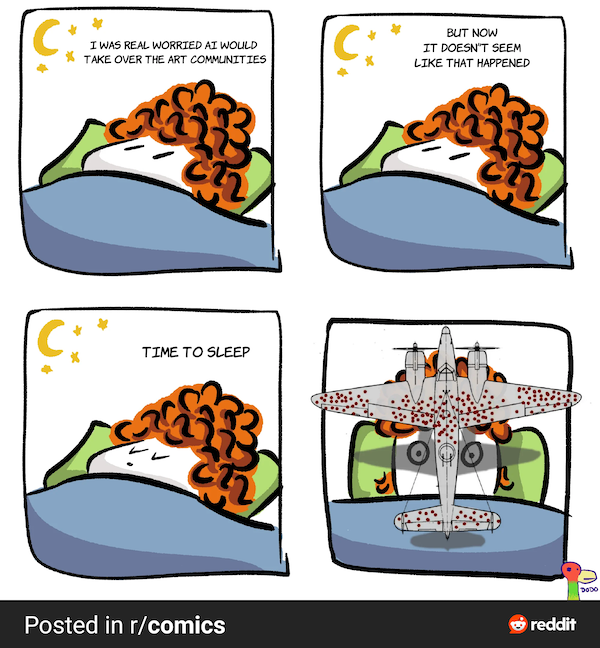
The classic example (and indeed the current illustration on the Wikipedia page for the topic) is the story of fighter aircraft returning from combat riddled with bullet holes everywhere but the cockpit and the engine. The naïve approach is to conclude that the cockpit and engine do not need any reinforcement in future aircraft designs. The selection bias is that planes shot in the cockpit or engine never made it back – so the correct conclusion is exactly reversed.
I suspect the same thing is at work with cats that present humans with small creatures they have killed. Cats were at least partly domesticated for their ability to hunt rodents that threatened human health and food supplies; a cat that brings its trophies to the human will be assumed to be doing a better job than one that just gets on with it, and so will more likely be selected by humans for breeding. (This process is quite similar to the Goodhart/Fisherian issue mentioned in the last things).
Other examples:
- People hear vegans talking about being vegan. They assume all vegans talk about being vegan all the time. They do not account for the silent vegans. (Or the fact that vegans are frequently asked to explain themselves by non-vegans at meal times and so are pushed into talking about it).
- People assume (often without even confirming) that they can correctly identify art made by AI. Certain styles certainly have become hallmarks of AI – dot-eyed rounded comic figures, overly rendered and brightly saturated smiling humans, excessively detailed yet generic fantasy scenes. But this can give us false confidence and lead us to make Type I (‘don’t think it’s AI, but it is’) errors. (Take a skim through this video to see what’s now possible with animation generation as an example)
- A criminal was getting away with something, but then they pushed it even further and were caught – people then say “they always go too far!”, which of course ignores those who do not go that far, but is also blind to those who do go that far and still get away with it.
- Major plane crashes have much more salience than car crashes as we hear about almost every single one. Some people thus become afraid that planes are dangerous. I made a simple estimate for how many major plane crashes would be equivalent to the annual number of car crash deaths; it’s about one major plane crash a day.
AI identification errors – Type I and Type II
Jumping off from the above, it’s one thing to make a Type I error when judging the source of text/image/video (‘don’t think it’s AI, but it is’), but what seems a lot more tragic is the rising trend of people making Type II errors (‘think it’s AI, but isn’t’). Even if you don’t mind the existence or use of AI art, the fact this error can arise is still pretty sad because it dilutes the respect an artist can get for their ideas and skills.
This really came into focus for me in July 2026 when it was reported that a 7-figure book deal fell through over questions of AI-use. Without knowing the true facts of the case, this still highlights how frightening the Type II error is here: you could now have an incredibly promising book deal fall apart just because of the suspicion of AI use. (Side-note, if I wanted to get a book published maybe it will help that I have decades of blog posts to point to as prior form; or maybe it won’t because AI can be trained on that).
I do find it quite useful to keep an eye on r/RealOrAI to continue to tune my AI-detection ability.
All the above is mostly just to give you the context for this comic:
Rotations of major bodies in the solar system
I’m very drawn to finding useful ways to look at things that help you understand them better. There’s usually no single “right” way, but having different views helps. For example, you can think of democracy as a way of harnessing the ‘wisdom of the crowd’, or a means of facilitating peaceful transfers of power, or more bleakly as a system for creating consent to be governed.
Anyway, it turns out that a great way to get your head around the spins and orientations of major bodies in the solar system is to put faces on them:
Music Video: Chet Faker – Gold
One of my favourite music videos is for Chet Faker’s Gold: a ‘single take’ of choreographed roller-skating at night that perfectly matches the rolling, wistful feel of the song, has a slightly mysterious air, and is just very impressive. It’s directed by Hiro Murai, choreographed by Ryan Heffington, and stars roller skaters Candice Heiden, April Corley, and Appelusa McGlynn. One caveat: it does seem to be shot for the ‘male gaze’, which is how it often goes in music videos:
I like to bring similar Things together in threes (like the effortful music videos from last time or mysterious music videos I posted in 2022), but when I realised I knew of nothing like Gold, that made me want to look into it more deeply. (Side note, let me know if you do know of any similar videos!)
I couldn’t find a “making of”, but there is this great interview with lead skater Heiden, (who is also a skate consultant and choreographer) talking through how the video came about, the execution, and a bit of choreography demonstration. Notably at 8:07 Heiden gives commentary over the opening part of the song, explaining where and how she’s putting in extra work to stay in the light while making it look like part of the choreography.
It’s always fun to know quite how hard it was to do a thing like this, and Heiden explains that they started shooting at 8.30pm on this small access road, driving and performing one way then turning around and doing the same going back – and apart from a short ‘lunch’ break in which Chet Faker filmed his cameo, they continued trying to get the perfect take(s) until dawn.
Based on the descriptions, I assume the location was Escondido Canyon Road (California) or nearby. Assuming it was filmed around 1st August (ahead of its 12th August 2014 release date), sunrise would have been at around 6am, making for about 9 hours of shooting to get the final takes. The shoot has been described as taking 14 hours, but I assume a bunch of that will have been getting the road swept and ready before shooting began. Either way, I’m now even more impressed than when I first watched it.
- Transmission Ends