Categories
New

Things 121: Kitten Cam, Chain World, Hand-Waving Explanations

Tim Game Thing
If you ever watched Knightmare and wanted to be the kid in the vision-restricting helmet asking “Where Am I?”, or if you wanted to be the team responding “You’re In A Room” and then frantically shouting “Sidestep left”, or perhaps if you wanted to come up with your own ideas for dungeons for those players to explore, then I recommend you come along to Hide & Seek’s free Sandpit event this Friday 25th May (6.30pm-10pm at the Royal Festival Hall near Waterloo), where I’ll be running a game that gives you an opportunity to do exactly those things.

There will also be a lot of other games going on, which sound pretty amazing, so read all about it, and come along.

VideoCat and Kitten webcams
Which is more compelling: a high resolution webcam of some kittens, or low-resolution webcams you can move around and remotely operate cat toys through (if you’re prepared to use Internet Explorer and Silverlight)?

It turns out that even though the latter sounds superficially cooler and more engaging, it’s nowhere near as good as high-resolution kittens.

LinkJason Rohrer’s Chain World
Jason Rohrer has made some very interesting games (I particularly like Sleep Is Death (or at least the idea of it – I haven’t played it yet), Inside a Star-filled Sky, and Passage is apparently pretty amazing (and very short) if you don’t play it stupidly the first time like I did), so it’s not particularly surprising that he came up with the winning concept in a competition to pitch an idea for a game that in some way represented the abstract idea of religion, and which, when actually released into the world, generated some pretty fascinating results.

Heavily Caveated Film Recommendation
The Green Hornet is a Seth Rogen action/comedy vehicle directed by Michel Gondry. If you analyse that sentence you may realise that this was recipe for disaster. With Seth Rogen starring and also writing (with long-time friend and collaborator Evan Goldberg), there was inevitably going to be some creative conflict with a director as idiosyncratic and driven as Michel Gondry (the man behind some of my favourite music videos).

Trailer: (2’06” is the moment that screams “Gondry!”)

Refreshingly, listening to the commentary makes this very clear, as Gondry, Goldberg and Rogen frequently reference the arguments behind almost every good idea in the movie, and occasionally break into new arguments about them (“We had to convince you that this would work!” “No no no! This was my idea! You guys didn’t want to let me do it!”).

This conflict doesn’t particularly damage the movie, but I ended up wishing Gondry had had more things go his way, because all the really weirdly brilliant parts are unmistakeably his. For example, at one point, the bad guy wants to send a message out through his criminal network, and this is how Gondry represents it:

http://www.youtube.com/watch?v=UA5ZuJdrgyc

It’s also great to hear his enthusiasm for his own ideas in the commentary, as when this scene starts: “This is awesome, look! Two cameras from one camera! How… did… the hell it happen?!” (Answer: they got the actors to stay in position while shooting one part, then came back to them and picked up shooting from the same position, then forced the shot to match in digital post-production, which is fine, but just count the splits and think about actually pulling that off).

The real problems with this film (to save you the trouble, it’s a 6.0 on IMDb and 44% on Rotten Tomatoes) are I think twofold:

1) Goldberg and Rogen consciously chose to reverse many of the staples (some would say clichés) of a superhero movie, which is admirable, but as is so often said, you need to be very familiar with the “rules” of any art form if you want to break them and still have the thing work, so this sentence ends in just the way you would expect.

2) There’s a fine art to crafting an action movie in which the audience can root for the protagonists, even when they’re harming or even killing bad guys. I don’t know how you pull this off, and apparently neither did anyone making The Green Hornet, because these moments frequently feel wrong.

All of which was fascinating, and I don’t regret watching the movie at all.

Answer 2A and 2B – Temperature/Pressure Pairs
Do there exist a pair of points opposite one another on the earth with exactly the same temperature and pressure? I say yes, and here’s my hand-waving explanation for that.

Stage 1
Let T(x) and P(x) denote the temperature and pressure of point x.

Choose two opposite points, A and B (if T(A) = T(B), do this stage with pressure instead of temperature). Consider a path from A to B (blue arrow in Fig 1a) and the corresponding opposite path from B to A (red arrow in Fig 1a).
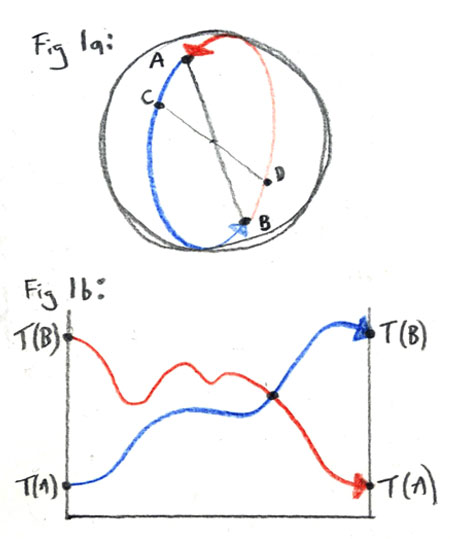
In Fig 1b, we chart the temperature of the opposite points as we move around these paths. Just as with the Joss Whedon ascent/descent puzzle, since each line of temperature is continuous, they must cross at least once, and this represents a point at which the temperature is equal on opposite sides of the globe (points C and D in Fig 1b).

Stage 2
We now imagine rotating the circlular path we’ve considered about points A and B (Fig 2a). As we do this, the lines of temperature move continuously (Fig 2b), but since they always start and end at points A and B, the end temperatures remain fixed, and so the point at which the lines cross also moves continuously.
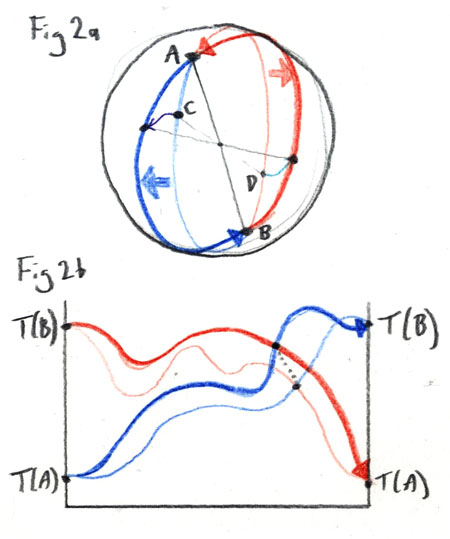
This starts to trace out a line of equal-temperature-opposite-points on the globe (turquoise and purple lines in Fig 2a).

Stage 3
If we continue that rotation all the way around, we trace out a continuous wiggly line of equal-temperature-opposite-points around the globe (Fig 3a, purple and turquoise lines).
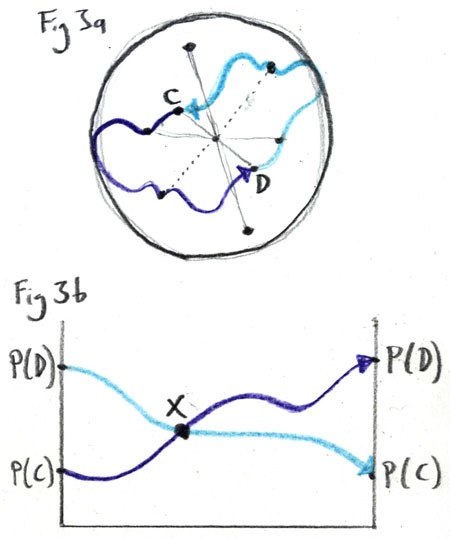
We now consider two opposite points on this line, C and D (Fig 3a). We consider the pressure as we trace out a path from C to D (purple line) and the corresponding opposite points on the path from D to C (turquoise line). We can now apply exactly the same argument as in Stage 1 – the two lines of pressure (Fig 3b) are continuous and so must cross at some point, X. At that point, both the temperature and pressure are equal on opposite sides of the globe.

While this is not a proof, it’s reassuring that the Borsuk-Ulam theorem does prove that the result is true, although that’s no garantee that this reasoning is completely sound.

Dom Camus supplied a similarly hand-waving explanation but with a much more audacious line of attack, so if you liked the above, you should definitely check it out.

Phil has a pretty elegant approach, although he didn’t sound that convinced by it. He points out that “On any closed curve (not just great circles), the same sort of argument [as in Fig 1 above] holds […] I claim you can always construct a closed curve containing all its own opposite points and along which the temperature is everywhere equal at opposite points [like the turquoise/purple path in Fig 3]. Otherwise there would be some closed curve containing all its own opposite points, along which the temperature was never equal at opposite points, a contradiction.” You can then repeat Step 3, as above, to reach the same conclusion.

Puzzle Level 3The Crumpled Map
The final level in this series (suggested to me by Tarim) is one I don’t have any kind of hand-waving proof of, but I would love to see one.

Imagine you are on a lovely desert island with a selection of your favourite music, a pencil and paper, and an uncannily perfect map of the island. Actually, only the map is important.

If you lay the map on the ground and align it perfectly with the island itself, it’s quite easy to visualise that there must be a single point on that map which corresponds precisely to the bit of the island directly below it.

Now imagine folding and crumpling the map in any kind of way (but not tearing it) and throwing it anywhere on the ground. Wherever it happens to land, will there still be a point on the map that exactly corresponds to the place on the island directly below it?


Categories
New

Things 119: Journey, Tree Record, Climb and Descent

Game: Journey
If you’re a gamer, you’ve probably heard about Journey. If you’re not a gamer, then you should have heard about it anyway, because it’s quite beautiful and amazing, and only takes 2-3 hours to play through, which means you could visit a friend that has a PS3 and play it in one sitting.

But why would you want to do that?

In this interview, Jenova Chen, the game’s creative director, says:

“Augustine wrote: ‘People will venture out to the height of the mountain to seek for wonder. They will stand and stare at the width of the ocean to be filled with wonder. But they will pass one another in the street and feel nothing. Yet every individual is a miracle. How strange that nobody sees the wonder in one another.’

“There’s this assumption in video games that if you run into a random player over the Internet, it’s going to be a bad experience. You think that they will be an asshole, right? But listen: none of us was born to be an asshole. […] It is the system that made the player cruel, not the player themselves. So if I get the system correct, the players are human and their humanity will be drawn out. I want to bring the human value into a game and change the player’s assumption.”

The reason I say the game is amazing is that it succeeds at this seemingly impossible aim. I’ve played through it a few times now, and each time I’ve had at least one incredibly positive and sustained play experience with a complete stranger.

http://www.youtube.com/watch?v=_mF8KkDiIdk

[Video not working, try this search – metatim, 02/08/15]

Film: The Cabin in the Woods
If you like horror films, you really should watch The Cabin in the Woods. I don’t think it quite succeeds at Joss Whedon’s stated aim (which you shouldn’t look up until after you’ve seen it), but it’s worth it for the wonderfully insane final half hour or so, which, impressively, the trailer largely resists showing any of:

http://www.youtube.com/watch?v=7ENUBUdFswM

[Video not working, try this search – metatim, 02/08/15]

Video: Tree Record / Years
The technology to turn wistful ideas into a reality is in our hands. Look at this device and imagine what you want it to do:

Now check out the video, where it does exactly that:

Read a bit about it here.

Puzzle: Climb and Descent
Tarim recently introduced me to levels 1 and 2 of a puzzle I’d only ever previously heard set at level 3. This week: level 1.

On Day 1, Joss Whedon hikes his way up a mountain, starting at the bottom at midday, and reaching the top (with a few rest stops along the way) 12 hours later, at midnight. He basks in the glory of his achievement for 12 hours, then at midday on Day 2 sets off back down the mountain, reaching the the bottom 12 hours later again, at midnight.

The question: is there a particular time at which he passed through exactly the same altitude on both his Days 1 ascent and Day 2 descent?

Answer: Voice recognition
A long time ago I asked what one could do to improve the chances of having your words understood by one of the many would-be voice-recognition services we find around us today.

After a bunch of googling around, the answers seem to be:

  • Reduce ambient noise where possible
  • Don’t speak too loudly and close to the microphone
  • Leave longer gaps between words than you might in natural speech
  • Speak with the accent the device was tested for

That last point is the one I’m most interested in. The question is, what accent should you use?

It seems the various companies offering this service (Apple/Siri, Google voice search, Xbox Kinect) do have to release different versions for different parts of the English-speaking world (I don’t have a good source for that, but it’s the impression I get from their staged releases, people’s reported experiences, and common sense).

My next plan is to carry out a small personal test in which I try putting on different accents. Results will of course be reported here.

@metatim

Categories
New

Things 114: Kern Test, Robot Bird, Social Graph, Too Soon To Say

Puzzle
This week, try testing your ability to kern.

If you liked that, try the splines.

Video
It’s easy to get overexcited about human progress, when in the grand scheme of things we’re still pretty small fry. I would periodically remind myself of this by considering that for all our ingenuity, we still couldn’t make a robot the size of a bird that could fly like a bird. Thanks to the determined efforts of Festo, I’m going to need to come up with something else.

Link
I’ve seen this link crop up in a few places now, but for good reason – I think this is some really important stuff that we are collectively getting wrong on a large scale right now: “The Social Graph is Neither” by maciej.

Cutting large swathes of great text for concision, here’s my favourite part of the  argument:

[…] declaring relationships explicitly is a social act […] Social graph proponents seem uninterested in th[is] signaling problem. […] [and] how does cutting ties actually work socially? […]  In real life, all relationships fade naturally if you don’t maintain them, but right now social networks preserve ties in amber until we explicitly break them […] Can I unfollow my ex now, or is that going to make her think I’m still hung up on her?

[…] You might almost think that the whole scheme had been cooked up by a bunch of hyperintelligent but hopelessly socially naive people, and you would not be wrong.

However, after a lot of good stuff, it ends with something of a shrug:

It’s just a matter of waiting things out, and leaving ourselves enough freedom to find some interesting, organic, and human ways to bring our social lives online.

I’m not sure that’s quite the right way to put it. I don’t think it’s about bringing our social lives online. Its more about augmenting our social lives with online functionality that goes with the grain of human nature.

That said, leaving ourselves enough freedom is critical. Quite how we do that is a topic for another day.

Quote
In the early 1970’s, Richard Nixon asked Zhou Enlai what he thought of the French Revolution. Zhou notoriously responded:

It is too soon to say.

Which everyone thought was quite wonderfully representative of Chinese sagacity.

This year it emerged that the whole thing was a misunderstanding too delicious to invite correction, as Zhou thought Nixon was referring to the much more recent student riots in Paris.

But this doesn’t matter, because the misread quote still stands as a useful reminder that we should err towards taking a longer-term view when evaluating the benefits of things. On a similar note, Ben Hecht says:

Trying to determine what is going on in the world by reading newspapers is like trying to tell the time by watching the second hand of a clock.

Last Week’s Question
Last week I asked: when someone says “next Thursday” on a Monday, which Thursday do they mean?

Richard’s response was the same as mine – always clarify. However, where I was aware of two interpretations, he identified three [This part added thanks to Richard’s clarification – T.M. 25/11/11]:

I have come across three possible scenarios:

|

(a) this = first occurrence, next = second occurrence
(b) this = occurrence in the week you’re in, next = occurrence in the following week
(c) this = occurrence in the week you’re in, next = first occurrence

|

I don’t think anyone actually uses (a).
Personally I use (b).
I have met people who use (c).

|

To give some examples, on a Tuesday, referring to “This Monday”
and “Next Monday”.

|

(a) This Monday = 6 days times, Next Monday = 13 days time
(b) This Monday = -1 days time, Next Monday = 6 days time
(c) This Monday = -1 days time, Next Monday = 6 days time

|

I can’t think of anyone who would use (a).  (b) and (c) agree.

|

Another example, on a Tuesday, referring to “This Friday” and
“Next Friday”.

|

(a) This Friday = 3 days times, Next Friday = 10 days time
(b) This Friday = 3 days time, Next Friday = 10 days time
(c) This Friday = 3 days time, Next Friday = 3 days time

|

(a) is indistinguishable from (b), hence somewhere who is a (c)
might assume upon hearing (b) that their algorithm is actually
(a).  I would use (b).  I have met people who use (c).

However, I now wonder if this is paranoia – how divided are we really on this issue? Do the vast majority of people use one of these interpretations? My plan is to start to collect instances of people using this form of date referral, noting on which weekday it was said, and which day they were intending to refer to. I’ll report the results here when I have enough data, which may take a few years.

Categories
New

Things 111: Malady X, Stretching Cat, 3 Panels

Question
(Thanks to Simon for reminding me of this important probability lesson!)

At random, you are tested for Malady X. Alarmingly (particularly given that you don’t even know what Malady X is) the test comes back positive. But you know these tests are not always perfect – there’s a chance that it’s wrong, and you don’t really have Malady X at all. So you ask how accurate the test is. You are told that if someone really does have Malady X, there’s a 99% chance the test will come back positive; for someone that doesn’t have it, there is a 99% chance the test will come back negative.

What is the probability that you actually have Malady X?

Animated Gif
Here is the best animated gif of a cat I have seen in a long time:

Link
(via Silv3r): A huge and (I think?) growing collection of street fliers that play with the form, some okay and others quite, quite brilliant, can be found here (browse the other pages if you like what you see).

Picture
I am proud to be able to say that I know James White, the author of this perfect 3-panel comic, personally.

Answer
Last time I asked about what people really mean when they claim “change is accelerating”.

The most direct and plausible answer came from John B, who suggested that the scope of human knowledge is the thing that is really growing, and the subjective change we experience is what arises from these discoveries. While it’s only a proxy, one way to measure this is to track how many patents are granted over time, and on a logarithmic scale this does look kind of linear (indicating acceleration).

Bex has an alternative view. The perception of change seems to generally accelerate with age (which in itself is already enough to explain why people claim this all the time). The population of the UK (at least) is ageing. Therefore, the speed-of-change will be reported to be, on average, faster over time. Sneaky!

As the Wikipedia article on the subject currently notes, another confounding factor could be the growth of the human race itself. For example, if a fixed proportion of humans files patents, exponential growth in human race will directly lead to exponential growth in patents filed.

In any field, taking any trend and extrapolating it arbitrarily far into the future is generally unwise. If we don’t know exactly what we’re measuring, and we don’t understand the factors governing the change, even less so. Given the potential disruptions of the technology we’re seeing already, if anything it seems just as likely to me that sudden power imbalances become more likely, which could lead to large swathes of humanity being wiped out, or global human society turning into a dead-end all-powerful dictatorship with no desire to change the status quo.