Categories
New

Things 110: Tom Cookie Monster Waits, Base Jumping with Dan Deacon, Nothing To Hide

Question – is change accelerating?
I’ve had vague qualms about the rhetoric of accelerating change, but intuitively felt that even if the arguments weren’t quite right, there was still some truth in it. Matt Edgar confronts these arguments directly here, noting among other things that Moore’s law is hardly a useful measure of change as experienced by humans, that the human perspective tends to see the present as faster-moving than the past, and that by some important measures, change has actually reduced:

There is one factor that is radically different today from any other time in history, and that is the size of the Earth’s human population […] one might argue that the global population boom is only made possible by stability in whole swathes of the world previously troubled by uncertainty and disruptive change.

So this week’s question: when we say “the pace of change is accelerating”, what exactly do we mean by that, and how can that be proved?

Video
Another example of a cracking concept combined with an excellent execution (provided you’re already passingly familiar with the work of Tom Waits and the Cookie Monster):


Link

The extraordinary API-linking service that acts like internet duct-tape, If This Then That (which I mentioned back in July when talking about how I find things on the internet) has now properly launched. They explain it pretty well on this aptly named page. One of the hardest things to do with IFTTT is work out what you should do with it, so rather brilliantly you can now see a list of the most popular tasks. (Personally I use it to cross-post my webcomic to Tumblr, email myself a reminder to do various things at the end of the month, and to add Twitter favourites to Read It Later).


Another video
That was technically a link I have shared earlier, so here’s something else: a rather nice video of people base jumping in some particularly ridiculous ways. However, the soundtrack gives the impression that they are striving to achieve something important for all of humanity, when in fact it’s pure, senseless, wonderful frivolity. As such, I recommend using a Dan Deacon soundtrack, which I conveniently provide for you below to play at the same time. (Dan Deacon is not to everyone’s taste though, so feel free to substitute your own flavour of insanely optimistic music).

For those that haven’t done this before: hit play and pause on both videos to get them streaming. Turn down the volume on the base jumpers to zero. Then when you’ve got enough streaming going on, hit play on both, and fullscreen the base jumpers.

Note that in terms of content, both videos take about a minute to kick off properly, so if you’re impatient then jump to ~50s into each one first.

http://www.youtube.com/watch?v=vFlBJ1xZK10

There. Much better!


Quote

Very surprised I never came across this one from John Adams before:

“It is more important that innocence be protected than it is that guilt be punished, for guilt and crimes are so frequent in this world that they cannot all be punished. But if innocence itself is brought to the bar and condemned, perhaps to die, then the citizen will say, “whether I do good or whether I do evil is immaterial, for innocence itself is no protection,” and if such an idea as that were to take hold in the mind of the citizen that would be the end of security whatsoever.”

Rather satisfyingly (in a TV Tropes kind of way) this general idea is filed under Blackstone’s Formulation.


Last Week’s Question – Nothing to Hide?
Last week I asked for tweetable responses to the argument, “If you have nothing to hide then you have nothing to fear”, and got an impressive range of responses.

Xuan somewhat flippantly shot back:

“I have nothing to hide but a lot to lose so piss off Big Brother”

Simon says “nothing to hide” is wrong because it

“…presupposes that the reason someone desire[s] privacy is to conceal a wrong. What if people want privacy for other reasons?”

This is similar to my own thinking, which is essentially that privacy as a notion is a counterargument in itself. Hence my own answers along the lines of:

“If you have nothing to hide, why do you have curtains?”

“If you have nothing to hide, you’re not representative of the majority”

Richard pointed out that at the peak of the Wikileaks hubbub, this tweet did the rounds:

“Dear government: as you keep telling us, if you’ve done nothing wrong, you’ve got nothing to fear #wikileaks”

On a similar note, Rik points out that this is a good time to quote Juvenal:

“Who watches the watchmen?”

This neatly digs out the hidden assumption of “nothing to hide”, which is that the people you might hide something from can themselves be relied upon to act on that information “correctly” (whatever that may mean). However, this argument is a double-edged sword. The strongest reading (as I see it) is that the very idea of watchmen hides a kind of Gödelian paradox (after all, who would watch the people watching the watchmen?). But if you interpret it more simply it suggests that the answer to bad surveillance is good surveillance.

Or put another way: it seems to suggest that problems with surveillance can be solved by adding more surveillance. Given that surveillance already has that feedback loop baked-in (if crimes take place out of sight of CCTV then naturally you solve this by having more CCTV), this counterargument might not actually help.

A more direct line of attack might be to use extreme examples of Watchmen we may not feel comfortable about, for which I suggest:

“In Orwell’s 1984, should Winston Smith have anything to fear from Big Brother?”

“Would you still have nothing to hide if an extremist party formed part of the ruling coalition?”

Finally, Adam has a different approach:

“Given enough information I can make anyone look guilty”

An idea we’ve seen in various political and journalistic thrillers is that everyone has something that you could expose to damage their reputation, but Adam’s argument takes this a step further. This also confronts the above mentioned feedback loop of increasing surveillance head-on. As Adam says:

As […] data on each person grows, so too does the scope for misuse, misinterpretion and misidentity. […] No individual fact could be incorrect, but they could be formed into a picture that is, as it is known that people look for facts that meet their beliefs, and with enough information this could be achieved an alarmingly high proportion of the time…

That’s my favourite answer so far, although it does need people to buy into some form of Blackstone’s formulation (see above John Adams quote). This will be an argument to refer back to over the coming years I suspect.

There’s much more to say on this, but that will have to wait for another blog post.
Categories
New

Things 109: Jonathan’s Card, Dr Who Cats, Mix Shift Visualisation

Question – Nothing to Hide
As technology makes surveillance of many kinds ever easier, some people  are worried about Big Brother, two words which conveniently encompass the general idea that this would be bad, via Orwell’s 1984, which incidentally is one of those classics that you really should read if you haven’t yet as it is only becoming more relevant.

In response to this, others say “If you have nothing to hide, then you have nothing to fear,” which is powerfully concise rebuttal to these vague fears.

I can think of some counterarguments to that, but they tend to be long, and as noted by The Brads, something that takes more than 140 characters to explain doesn’t generally spread. So: this week’s challenge is to come up with a counterargument for “nothing to hide” that is 140 characters long or fewer.

Link
A while ago, as an experiment, Jonathan Stark made his Starbucks card details public, so anyone could add credit and anyone could spend that credit. His page explaining this is here. (Note the caveat at the top – this no longer works).

Sam Odio found an easy way to transfer credit to his own Starbucks card, and I recommend reading his take on the idea (and his exploit) here.

If you don’t have time for that, you could just read this summary of the whole story over at Good, which lays out the whole strange tale.

Quote
Les Dawson:

“There is a remote tribe that worships the number zero. Is nothing sacred?”

Picture (via Jason)
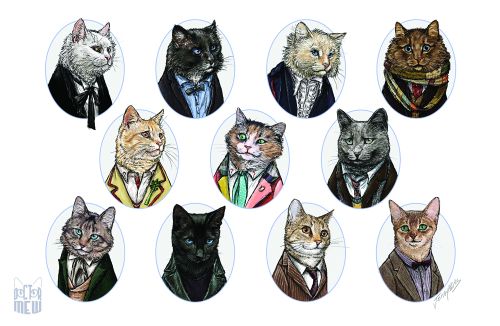
Pure internet linkbait, but with an execution this good, it deserves to be: Dr Who cats.

Previous Puzzle
Last time I asked for ways to visualise data in such a way that mix shifts affecting conversion rate would be readily apparent.

Adam naturally had a full consultant’s answer, explaining how he would show the data different ways depending on the audience (sales director, website content manager, SEO manager…), and how he might talk through the component parts of the change in a sequence of slides, which is all very sensible. However, what I really want is something that I as an analyst can look at to apprehend the whole situation, ideally in a generic way, so any given shift becomes clear.

Simon described an interesting single-view answer, but in preparing this post I realised I needed to confirm some of its details with him, so that will have to wait for a later edition of Things.

On to my answer… the data set was as follows:

[before mix shift | after mix shift]:

Banjo section visits [10,000 | 20,000] – lots more traffic
Banjo section sales [100 | 220]
Banjo section conversion [1.0% | 1.1%] – conversion increases!

Gun section visits [1,000 | 1,000] – same traffic as ever
Gun section sales [100 | 110]
Gun section conversion [10% | 11%] – conversion increases!

Overall conversion before:
(100 + 100) / (10,000 + 1,000) = 1.82%
Overall conversion after:
(220 + 110) / (20,000 + 1,000) = 1.57% – overall conversion has decreased!

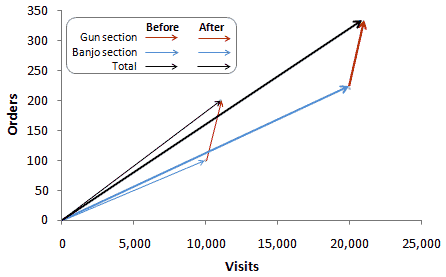
My solution looks like this:

This shows how the total visits and orders (black lines) are composed of the individual sections (red/gun and blue/banjo). While both the blue and red arrows get steeper (representing improved conversion, although it’s hard to see this on the red arrow), the angle of the black line decreases (representing the overall decrease in conversion), since the blue arrow became so much longer.

This pretty much works for the extreme example given. However, it has significant weaknesses as a general solution:

  • It doesn’t work as a trended view – conceivably it could be animated, but that seems like overkill
  • It’s hard to compare the angle of arrows when traffic changes significantly, as in the gun section above
  • It tends to encode all the interesting information into a narrow diagonal band of the chart.

Further improvements are of course welcome!

-Transmission Ends

Categories
Special

Things 58: Video Special

(Originally sent September 2009)

I’ve built up a backlog of interesting videos I think are worth sharing, so it’s time for a Video Special. Whenever someone links me to a video I always have two questions I want to know before committing to a click – how long is it, and do I need sound – so I include this information after each link. [In the blog version videos are embedded so you can see the run time; I’ll just note if you need sound – T.M. 7th August 2011]

Everything is amazing, nobody is happy
Standup Louis C. K. gets some great mileage out of how the incredible speed of technological change is still exceeded by the human capacity to adapt to and take for granted new concepts (sound is all you need):

Mad Skills
“A man who taught himself rock climbing and acrobatics to escape poverty in India” – most amazing climbing move features at 30s (no sound needed):

http://www.youtube.com/watch?v=BPN3gLVDsOY


The idea mill
Assuming I saw the same trigger video, this is the fastest turnaround from an individual’s creative work going viral to the same idea being used in an ad I’ve ever seen (sound optional for all of these):

9th April 2009: “Wolf vs Pig”, using a kind of meta-Stop Motion:

2nd July 2009, 84 days later: same concept used in an ad for the Olympus PEN:

A bit later (as it doesn’t seem to have been officially uploaded), the same thing again, this time for Land Rover:


Simplicity
I find this kind of video reassuring – a simple concept and attention to detail in the execution, rather than incredible extravagance, can still produce a really nice result (sound essential):

Teaser trailer
Christopher Nolan (Memento, Dark Knight) has a new film coming out next year. I think this is my favourite teaser trailer ever, for conveying just an atmosphere and a single fun idea (sound not essential but awesome):

Categories
New

Things 106: Best at Chess, Art of Science, Crowdfunding

Tim Link – Competitive Sandwich Making
Last week Clare and I ran a game based on tessellating pieces of cheese to make the best sandwich for the Hide&Seek Sandpit event. You can read about it and see the photos on my project blog, Tower of the Octopus.

Puzzle
In a chess tournament in which anyone can use any means available to them to come up with their moves, who would win? Some possible answers to give an idea of what kind of thing I’m talking about here:

  • A high-ranking chess Grandmaster
  • A really good chess-playing supercomputer
  • A huge team of moderately skilled players with some method of combining their ideas
  • A moderately skilled player with access to a moderately good computer that can run some basic chess calculations

(I had wondered about this in an abstract way before, but recently found out that has actually been done. I’ll relate what happened in that event next week, but you could of course try to Google as well as guess the answer if you wanted).

Video
(Via Phil): Art out of Science:
(Two views of the same thing. If your browser is up to it, you could try watching both videos simultaneously – start the bottom one 20s after the top):

Links
Kickstarter is one of my favourite things on the internet: people with an idea for something get a platform from which to shout about it, and to collect pre-orders or donations from people that like the idea. If there’s enough interest, the project can go ahead, and everybody wins.

So far I’ve helped fund two comics, the Wormworld Saga app (which saw so much success the creator, Daniel Lieske, decided he could give up his day job), and I’m currently backing The Endangered Alphabets Project, which is the kind of thing I like to imagine in a vague way is going on in the world, but I now have the opportunity to facilitate it directly (also, it’s only just on track to hit target, so do go check it out).

You can follow Kickstarter on Twitter, or go to their home page and scroll to the bottom to sign up for the weekly newsletter which highlights the most interesting projects.

IndieGoGo is similar but for reasons I can’t really pin down doesn’t work as well for me.

Crowdfunder is a UK version which I don’t tend to find as inspiring, but would probably be the best one for someone in the UK to create a project with (since Kickstarter requires a US bank account).

Quote
Overheard in the maths common room when I was studying for my PhD at Royal Holloway:

But nobody knows what probability is! Probability is defined in terms of randomness, and randomness is defined in terms of probability!

Answers to Monty Hall and the Two Envelopes
Last week I asked about the Monty Hall problem, which I should have introduced before the Two Envelopes problem I set two weeks ago.

The Monty Hall problem has a nice Wikipedia page, the most helpful part of which is probably the decision tree showing all possible outcomes.

In brief, the answer is that you should switch after Monty shows you an incorrect door, but certain misguided instincts steer most people away from that choice. The Endowment Effect and Loss Aversion mean that regardless of probability, people fear they would regret “giving up” their first choice more than sticking with it if they end up losing.

The more subtle effect is an instinctive (or partially trained?) feeling that the choices of others have no effect on the probabilities of our own choices in these kind of contexts. This is true when the other person has just as much information as you, but that is not the case here – Monty knows where the car is, and uses that information to ensure that he always opens a door with a goat behind it. So he has more information than you, and when you see his choice you gain some information.

Or to give an answer that might go with the grain of instinct for some people, consider this: there is a 2/3 chance that the car is behind one of the doors you don’t pick. Monty shows you that it definitely isn’t behind one of them. So there’s still a 2/3 chance the car is behind the other one, and a 1/3 chance it’s behind the one you first chose.

As for the Two Envelopes, it turns out this is more difficult than I originally remembered. Again, there’s a great Wikipedia page on the subject, which has quite a lot of detail.

As Thomas noted, a key phrase missing from the subtly specious argument for swapping is “Without Loss of Generality” (WLOG), which one must always be careful to check whenever substituting a variable (in this case, the amount in the envelope) with a specific figure (£10 in the example I gave).

Is it true that the reasoning I gave based on having £10 in the envelope truly retains the generality of the problem – would the reasoning also hold for any other amount? In short, no. For example, there could be 1p in the envelope, or any odd number of pence, in which case we would have to conclude that we had the lesser envelope (although this still means you should swap). More dramatically (here we imagine the envelopes contain cheques, and that these cheques are totally reliable), your envelope could theoretically contain over half of all the money in the world, in which case you can be sure the other envelope contains less. More realistically, it could contain more than 1/3 the amount of money you expect the person filling the envelopes to be willing to give away, in which case you would strongly suspect the other envelope to contain the lesser amount.

If you’re interested, do read the full Wikipedia article, and meanwhile, remember to watch out for unjustifiable WLOGs.