Categories
New

Things July 2015: Royalty Redistribution, Live Train Data, Future Cameras and Robot Art

Fairer Royalties, Better Music

I’m very interested in how the internet is changing the music industry. Some things are better (from some viewpoints): it’s cheaper to make music and distribute it; it’s easier to find and listen to a wider range of music. Some things might be worse, but it’s hard to tell: has the average amount of revenue made per song, or per minute of music, gone down? What about for the most popular 10 artists? What about for the median artist by income? Are there fewer full-time musicians, or more?

I’ve not seen good data on that, but this piece in The Economist is suggestive at least: the average age of festival headliners has gone up by 10 years over the past 20 years. But it’s not clear if that’s just because demand (for festivals) has gone up, and supply (of festival-pleasing artists) has risen more slowly, driven by older artists whose audiences now find festivals cater to their needs.

Over on PopJustice (which has my favourite cookie warning message), they suggest the move by Apple to streaming is the final nail in the coffin for not just paid downloads, but a thriving new music industry in general. If this seems hyperbolic, bear in mind that music buying doubtless follows a Pareto curve, and the small cohort that account for most of the music-buying have the strongest (short-term) incentive to switch to streaming.

With all this going on, it’s interesting to take a look at royalty distribution on streaming services. Superficially it seems simple and perfectly fair: they collect subscription fees and ad revenue, and then distribute them to artists based on how often their tracks have been played. This is how it works on Spotify.

But as this thoughtful article points out, that’s not necessarily the fairest. It would be fairer to directly distribute the revenue from a particular customer to the artists that customer listened to. That doesn’t sound like much of a change, but it really is, so I do recommend reading the article to see why. The author also argues that such a situation would be better for everyone, even the labels, and as such should be adopted. I’m less convinced by that. It’s true ‘on average’, but I suspect the current system benefits the bigger labels more, and they have a lot more of the power.

On the plus side, with Apple and Google (and others) getting into the game, perhaps this might emerge as a competitive strategy from one of them…


Dan Deacon: WIWDD

On the subject of new music, well, Dan Deacon is one of my favourite musicians, and it seems Adult Swim had a bunch of animators contribute segments to go with the track “When I Was Done Dying” from his most recent album, and all of those animators seem to have put in about twice as much effort as I was expecting, with this mind-boggling result:


Noticing Racism

For an eye-opening insight into what one might term ‘soft’ racism, I highly recommend reading this sermon followed by these excerpts on prosopagnosia. Primed by the first article, the last couple of paragraphs of the second hit pretty hard.


Real Time Trains

(via @PlanetTimmy)

I found it absurd that I could be on a train with internet access and yet be unable to find out when that train was expected to arrive at the various stops along the way. Evidently I wasn’t looking hard enough, because it turns out this brilliant website has that covered: RealTimeTrains.co.uk

There’s also a wonderful site with much more precise data than most people would know what to do with regarding the exact positions and statuses of trains at various key junctions. Each day a random map is free, and it’s £10 for a full year subscription. I haven’t done that yet but it’s very tempting. Check it out!

Of course, once you have this data, you want to make more efficient use of it. For instance, it’s possible with many clicks around RealTimeTrains to figure out if you can make a more efficient connection by boarding a delayed train that was originally supposed to depart before you arrived. So the next thing I need is a service that will tell me not just the best route, but the best route based on where trains are right now.


3D Maps of London Underground Stations

If, like me, you ever wanted to see maps of all the underground stations (specifically the 120 that are actually underground), Ian Mansfield has cleaned them all up and presented them nicely here.


Here Comes The Future

Finally a couple of things that gave me a bit of ‘future shock’.

This (proof-of-concept) camera is powered by the light that its sensor receives. Which, given the similarity between a digital camera’s sensor and a solar panel, actually makes sense. So cameras don’t need batteries. Wow.

Secondly, neural networks can make art. Okay, there is a human operating the controls and deliberately manipulating things to make cool-looking stuff, but maybe later a neural network can figure out what ‘cool-looking’ means better than us, and start producing all kinds of cool stuff. Okay, that bit’s probably a lot further away, but this does make me lose a bit of confidence in the belief that artist’s jobs are robot-proof. Nobody’s job is safe from the robots. The robots are coming. We have been warned.

Transmission abruptly ends

Categories
New

Things June 2015: Trolley problems, Crystal Maze, Car Review

Lesser known Trolley problems

Trolley problems are thought experiments in ethics in which one typically evaluates who one might sacrifice to save someone else, as well as whether inaction involves less culpability than action. They quite neatly distil certain ethical problems, but are also so extreme and implausible that it feels slightly uncomfortable to draw general conclusions from them.

I recall an interesting debate on the radio in which someone was proposing measures to protect endangered wild tigers (at some cost to some group of humans; I don’t remember exactly what), and she was given the following challenge: if you had a gun, and one of these endangered tigers was about to attack and kill a man, would you shoot the animal? “I don’t think that’s a very useful question,” she responded, “for example, what if that man had killed your daughter. Would you still choose to shoot the tiger then?” to which they responded: “Well that’s just silly.”

Anyway, here’s a nice collection of examples along those lines: Lesser known Trolley problems variations. For example:

There’s an out of control trolley speeding towards four workers. Three of them are cannibalistic serial killers. One of them is a brilliant cancer researcher. You have the ability to pull a lever and change the trolley’s path so it hits just one person. She is a brilliant cannibalistic serial killing cancer researcher who only kills lesser cancer researchers. 14% of these researchers are Nazi-sympathizers, and 25% don’t use turning signals when they drive. Speaking of which, in this world, Hitler is still alive, but he’s dying of cancer.


Stop YouTube Autoplay

Most internet companies make money from advertising, and therefore (only slightly indirectly) from your attention. As a result, once they have your attention, they are desperate to keep it. That’s why you’ll see other articles heavily pushed at you when you finish reading one (or even when you’ve just started reading one, as that’s when most people will bail), why Spotify will do anything with its UI to trick you into listening to a never-ending stream of music rather than just what you chose, and why, most recently, YouTube has started automatically forwarding you from the end of your chosen video to the start of one that it has algorithmically guessed you might like (or are perhaps least likely to stop).

YouTube’s algorithm is pretty good, so this is a little bit like being provided with a bottomless bowl of nachos that’s difficult to stop eating from. In order to take the bowl away, you have to switch off the little switch at the top of the recommended videos list on the right, like so.


Review of a petrol car

I enjoy reviews in which Status quo bias is revealed by reviewing something with that bias reversed (I mentioned a couple in Things 130). In particular, we tend to take the disadvantages of existing technology for granted, so when a new technology has different disadvantages it can seem much worse. Here, Tesla Club Sweden review a petrol car.

One could hear the engine’s sound and the car’s whole body vibrated as if something was broken, but the seller assured us that everything was as it should. The car actually has an electric motor and a microscopically small battery, but they are only used to start the petrol engine – the electric motor does not drive the wheels. The petrol engine then uses a tank full of gasoline, a fossil liquid, to propel the car by exploding small drops of it. It is apparently the small explosions that you hear and feel when the engine is running.

Origin of the Crystal Maze

A lovely look back at how the Crystal Maze came about, and the logistics of filming the show.

We were going back and forth to Paris and one day they drove us to an industrial part of Paris and opened a warehouse door and there was a crystal dome. We said, “What are you doing with that?” They said, “We don’t don’t know, we just built it, but we don’t know what to do with it.” We said, “We’ll have that!”

GIF of the month

Helps if you’ve seen Pacific Rim, but not essential.

– Transmission ends

Categories
New

Things 128: No spoilers, Beethoven played correctly, automation vs humans

Puzzle – Do Spoilers Matter?
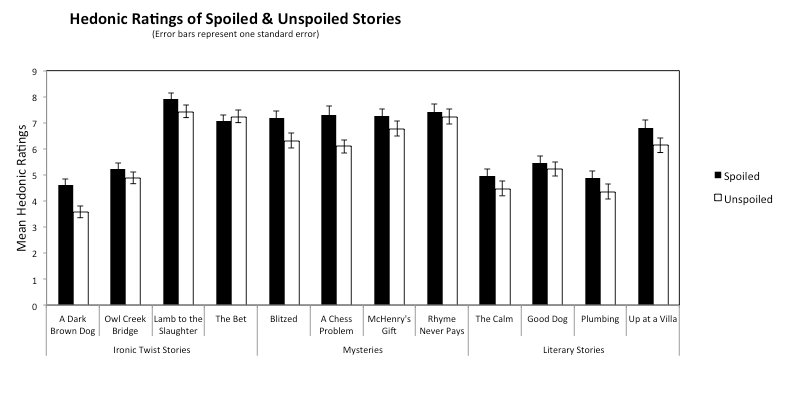
Research looking into the enjoyment of short stories found that reading a ‘spoiler’ beforehand tended to increase enjoyment. That seems quite possible, but the strangest part is that it holds even for mystery or ironic-twist stories. They even have a chart with error bars, which looks pretty compelling (click for big):

So, you’ll generally enjoy all stories you read (or presumably consume in any medium) more if you read about the ending first.

The question, then: how can you justify not doing this?

Video – Omlette
Here’s a really lovely short (2’30”) animation about a dog and an omlette. If you’re having a hard day, I particularly recommend it.

Audio – Beethoven wants you to play faster
When Beethoven eventually got his hands on a metronome, he marked up symphonies with tempos that nobody can quite believe he really meant, and which are pretty much entirely disregarded. This excellent Radiolab podcast investigates. (The forced conversational ‘style’ gets a little irritating, but the demonstration at the end is fantastic).

Links – Race Against The Machine
Our old friend the Invisible Hand guides us to make work more efficient with technology: robots replace humans on production lines, computer work becomes automated, cars and vacuum cleaners operate themselves, and productivity increases. Brilliant.

From the Luddites on, people have been fighting this change to defend their old jobs, but with hindsight we can say they were mistaken, as prosperity has increased, every time, and will continue to do so.

Or will it?!

Despite the apparent historic benefits, it’s still hard to imagine this trend continuing indefinitely and remaining benevolent.

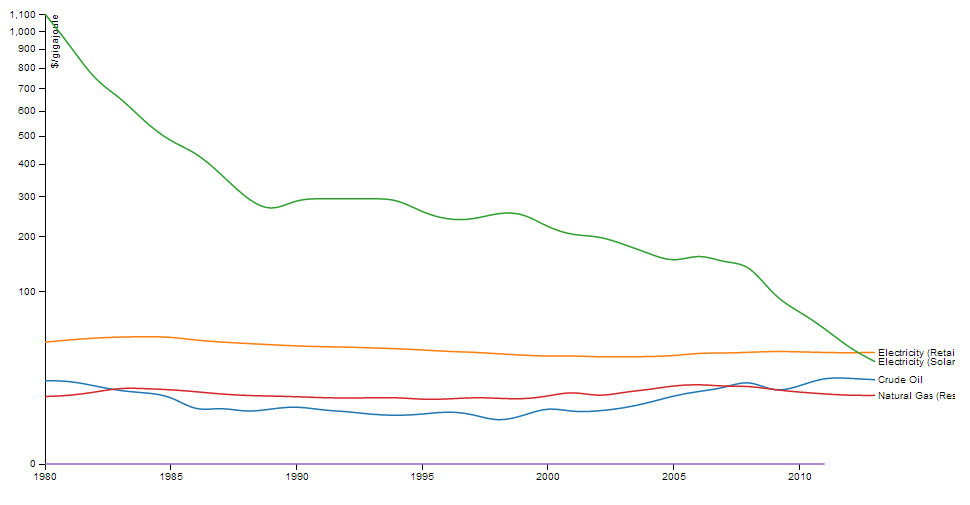
Now, one can imagine some sort of desirable end point, in which (say) solar power becomes incredibly cheap:

… and robots / algorithms are able to do everything humans don’t want to do, and everything is wonderful and everyone is happy.

Of course, quite how you would run such a society isn’t entirely clear, and as Voltaire points out, work isn’t only about earning money:

Work spares us from three evils: boredom, vice, and need

But of more concern right now is how we organise society as we transition towards that end-point. In particular, it seems reasonable to suggest that automation of jobs will tend to increase inequality, as (in a simplistic model), the few that own the robots / server farms reap all the rewards of that automated labour while everyone else loses their jobs.

In case you need reminding, inequality is bad for almost everyone. By the way, a concise point on this topic made by Nick Hanauer in 2011:

If the average American family still got the same share of income they earned in 1980, they would have an astounding $13,000 more in their pockets a year. It’s worth pausing to consider what our economy would be like today if middle-class consumers had that additional income to spend.

Here’s a fun sequence of slides putting the current economic situation (in the US) in 50 years of context (brought together by Business Insider):

Corporate profits as a % of GDP at all time high:

% of Americans with jobs is significantly down:

(Something interesting is happening here, because the more common measure of “unemployment rate” doesn’t look as bad)

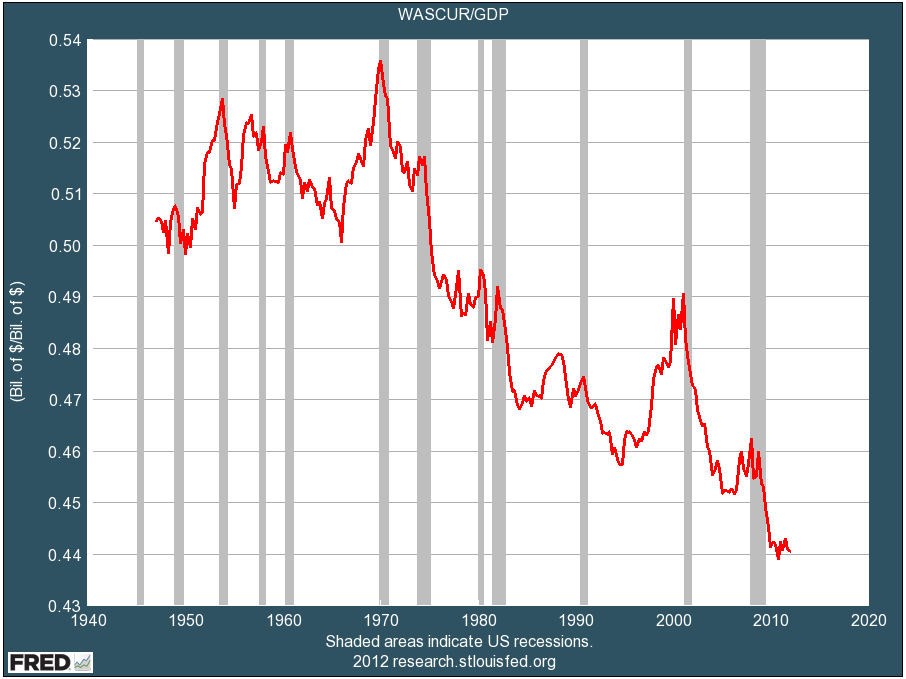
Wages as a % of GDP at an all-time low:

(Side-note: these were extracted from a longer chart-based argument to do with wages and debt, which is quite interesting but somewhat disingenuously suggests that just “looking at the data” is some non-political process that can reveal answers, and doesn’t consider the fact that over the same time period the % of retired persons in the US increased from 8% to 13% and could reach 20% in the next 30 years. Still worth a look, though.)

Now, there are many other drivers of inequality (including the feedback loop of lobbying, which The Onion satirises perfectly), and while automation may not have been the biggest contributor so far, it’s worrying that we’re not in a good position just as automation is starting to look like a credible threat to prosperity.

There’s a book on this which characterises the problem in its title: “Race Against the Machine“. I haven’t read it, but apparently the authors make an interesting case and then fail to offer any realistic solutions. The absence of solutions and the seemingly inevitable progress along this line is why I consider this one of the major problems we need to solve (after climate change).

Finally, a really important sci-fi story on this topic: Manna by Marshall Brain, which demonstrates a method by which automation can creep into jobs without replacing them entirely, but the consequences are just as dire. Chapter 1 gives you the gist, but it’s worth continuing to see how he plays out the trend. (At the end he appears to suggest a solution, and unfortunately it appears to be much less realistic than the problem).

-Transmission finally ends

Categories
New

Things 124: Puzzles & Polaroids, Bond is now Bourne, Cooking Tips

OctopusFruitbat Game Write-upPuzzles & Polaroids at the British Museum
Clare and I were asked by Stubble & Glasses (who I also happen to work for) to design and run a company game event in a professional capacity, because some of them had enjoyed some of our earlier game events. So we formed a company called OctopusFruitbat, came up with something that combined puzzle-solving with creative instant-photo-taking, and it went a bit like this. If you’re ever looking for someone to come up with a similar event, of if you want advice on doing something yourself, please do get in touch!

Also don’t forget, this Friday I’ll be running Competitive Sandwich Making (which last year went like this) as part of the amazing all-weekend festival of gaming that is Hide&Seek’s Weekender at the Southbank Centre.

Quote
I’ve been nurturing the idea that films that follow the “They Made Him, Then Tried To Kill Him, Now He Must Fight Them” storyline are rising to such prominence that it must be some kind of Hero’s Journey for the modern age (I’m thinking Bourne, Hitman, Grosse Pointe Blank, Kill Bill, Blade, Ultraviolet…). The closest I could find on TV Tropes was Contract on the Hitman, which doesn’t quite nail it.

On metafilter, wuwei draws it out more explicitly by contrasting James Bond with Jason Bourne:

Who is our generation’s James Bond? Jason Bourne. He can’t trust his employer, who demanded ultimate loyalty and gave nothing in return. […] Bourne survives as a result of his high priced, specialized education. He can do things few people can do […] and like the modern, (sub)urban professional, Bourne had to mortgage his entire future to get that education. They took everything he had, and promised that if he gave himself up to the System, in return the System would take care of him. It turned out to be a lie.

(You can read the post in full here).

Is there any evidence that there really has been such a transition, that corporations are now violating the social contract in some way that they weren’t before? The three charts in this article do seem to actually endorse this idea – Corporate Profits Just Hit An All-Time High, Wages Just Hit An All-Time Low.

Pictures
Here are some pictures with captions that have some amazing food-preparation tips, for example:

Previous PuzzleThe Shrinking Empires
Last time I asked why Empires seemed to be getting geographically smaller. I’ve actually asked this question when interviewing analysts, and get two kinds of answers.

The most common answer is that population density is increasing, and apparently human political power tends to stabilise around the 10m-50m range. For example, the Roman Empire was pretty big, but probably only covered ~60 million or so people, ten times fewer than those living in the same geographical area today (according to Citation Needed, but hey, it sounds about right).

A more interesting idea is that it has something to do with technology and inequality. I once heard it said that technology is not politically neutral – for example, Nuclear Power requires greater centralisation of government power than, say Wind Power – and I find this an appealing idea. Perhaps, for example, improved forms of communication give greater power to the people, who are then better able to resist tyrants with aspirations of empire-building through war.

But the more I dig into this, the more it starts to look like post-rationalisation, because I can imagine giving examples to prove the opposite. If everyone can manufacture guns cheaply, is it easier to terrify your populace with asymmetric power you can give your enforcers, or is “a well armed population the best defense against dictatorship”? If you improve transport, is it easier to avoid conscription, or easier to wage war? If you combine Moore’s law with the internet to create continuous public surveillance, do you end up creating a single global culture with no crime, or do you permanently enforce the power structures that exist at the point of implementation? Well, that’s a question for another day.

PuzzleGoogle Correlations
Google Correlate lets you find closely correlating Google search term trends, which sometimes gives silly results by coincidence, and sometimes reveals something very interesting. The question is, how many of these correlations can you explain?