Upcoming Event, Thursday August 4th
People that like Things are very likely to like this. On Thursday August 4th from 7pm-10pm, Hide & Seek are running a Sandpit gaming event at the Southbank Centre. In practice this means you get to turn up and play lots of interesting games (for adults) for free. Having been to quite a few of these in the past, I highly recommend it as the games are always fascinating and inspiring. I’m particularly excited about this one because Clare and I will be running a game ourselves, one based on the age-old problem of tessellating pieces of cheese to make a perfect sandwich.
More details of the event can be found here, and the official Facebook event is here. Let me know if you think you can make it!
Puzzle – Monty Hall
After talking to some people about last week’s Two Envelopes puzzle, I realised that many Things readers may not be familiar with the Monty Hall Problem, which one should really understand before tackling the Two Envelopes. So I’ll state that here, then go through the answers to both in the following Things.
In the Monty Hall problem, you are in a gameshow presented by the eponymous Monty. You are asked to choose one of three closed doors. Behind one of the doors is a nice car that you apparently want to win. Behind the other two doors are goats. If you choose the door with the car behind it, you win the car. If you choose a door with a goat behind it, I don’t think you win a goat, but you definitely don’t win the car. Basically the goats are there just for comedic effect.
So you choose a door, pretty much at random. At this point Monty (who knows where the car is) opens one of the remaining two doors to reveal a goat. He does this in every episode of the show – whichever door the contestant chooses, Monty will always then open one of the remaining doors to reveal a goat. He then offers you the chance to switch from your first choice to the other unopened door. The question is: should you switch?
Quote
From Jon Stewart’s speech at the “Rally to Restore Santiy”:
The press can hold its magnifying up to our problems bringing them into focus, illuminating issues heretofore unseen or they can use that magnifying glass to light ants on fire and then perhaps host a week of shows on the sudden, unexpected dangerous flaming ant epidemic.
Picture
This National Geographic healthcare data visualisation achieves a rare feat: showing the data in an unconventional way that nonetheless actually tells a story with the data quite well. Charlie Park has some great commentary on why a scatter plot of this data isn’t actually as useful in his general discussion of slopegraphs.
Video
The effect of music on the brain is a very interesting thing that varies tremendously by individual. Last year I discovered a track that has an incredibly powerful mood-altering effect on me: Olympians, by a band with a potentially offensive name. It took a couple of initial slightly bemused listens before it properly seeped into my brain, but now as soon as I hear this track, I feel unbelievably positive, and become filled with an absurd confidence.
Unfortunately I suspect the fact that this track is so resonant for me also suggests that it’s very specific, and it will seem really quite boring to most others. But I find it so amazing I just have to share it anyway. So first, here’s a short version with a video to slightly entertain you while you wonder what on earth I’m going on about:
And if you are so inclined, here’s the full length version:
Tim Link
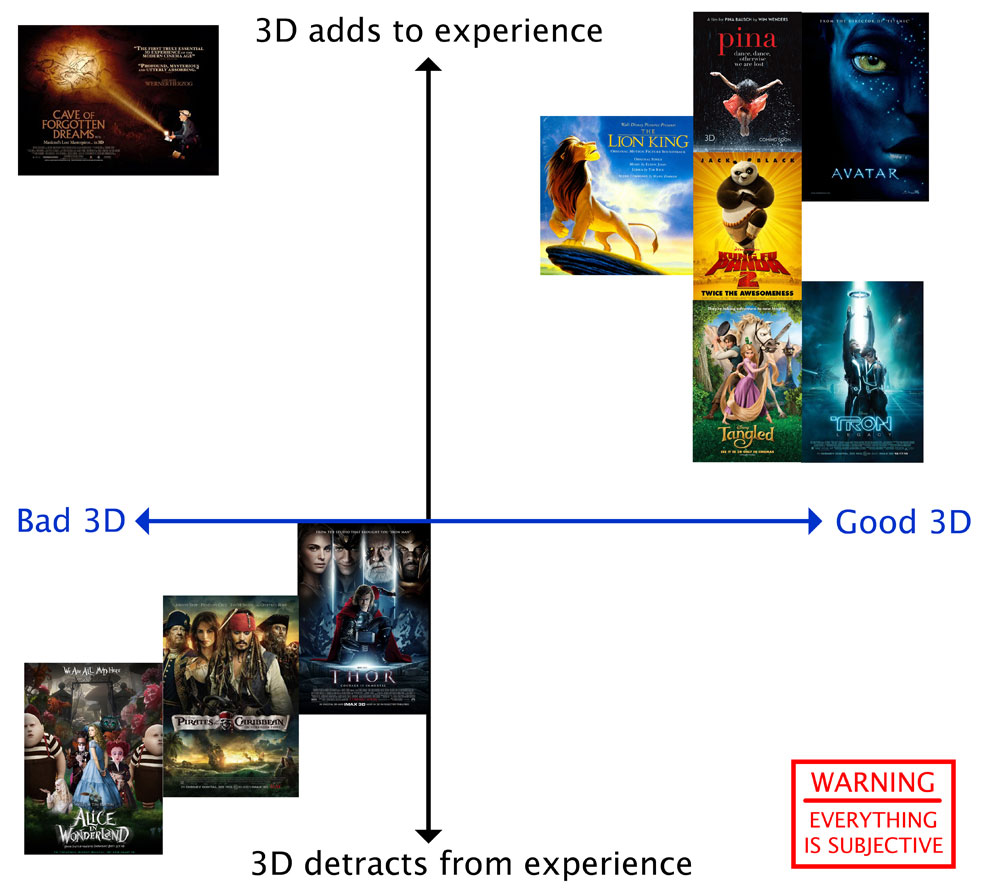
I saw The Lion King in 3D at Edinburgh International Film Festival, and reviewed it here. The short version of my review would essentially be this:
Quote special: Misleading Impressions
Thanks to Last.fm recommendations I discovered Brian Transeau (BT)’s album This Binary Universe, which turns out to be a bit different to his other albums. As I listened to his back-catalogue I thought I detected an incredible sense of optimisim and positivity. When I later found Brian Transeau was on Twitter, I found this impression was entirely correct. Sample tweet:
5am and time for our first ever sunrise, father daughter bike ride. Today is already #WIN Good Morning!
My favourite musician is probably Jon Hopkins who I now listen to instead of any other Chill Out music since for me he somehow trumps pretty much the entire genre. He is behind some of the most relaxing and beautiful tracks I know, so I was curious to see what he was like on Twitter. The answer: actually a bit different. Brilliantly, this was the first Tweet of his that I read:
I wish one of James May’s Big Ideas was to FUCK OFF
Finally, moving away from music, I referenced Mitch Hedberg’s famous escalator line in my Lion King 3D review:
An escalator can never break – it can only become stairs.
Realising I was unfamiliar with his work, I ended up reading through his Wikiquote page, and found much to like, such as:
My belt holds up my pants and my pants have belt loops that hold up the belt. What the fuck’s really goin on down there? Who is the real hero?
and:
When you go to a restaurant on the weekends and it’s busy they start a waiting list. They start calling out names, they say “Dufresne, party of two. Dufresne, party of two.” And if no one answers they’ll say their name again. “Dufresne, party of two, Dufresne, party of two.” But then if no one answers they’ll just go right on to the next name. “Bush, party of three.” Yeah, what happened to the Dufresnes? No one seems to give a shit. Who can eat at a time like this? People are missing! You fuckers are selfish. The Dufresnes are in someone’s trunk right now, with duct tape over their mouths. And they’re hungry. That’s a double whammy. Bush, search party of three, you can eat when you find the Dufresnes.
So after that I naturally looked him up on YouTube, and at that point discovered him to be completely different to what I had imagined:
http://www.youtube.com/watch?v=2491LucLa1g
Gone, try this one:
Picture
A lot of infographics annoy me, but I like the idea of bringing together the data that drives this one so much I don’t mind its shortcomings.
Puzzle – The Two Envelopes
I can’t believe I haven’t put this one in Things before.
In a standard abstract setting with no distracting details, you and another person are presented with two envelopes. One envelope contains some money (but you don’t know how much). The other envelope contains twice as much money. You get to select an envelope, and you get to keep however much money is in it. The other person gets the other envelope. There isn’t anything to go on, so you choose one of the envelopes for arbitrary reasons.
Before you get to open it, you are offered the chance to change your mind, with the following reasoning:
You don’t know how much money is in your chosen envelope, but for the sake of argument let’s say it’s £10. That means you either have the envelope with twice as much money (so the other contains £5) or you don’t (so the other must contain £20). So if you decide to swap, there’s a 50% chance you get that £5, and a 50% chance you end up with the £20. Since you currently have £10, that means there’s a 50% chance of effectively losing £5 and a 50% chance of gaining another £10. Imagine if the universe split into two at the moment you made that decision – one of you loses £5, the other gains £10, so on average you gain (£10 + (-£5) )/2 = £2.50. Since the average gain is positive, clearly that’s a gamble worth taking, and you should definitely swap.
This is of course a strange conclusion. You effectively chose an envelope at random, so how does swapping it improve your odds of getting more money? The paradox is even more stark if we consider the fact that the other person could be convinced to swap by exactly the same argument.
Previous Puzzle – Co-operating with yourself
Last time I asked how well you would get on with yourself.
Xuan said:
They say that people you dislike/hate are likely to be people who’s characteristics are most like yours. People are most critical of what they see in the mirror. My clone better not have the same taste in clothes.
Which reminded me of a problem the sci-fi stories don’t tend to go into – if there’s suddenly two of you, you’re going to need some more clothes, and one of you will probably have to find another job, and probably somewhere else to live. Marriages get complicated. Phil suggested David Gerrold’s time-travel sci fi story The Man Who Folded Himself for an in-depth dissection of this kind of problem.
Richard observed that he tends to like people with whom he shares attractive personality traits, and dislike those that share his negative personality traits, suggesting that the latter may be because they serve as a reminder of these aspects of himself. This potentially makes the question even harder to answer, although one might guess that a negative would trump a positive and ultimately lead to the kind of confrontations that usually crop up in sci-fi versions of this problem (and endorsing Xuan’s observation).
I think the question raised by The Man Who Folded Himself of co-operating with a version of yourself in the future is a clue to how we can actually ask this question of ourselves. In a very real sense, we really do choose how much to co-operate with our future selves every day: will you do a chore now, or will you force your future self to do it instead? Will you eat all of the cake, or will you save some for your future self? If you know how you generally answer those questions, I suggest this gives you an idea of how well you would get on with yourself.
In practical terms, just thinking of these kinds of questions in this framework makes me more likely to co-operate with my future self, which is probably a good thing. Well, I’m glad that my past self thinks that way, anyway.
Video
I just got back from Edinburgh International Film Festival, which had some problems this year, but as an individual punter I nonetheless carved myself out an even better time than last year, thanks mainly to Clare’s choices from the programme and also to Twitter for alerting me to a few late-announced events. A full write up will naturall follow, but for now, I will simply recommend this, which will apparently see some sort of UK release in early September:
http://www.youtube.com/watch?v=TLEo7H9tqSM
Link
I suspect we will start to see more and more of this kind of thing: algorithms written to handle clever tasks in a not-perfectly-clever way, interacting with one another in ways their creators did not forsee since they did not anticipate the other algorithms theirs would be interacting with, to produce bizarre results like this Amazon marketplace book being listed for $23m. Hilarious and terrifying at the same time.
Question
A bunch of sci-fi stories (most recently some Dr Who episodes) confront us with the question: if you encountered an exact copy of yourself, how well would you get on? Very often in these scenarios, the duplicates end up fighting one another. Does that seem realistic for most people? For you? (I have a slightly tangential self-test for this one)
Pictures
For those of us that live in the UK, it’s hard to imagine that for some people London apparently has the same kind of Destination Appeal as New York, Paris or Tokyo. These pictures of London from above help me to start to see their point of view.
This Week’s Puzzle
I have a Tumblr on which I post daily things to draw, called Now Draw This. I really want to make sure I credit the relevant artist when I post a piece of artwork. (I should do that with the photos too, but for various reasons that’s not as important to me).
TinEye is an awesome reverse image search engine, which in the past has helped me track down artwork even when the version I had turned out to have had the colour palette significantly edited. Pretty clever.
The problem is, this site posted the above image (of Ico and Yorda from the game Ico), and neither TinEye nor wily Googling is helping me track down the original artist.
Can you find out who created the above image originally?
Video
Technology expands the range of things we can do. As a society we try to keep up by generating some kind of idea of what we should do. For example, mobile phones enabled us to use ostentatious ringtones. For a while they were everywhere. Now, it seems we’ve collectively decided that’s not such a good idea.
So here’s something I hadn’t even considered: what if you could collect some kind of real-time usually-invisible data about yourself, and then manifest it with a clear physical signal? Would that ever be a good idea?
http://www.youtube.com/watch?v=w06zvM2x_lw
Link
Michael Lewis writes long articles on complex but important topics, that are nonetheless incredibly engaging, thus creating pretty much optimal long-form journalistic pieces. I highly recommend that you make time for his article Beware of Greeks Bearing Bonds (which I thought I’d linked to before but can’t find in my records), and if you like that then you should also read When Irish Eyes Are Crying.
If you look at a lot of the digital creatures in Harry Potter, you couldn’t go home and sketch them – you’d need a draughtsman’s degree. […] The charm is to go home and feel that it’s possible to figure out how they did it. When I was a kid, I’d go and see Ghostbusters and spend the next day trying to draw the Stay Puft Marshmallow Man, or trying to get the logo right. They had a graphic simplicity that was much more infectious and warm and authored than a lot of the stuff now.”
I had the same childhood experience, and I think it’s a really fun rubric. Attack the Block‘s creature design succeeded in exactly that way.
Last Week’s Puzzle Last week I asked what the purpose was of this insect-eye mirror I saw on the ceiling in a bank in Vienna, but nobody hazarded a guess.
You can tell from the shadow that there’s a bright spotlight pointed at the mirror, so my hypothesis was that it was some kind of way to generate a bright, ambient light throughout the room. But it seems like overkill / overdesign if that’s the goal. And why would you want to have a diffuse, shadowless light that badly anyway? I like to imagine, completely baselessly, that there’s a local superstition about some kind of money-stealing creature that inhabits shadows. But if you can think of something more plausible, do let me know.