Categories
New

Things 102: Bionic Cat Ears, Brilliant Journalism, Drawable Monsters

This Week’s Puzzle
I have a Tumblr on which I post daily things to draw, called Now Draw This. I really want to make sure I credit the relevant artist when I post a piece of artwork. (I should do that with the photos too, but for various reasons that’s not as important to me).

TinEye is an awesome reverse image search engine, which in the past has helped me track down artwork even when the version I had turned out to have had the colour palette significantly edited. Pretty clever.

The problem is, this site posted the above image (of Ico and Yorda from the game Ico), and neither TinEye nor wily Googling is helping me track down the original artist.

Can you find out who created the above image originally?

Video
Technology expands the range of things we can do. As a society we try to keep up by generating some kind of idea of what we should do. For example, mobile phones enabled us to use ostentatious ringtones. For a while they were everywhere. Now, it seems we’ve collectively decided that’s not such a good idea.

So here’s something I hadn’t even considered: what if you could collect some kind of real-time usually-invisible data about yourself, and then manifest it with a clear physical signal? Would that ever be a good idea?

http://www.youtube.com/watch?v=w06zvM2x_lw

Link
Michael Lewis writes long articles on complex but important topics, that are nonetheless incredibly engaging, thus creating pretty much optimal long-form journalistic pieces. I highly recommend that you make time for his article Beware of Greeks Bearing Bonds (which I thought I’d linked to before but can’t find in my records), and if you like that then you should also read When Irish Eyes Are Crying.

Quote
Joe Cornish, director of Attack the Block, interviewed by Little White Lies:

If you look at a lot of the digital creatures in Harry Potter, you couldn’t go home and sketch them – you’d need a draughtsman’s degree. […] The charm is to go home and feel that it’s possible to figure out how they did it. When I was a kid, I’d go and see Ghostbusters and spend the next day trying to draw the Stay Puft Marshmallow Man, or trying to get the logo right. They had a graphic simplicity that was much more infectious and warm and authored than a lot of the stuff now.”

I had the same childhood experience, and I think it’s a really fun rubric. Attack the Block‘s creature design succeeded in exactly that way.

Last Week’s Puzzle
Last week I asked what the purpose was of this insect-eye mirror I saw on the ceiling in a bank in Vienna, but nobody hazarded a guess.

You can tell from the shadow that there’s a bright spotlight pointed at the mirror, so my hypothesis was that it was some kind of way to generate a bright, ambient light throughout the room. But it seems like overkill / overdesign if that’s the goal. And why would you want to have a diffuse, shadowless light that badly anyway? I like to imagine, completely baselessly, that there’s a local superstition about some kind of money-stealing creature that inhabits shadows. But if you can think of something more plausible, do let me know.

Categories
New

Things 101: Mystery Mirror, Cutaway Lens, Scientific Method Madness

Puzzle
I saw this strange insect-eye mirror on the ceiling inside a bank in Vienna. What is its purpose?

Quote
This puts into words something I’ve been feeling strongly over the past few years:

“Excellence is an art won by training and habituation. We do not act rightly because we have virtue or excellence, but we rather have those because we have acted rightly. We are what we repeatedly do. Excellence, then, is not an act but a habit.” – Aristotle

Link
Lifehacker brings together different pieces of research to look at the Cognitive Cost of Doing Things. For me the most important one is Activation Energy (emphasis mine):

[S]tarting an activity seems to take a larger [amount] of willpower and other resources than keeping going with it. Required activation energy can be adjusted over time – making something into a routine lowers the activation energy to do it. Things like having poorly defined next steps increases activation energy required to get started.

The idea in the Aristotelian quote above is the reason I’ve built routines around all the things I want to do; the above sounds like the reason it’s been working.

Picture
Physical cutaway of a Leica lens, one of a few different angles you can see here.

Last Week’s Puzzle
Last week I linked to a New Yorker article that implicitly asked “What is Going Wrong with the Scientific Method?”

The article brings together an interesting collection of anecdotes, observations and studies that suggest in different ways that across many fields, after an effect is observed (e.g. effectiveness of a drug to treat a disease, ability of an individual to telepathically identify Zener cards) subsequent measurements of the same thing will see progressively weaker versions of that effect. This seems to undermine the scientific method, which uses replicability to sort chance results from real ones.

Unfortunately, the article is constructed in a way that tends to disguise how the different pieces of the puzzle relate to one another. I think the apparent effect can be adequately explained by the following:

1) Regression to the Mean
The article mentions this key idea relatively late on, but this is an essential background problem that many of the anecdotes have to be considered against. Cut straight to the ‘conceptual background’ section in the Wikipedia article to understand how this will tend to arise. (Note that this also tends to explain the Sports Illustrated Cover Jinx).

2) Bad Luck
The main thread of the article follows Jonathan Schooler’s experience of the “decline effect”. The poor fellow saw his most interesting result seem to decay away with subsequent replication attempts; he later tried measuring some more fanciful things specifically to see if those would also show effects that seemed to weaken over time, and sure enough, they did. He could put the first instance down to some kind of Regression to the Mean, but to have this happen repeatedly seemed all too unlikely.

He doesn’t really help his case by testing for paranormal effects, but in any case with hundreds of thousands of scientists testing different things all over the world, statistically, someone will end up seeing a lot of Regressions to the Mean.

3) Intentional and Unintentional Cheating or Bias
In the article, a telepathy experiment from the 30s is cited in which one undergraduate defied chance to make a series of seemingly miraculous correct guesses of Zener cards. Just as the experimenter was about to write papers on the result, the student “lost” this ability. It’s very hard to take such a result seriously, as it seems far more likely the undergraduate had found some way of cheating, which he chose to stop using as soon as he saw how high the stakes were going to get.

More importantly for conventional research, the paper “Why Most Published Research Findings Are False” highlights the kind of systematic effects that will unfortunately tend to produce a misleading overall impression if one considers the evidence for an effect purely based on published results. The New Yorker article mentions this paper by name and covers some of the observations, but it’s well worth a detailed read.

4) Placebo Effects in medicine
Even taken together, the above three ideas don’t seem to refute the large-scale “decline effects” the article mentions being observed in the field of medicine. I would suggest this is due to something else: problems with the placebo effect.

Richard recalled an article from New Scientist (which I can’t find online) that pointed to a general problem with double-blind drug studies: active drugs will often have side-effects, and placebos won’t. Patients in such a study that experience side effects are likely to assume they have been given the real drug and not the placebo, and will therefore enjoy a stronger placebo effect, so confounding the ability of any medical study to be truly double-blind.

Even more disastrously, as this Wired article notes, the placebo effect seems to be getting stronger over time, presumably because it relates to social perception of drug efficacy. This is exactly the kind of thing that would drive an apparent decline in effectiveness of many different drugs over time.

In Conclusion
The Scientific Method is fine. We just need to remember a few things about statistics. This XKCD should help somewhat.

Categories
New

Things 100: Spaceship Earth, Fake Hacking, List, Scientific Method, Owlbears

It’s Things 100. Time for some particularly epic Things.

Video
I remember reading (in Critical Path, lent to me by John) that Buckminster-Fuller felt it was very difficult to watch a sunset or sunrise and intuitively apprehend that what you see is due to the earth turning – but that if we could succeed at doing so, we would come to better appreciate our place in the universe, and perhaps make wiser long-term decisions.

Even though I’ve seen plenty of night-sky time-lapse before, for some reason this video is the first I’ve seen that really gives me that feeling:

The Mountain from TSO Photography on Vimeo.

Link
A while ago I thought it would be neat to make a program that took as input random keyboard mashing and produced as output  the appearance that you were doing some movie-style hacking, complete with big secret-service logos and password fields that flash up “ACCESS DENIED”, “ACCESS DENIED” and then “ACCESS GRANTED”, and obviously lines and lines of clever-looking code, but I didn’t have the know-how to make it happen.

Fortunately, the internet provides – it doesn’t do the whole window thing I imagined, but you do get to mash the keyboard while apparently producing reams of commented hacking-type code (none of which I understand). If you want a version that also makes bleeping noises for no reason, just like in the movies, you can use this one instead.

Tim Link
I blogged my responses to the first 10 questions in the “30 Days of Video Games Meme”. Probably worth reading if you’re interested in games, or in gamers, or the formative life experiences of me.

Quote kind of thing
Diving back into my own archive, I was quite pleased with this list of self-referential things I collected and created on my old Geocities self-referential page:

Imagine a world with no hypothetical situations.
This sentence has cabbage six words
There are no redundant redundant words in this sentence.
This statement is false
This statement is not provable by me. (Useful illustration of Godel’s incompleteness theorem)
The smallest number that cannot be stated in fewer than 22 syllables
Consider the set of all sets that have not yet been considered.
Mispeltt
Ptyo
Repetition
sdrawkcaB
The ‘pre’ in prefix
Quinquesyllabic
Self-referential
Word
Ineffable
Recherche
Sesquipedalian
Non-phonetic
Illiterate illiteration
“All clichés should be avoided like the plague” (attributed to Arthur Christiansen, found in “The Joy of Clichés” by Nigel Rees)
This is not the last example on the list.
Inelegantness
Pseudo-Greek
Aibohphobia (credited to Imre Leader, although the Wikipedia cites the Wizard of Id)
Grammar message in Microsoft Word: “This may not be a complete sentence”
TLA
Abbr.
This sentence contains three a’s, three c’s, two d’s, twenty seven e’s, four f’s, two g’s, ten h’s, eight i’s, thirteen n’s, six o’s, ten r’s, twenty fives’s, twenty three t’s, three u’s, three v’s, six w’s, three x’s, and four y’s.
In order to understand the theory of recursion, one must first understand the theory of recursion.
I don’t speak English (Je ne parle pas Francais, etc…)
Stretching a metaphor to breaking point, then snapping it, shredding it into small pieces and mashing them into a pulp.
Adjectival
Illegitimate
There are 3 kinds of people in the world; those that can count, and those that can’t.
Actually, there are 10 kinds of people in the world; those that can count in binary, and those that can’t.
“a7H.4hwJ?22i” is an example of a good password.
Repetition
A rag man
Penultimate
This is the last example on the list.

Puzzle
What is going wrong with the scientific method? That’s a very long article, but it’s a very big question, so worth a read and a ponder. (And hey, this is Things 100 after all.)

Picture
And finally… what do Owlbears look like? The ArtOrder asked, and a bunch of different artists came up with a really fantastic range of answers.

Categories
New

Things 99: Rules for Stories, Sci-Fi Map, Movie Bar Codes

Video
When an important character first appears in a movie, it’s generally good practice to have the first few things they do give a strong indication of what kind of person they are. I think this is why people get so upset about the “Han shot first” debacle, since it was such a character-defining moment.

Occasionally, real life can give us the same speedy insight into a person, such as these 14 seconds:

httpv://www.youtube.com/watch?v=DoYpJqFNj40

Quote
In screenwriter Todd Alcott‘s series of insightful and fascinating posts analysing The Shining and how it fits the standard three-act structure set against a driving need of the protagonist, provided that you consider the hotel itself to be the protagonist (which is actually quite a compelling argument; read it in full in parts 1, 2, 3, 4, 5, 6, 7), he has the following aside:

[I]n order for a protagonist/antagonist dyad to work dramatically, the protagonist must be aware that the antagonist exists, and is acting upon things, and vice versa. This is why […] fantasy stories always have magical characters who can see the future and know what’s going on in distant lands – because otherwise, the protagonist and antagonist would never know that the other exists.  If Gandalf is just some guy who tells Frodo to throw the ring into a volcano and Frodo says “okay” and sets out, there is no drama to Lord of the Rings.  It must be that Gandalf is a wizard and that Frodo can have visions when he puts on the ring and that Sarumon has a magic ball that sees things, or else everybody is just kind of doing things.

I wasn’t so sure about that when I first read it, but ever since then I’ve seen it more and more. I think it’s actually more the case that when a writer has a story in mind it’s very difficult for them to separate their omniscient knowledge of events from the far more limited knowledge held by the individual characters. If you have some kind of fantasy setting, it’s almost irresistably tempting to get around this by including some kind of magical information transfer. Harry Potter leans on this story crutch particularly heavily (although to be fair Rowling does fold the implications back into the narrative).

Picture
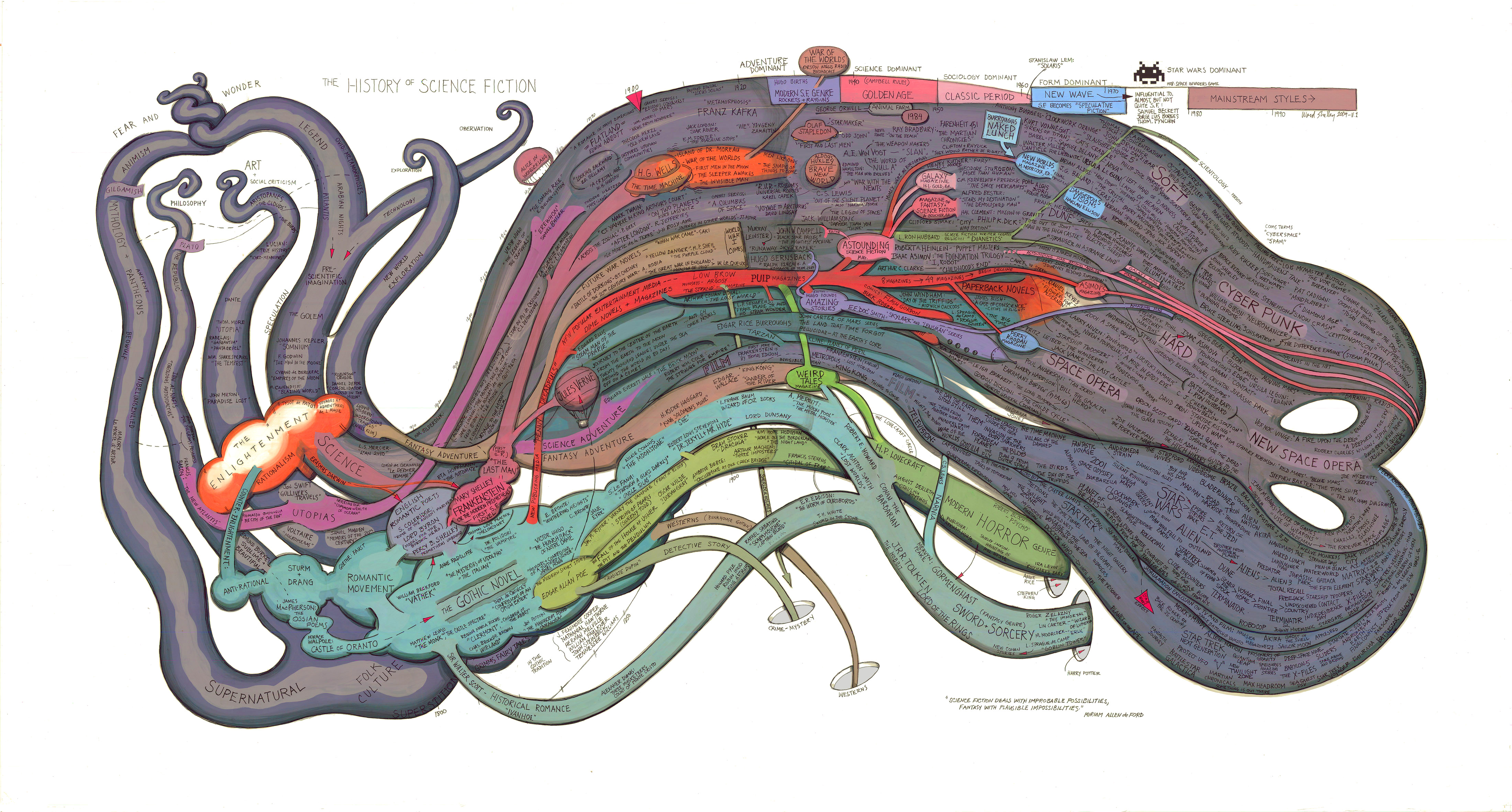
Ward Shelley’s History of Science Fiction, originally posted at scimaps.org:
(click for big)

Puzzle
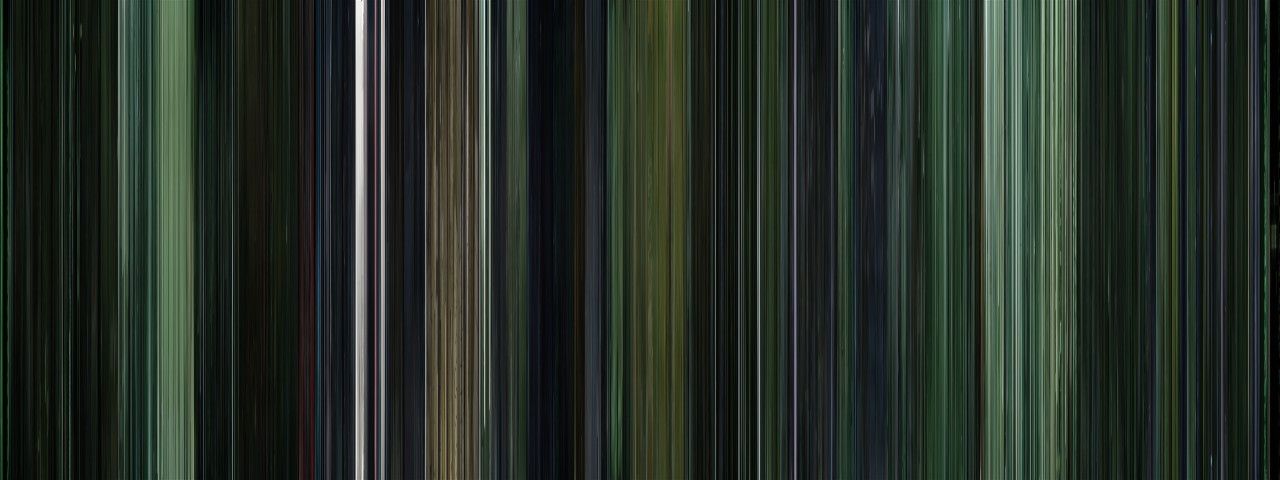
Imagine taking a frame from a movie, and squashing it horizontally to produce a thin vertical line. Now imagine doing that to every frame of the movie, and putting those lines next to one another in sequence. While I’m not sure of the precise transformation used, this is what Movie Barcodes essentially does.

For many movies, this will tend to produce a set of incomprehensible stripes that show little more than the general color grading of the film. The Matrix is a perfect example (click for big on this or any of the others in this post):

Films using distinctive palettes at different times reveal their underlying pattern, for example the distinct striations of Hero:

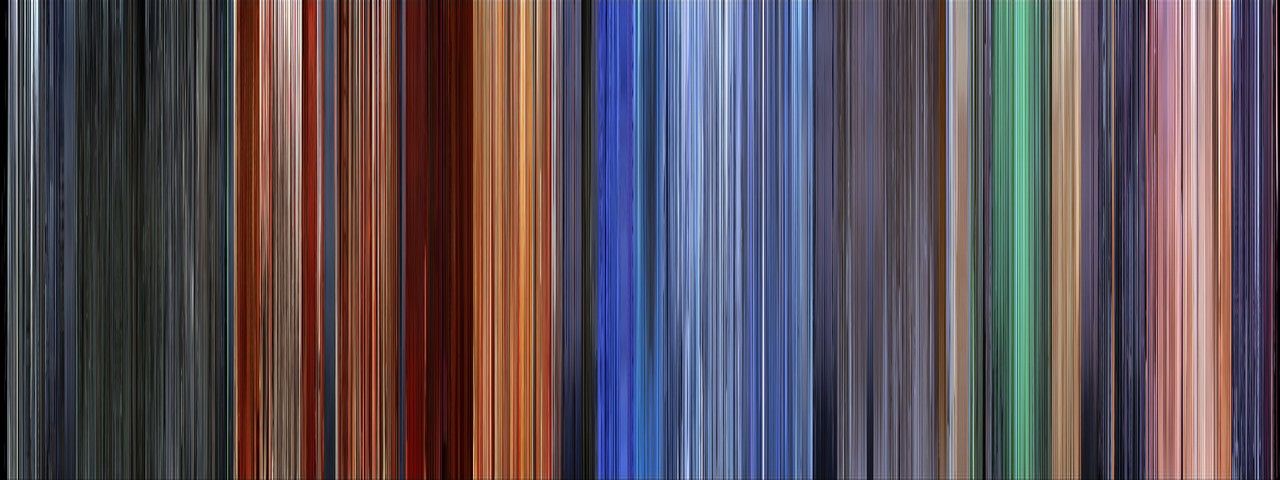
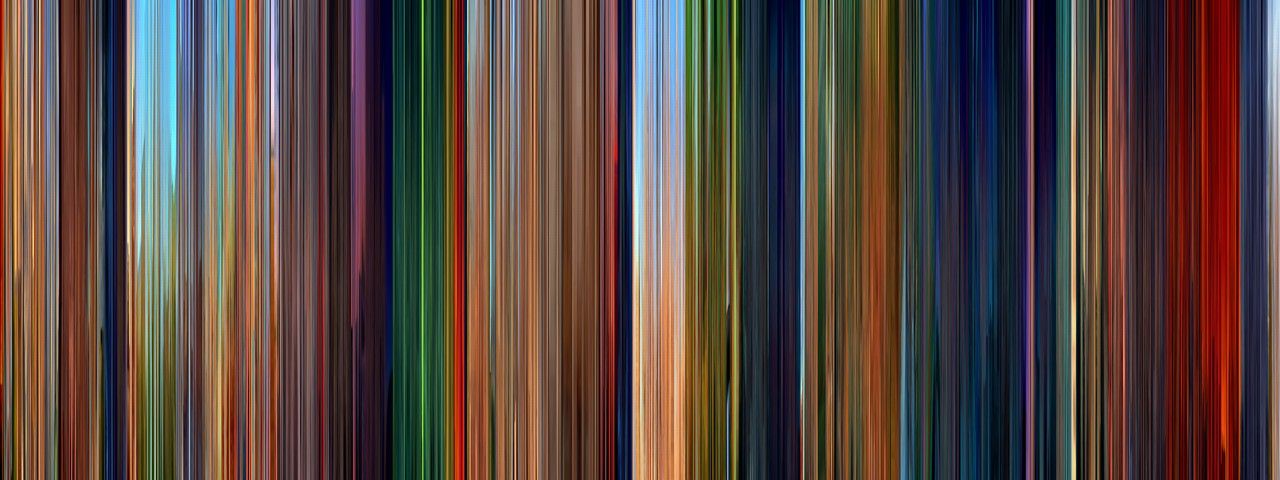
This begs the question: are there any movies which you could recognise from their “bar code” alone? I suspect this is only reasonable if you’re given a subset of movies to guess from, or if the movie is particularly distinctive. So for this week’s Things, see if you can guess the following movies (the answers are in the filenames of the images):

A famous Disney movie:

Another famous Disney movie:

A film I like:

New movies are regularly added to the Movie Barcode Tumblr, and most excellently they sell a variety of prints of some of the most popular!