Categories
New

Things 97: Vertical Ship, Climbing Game, State of 3D

Video
A brilliant solution to the problem of stability at sea:

httpv://www.youtube.com/watch?v=tQxQfQU_hsk

Link
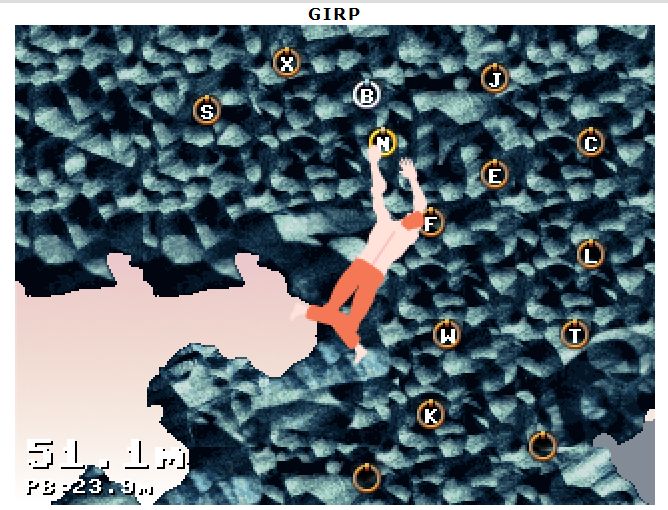
GIRP, a really nice little climbing game (probably easier to get to grips with if you know from the start that feet are not involved).

Quote
Chris Lake, in his self-referential post 10 Reasons Why List Based Posts Work Well Online, makes the key point:

We are all cognitive misers

Question
What is the oldest evidence of your own activity on the internet you can still provide a live link to now?

Last Week’s Puzzle
Last week I asked if it was true what they say, that 3D can never work. I think there are two compelling clues towards an answer here.

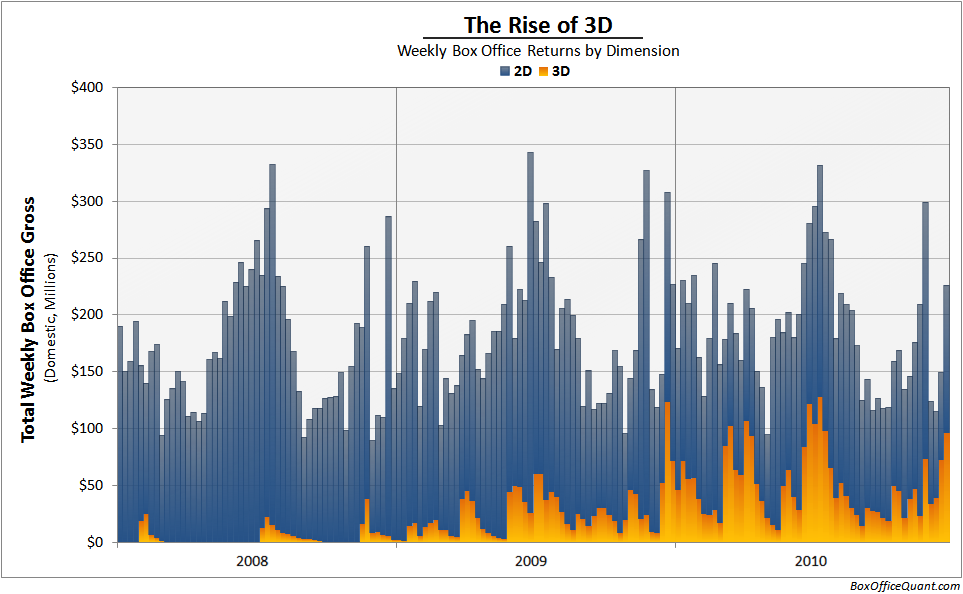
First, Box Office Quant takes a good solid look at what the money in 3D cinema is looking like. The conclusion is that after two years of 3D cinema being a serious consideration, it’s looking pretty solid. There’s lot of great data and visualisation of it over on the original post, but I’ll just reproduce the weekly revenues by dimension here:

It’s clear that something is working, anyway.

On the other hand, there was this development with Nintendo’s autostereoscopic 3DS by its producer Hideki Konno:

“We want to get software out to as many people as possible, and there are some people who just can’t see 3D […] We’re moving away from any stance that says if you don’t use the 3-D functionality you can’t play this game.”

While I’m yet to see some solid data, the picture that seems to be emerging is that a significant minority (10%?) really do have an issue with the convergence/focus conflict that Walter Merch identified (and which is, incidentally, the underlying science behind the apparent paradox highlighted in this XKCD), to the point that watching a full-length 3D movie or spending a significant time playing a 3D game is an uncomfortable experience for them. Naturally there’s also a small proportion of people that for various reasons do not perceive 3D in real life, for whom a 3D film/game has nothing to offer above a 2D one (and I suspect they are being used as a kind of smoke-screen to hide the bigger concerns about the former group in Hideki Konno’s quote above).

It seems that minority is small enough that 3D cinema revenue remains robust, but large enough that Nintendo don’t want to undermine their universal appeal by allowing 3D to be a barrier to participation.

Incidentally, I find it an incredible sign of the times that we now have three dimensional full-colour moving image experiences at a fully commercial scale, which is really quite an amazingly neat trick, and yet so many people I’ve spoken to seem to feel it’s not particularly worth having. Or in Louis CK’s words, “Everything is amazing right now, and nobody’s happy”:

httpv://www.youtube.com/watch?v=8r1CZTLk-Gk

Categories
New

Things 96: Rocket Path-Dependency, Lipstick Animals, 3D Doesn’t Work

Link
When speculating on the subject of extraterrestrial space-faring life, it’s all too easy to forget the many development factors that are likely to be local to us, and to assume that too much of what we have done will generalise to other life forms out there. This article puts forward a compelling argument that our rocket-based space-faring only arose because of certain very specific and not particularly likely events.

Quote
While I don’t think it could be objectively assessed, I rather like Arthur Koestler’s observation on originality:

The more original a discovery, the more obvious it seems afterwards.

Picture
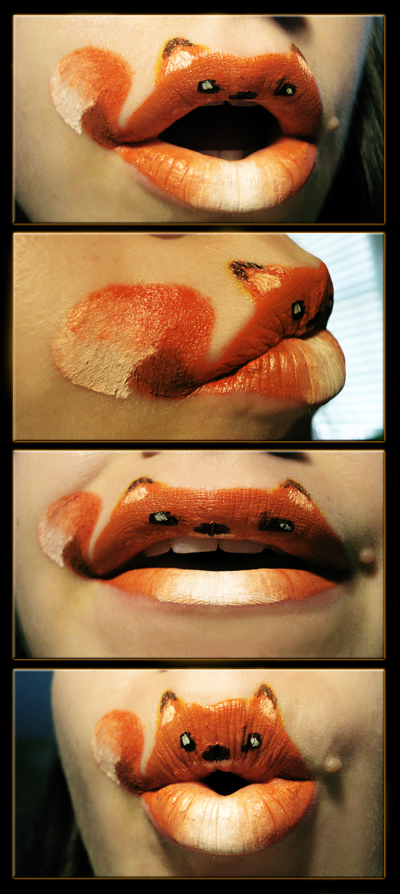
This is one of the things that makes me think of that Arthur Koestler quote: lipstick animals.

Lots more here.

Question
Why 3D doesn’t work and never will. Case closed.”
Roger Ebert quotes Walter Merch, as a Man Who Knows What He’s Talking About, who presents several arguments as to why 3D cinema can never work.

I’ve heard a lot of bad arguments on both sides of this debate, so it’s nice to see someone with a deep understanding of the medium draw out their arguments clearly. My question is, is he right?

Previous Puzzle
Last time I asked how a mouse could fall any distance and survive.

As Phil pointed out, the statement is strictly false: “a mouse certainly can’t fall further than the size of the universe, for example.” So instead we restrict ourselves to consider mice falling off things that are attached to the earth, and no higher than the point at which the atmosphere becomes too thin for a mouse to breathe, and that the survivability criterion is assessed upon landing, and that the landing area itself is not deadly to mice.

First we must address the idea some people recall from school that all objects fall at the same speed, as per Galileo’s thought experiment and his apocryphal dropping-objects-from-the-tower-of-Pisa experiment. This is clearly false as a feather falls more slowly than a hammer, and the confounding factor is air resistance. Rather excellently, the hammer-feather experiment was conducted on the moon to show that in the absence of significant air resistance, they will actually fall at the same speed:

httpv://www.youtube.com/watch?v=PE81zGhnb0w

When air resistance is introduced the shape and particularly the downward-facing area dimensions of the falling objects matter, and although it’s hard to have a good intuitive feel for this when comparing such random objects as animals, I find it’s much easier to imagine a kind-of equivalent parachute with a weight attached.

A small parachute with a big bag of hammers attached will be pulled down more quickly than the same parachute with a feather attached. Alternatively, if two parachutes have equal weights attached, but one parachute is much bigger than the other, it’s easy to imagine that the bigger parachute has greater air resistance and so will fall slower.

Now if we imagine a parachute the size of a mouse, with a weight attached that is the same weight as a mouse, we can imagine it will fall pretty slowly, particularly compared to a parachute the size of an elephant with a weight attached the same weight as an elephant. So we can intuitively understand that the mouse survives.

Or perhaps we can’t? I realise that wasn’t very scientific, but I tend to prefer thought experiments of this kind as they seem to help most people grok ideas better than formulae.

This article over at Everything2 also has some concise words to say on the subject of falling animals.

Categories
New

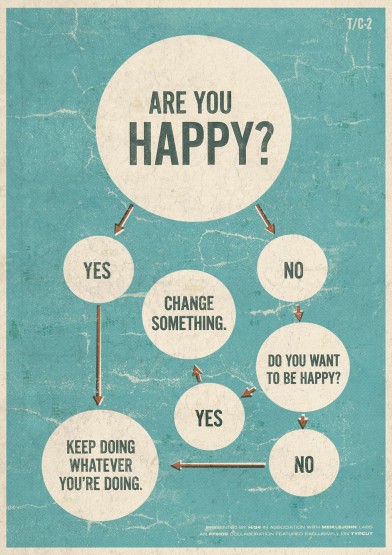
Things 95: Modern Movies, How to be Happy, Mouse Mystery

Video
A beautiful demonstration of physics (or perhaps chemistry):
httpv://www.youtube.com/watch?v=ZGjwe-BCfms

Quote
Scott Rudin, quoted in this GQ article about why movies are all rubbish these days:

Studios are hardwired not to bet on execution, and the terrible thing is, they’re right. Because in terms of execution, most movies disappoint.

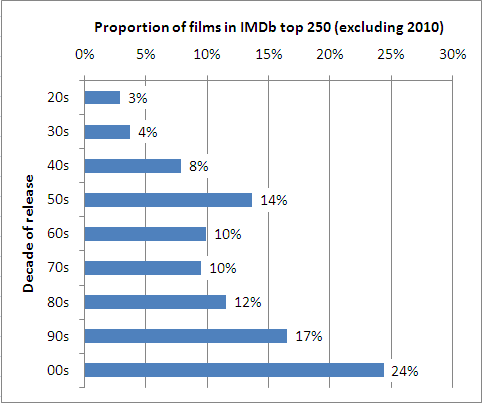
Incidentally, while there’s clearly a huge argument to be had about the relevance of the data to the argument, let’s just contextualise the “things are terrible now” discussion by looking at the breakdown of what proportion of pre-2010 films in the IMDb top 250 come from each decade:

We see a broad trend that is the opposite of the “films used to be better” argument, apart from a post-war spike.

As I said, this is a starting point for huge arguments, and if I was going to start one I would begin with one of the following:
-Any popularity poll will tend to bias more recent candidates
-Demographic bias of IMDb voters and the scoring calculation used for the IMDb Top 250 will skew the result away from the “Objective Truth” (ha ha ha) of the matter
-This data does not speak to the more important issue of ‘typical’ film quality by decade

This week’s question
A mouse can fall any distance and survive. How is this possible?

Picture
I’ve had this obvious-but-actually-important thought myself, and this is a pretty great way of expressing it:

Answer to the previous question
In Things 94, I asked why ovens didn’t come with a built-in thermomenter.

Uncharacteristically, the Things community was unable to answer – or perhaps you weren’t interested. So I asked the internet using my secret research alter-ego* on Yahoo Answers, and also on Quora just to try that out.

You can see the range of responses I received on Yahoo answers, some of which are quite useful. The question on Quora has yet to draw a response, so I’m guessing the community there is still too niche to cover this kind of thing.

Putting together the suggestions from YA and my own thoughts, this is my conclusion:

1) It’s difficult (and therefore expensive) to make an oven thermometer that will remain accurate for the device’s lifetime. If it wasn’t, I suspect ovens would be thermostat-based, and we wouldn’t have the problem to begin with. (As I said, baking books insist there is a problem, and anecdotally I can report my gas oven is almost two gas marks cooler than it should be, and adjusting for this significantly improved my baking results).

2) It also must be difficult (and therefore expensive) to design and calibrate an oven such that it accurately produces the intended temperatures throughout its lifetime, because (once again) if this wasn’t true the problem wouldn’t arise.

3) The solution to the problem is to have a separate thermometer and use it from time to time to calibrate your oven. That thermometer then doesn’t need to maintain integrity for every use of your oven, and even if it does break it’s much easier to replace than an integrated one would be.

4) Admitting there is even a problem looks bad, so any oven manufacturer supplying such a thermometer unit with its devices would be perceived as worse than those that pretend there isn’t a problem.

5) Even if a manufacturer did include a built-in thermometer, people unaware of the oven temperature problem would again presume the oven must be sub-standard to need one, and people that know enough to worry would realise an integral thermometer couldn’t be trusted for long.

I suspect similar principles apply to protective cases and screen protectors for mobile devices.

*A long time ago I thought it might be prudent to separate my question-asking online identity from my confident-and-opinionated online identity. This doesn’t seem quite as important any more, and now that Things is a blog it’s very easy for someone to connect the two anyway, so now I don’t worry about linking from one to the other. But I’ll still use it anyway.

Categories
New

Things 94: Black Swan, Vampire Squid, Stock Market Returns

Video
I saw Black Swan recently and recommend it to anyone that likes the look of the trailer, so long as you’re not squeamish as that’s a whole side of the movie the trailer skims over:

httpv://www.youtube.com/watch?v=5jaI1XOB-bs

With a reported production budget of $13m (which, as I never tire of telling people, would be just enough to cover Tron Legacy’s costume budget, and was also so restrictive that Natalie Portman opted to forego her trailer in order to afford an on-set medic), I was particularly fascinated by the beautifully subtle (and some not-so-subtle) digital effects they nonetheless managed to achieve. Most excellently, you can see a showreel of how these effects were put together on Look Effects’ website, although if you haven’t seen the film you should steer well clear as it will completely ruin the film for you.

Links
Have Instapaper or Read It Later at the ready because I’m about to flag up some serious long-form content. I don’t think it was available online when it was first published, but you can now read Matt Taibbi’s dilligently researched yet seething explanation of quite what Goldman Sachs does over at Rolling Stone, in which he memorably begins:

The world’s most powerful investment bank is a great vampire squid wrapped around the face of humanity, relentlessly jamming its blood funnel into anything that smells like money.

Over a year later even publications like The Week will casually refer to them as “Giant vampire squid Goldman Sachs”, which is I think excellent. It’s long, but well worth it, and it has a great twist ending.

As a nice follow-up (or much shorter way of cutting to the heart of the matter), Charlie Stross explains how we got to this point. Or if you want the whole thing in one pithy excerpt:

Corporations have a mean life expectancy of around 30 years, but are potentially immortal; they live only in the present, having little regard for past or (thanks to short term accounting regulations) the deep future: and they generally exhibit a sociopathic lack of empathy.

I think the way we tend to automatically expect groups of humans to behave like individual humans is one of the most disastrous mistakes we make on a daily basis.

Puzzle
All ovens that I’ve seen have some kind of temperature ‘input’ dial, but why do so few have any kind of readout of the actual internal temperature, to the point that there is a market for independently purchased oven thermometers? Shouldn’t market forces guide the manufacturers to include such a feature themselves?

Picture
I see a lot of data visualisations that make me angry because they do little more than treat data as almost random input for some kind of procedural image generation process (which is actually very cool when it doesn’t claim to be something it isn’t). This New York Times visualisation of stock market returns over the past 90 years, on the other hand, is actually quite practical at giving you both an overall sense of the patterns while still making each data point quite clear.

I'd just like to make it clear that I'm using the 'ragged edge' functionality of FS capture to show that this is only part of the image. A while ago, when everyone at work had just got in to FS Capture, it was used on just about every image you saw. Those were dark days.

Last Week’s Puzzle
Last week I asked why we seem to be so intolerant of variation in things like driving speed or grammar pedantry.

Angela suggests it’s all to do with herd instinct:

We are constantly (often subconsciously) comparing ourselves with others around us and balancing the desire to fit in (be part of the herd) with our desire to ‘self-express’ (stand out). Even small differences between us and others in the herd could potentially threaten us if they lead us to be ostracised or confer upon others some advantage in terms of survival or reproduction. I think that’s one of the reasons we a) notice and b) are so perturbed by even slight differences – they could signify a real risk to our deepest interests.

I think that’s part of the answer, although it doesn’t explain why we’re more tolerant of a lot of other things, or at least tolerant of variation in one direction (such as how we judge others’ use of free time).

I initially thought it covered those particular areas of life because we recognise them as prisoner’s dilemma / tragedy-of-the-commons areas, where a few people taking the easy way risk leading society to a collectively suboptimal Nash equilibrium.

However, I now think there’s two separate factors at work. In driving, even slight differences in speed add up to one car overtaking another, which we can’t help but read as a social signal that one is ‘doing it wrong’ (and we see the same thing with walking speed).

On the other hand, things like specific bits of grammar pedantry or household hygiene fall into a category of behaviours drummed into us as children, which we then cling on to tenaciously through a combination of Anchoring and Status Quo Bias. Deviation from these things is more on a sub-task basis (“I can’t believe they don’t clean their skirting boards!”) rather than a spectrum, as we adhere to whichever specific rules we were taught.