Categories
New

Things 93: Wormworld Saga, Newton and Pascal, Idiots and Maniacs

Link
If you like webcomics, or just enjoy seeing examples of excellent use of light in digital paintings, do check out the first chapter of Wormworld Saga.

Joke
Einstein, Newton and Pascal decide to play hide and seek. Einstein is it, closes his eyes, counts to 10 then opens them. Pascal is no where to be seen. Newton is sitting right in front of Einstein, with a piece of chalk in his hand. He’s sitting in a box drawn on the ground, a meter to a side. Einstein says “Newton, you’re terrible, I’ve found you!” Newton says “No no, Einy. You’ve found one Newton per square meter. You’ve found Pascal.”

Puzzle
This sprang out of the discussion on language pedantry last week on the RAPP CC list.

In “Eats, Shoots and Leaves” Lynne Truss makes the following observation:

Yes, as Evelyn Waugh wrote: “Everyone has always regarded any usage but his own as either barbarous or pedantic.” Or, as Kingsley Amis put it less delicately in his book The King’s English (1997), the world or grammar is divided into “berks and wankers” – berks being those that are outrageously slipshod about language, and wankers those who are (in our view) abhorrently over-precise.

A similar observation in a different field is attributed to George Carlin:

Have you ever noticed that anybody driving slower than you is an idiot, and anyone going faster than you is a maniac?

It seems to me that grammatical precision and driving speed fall into a very particular category of behavioural spectra in which we seem to be highly critical of others who vary from our own view in one direction or the other, even slightly. Other examples I’ve observed being described in a similar way and heard people comment on with varying degrees of politeness are alcohol consumption, smartness of dress, household cleanliness, and various aspects of personal hygiene.

The question is, what is it about these behaviours that makes us so sensitive to differences?

Picture
I’m not at all sure this diagram works fully, but I like it a lot anyway:

Categories
New

Things 92: Walk Straight, Marmite Looks, One Day Music Experience Timeline

Video
A nice bit of rotoscope animation that asks the question “Why can’t we walk straight?”

Link
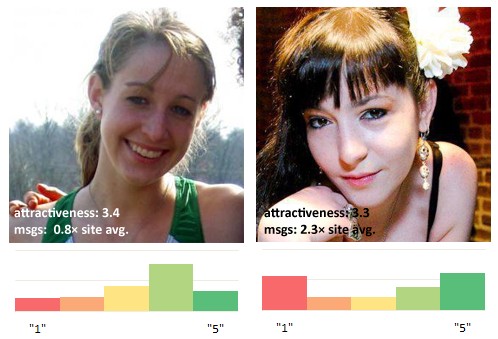
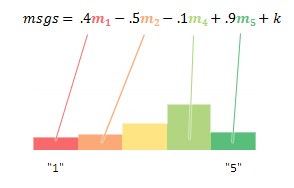
As an intriguing to follow-up to the question in Things 89 on why perceptions of attractiveness vary, OK Cupid have posted a related result: greater variation in attractiveness rating scores tends to generate more messages on the service.

The fact they say “men will get their turn under the microscope” might mean that the same result does not hold true for men, or they might just not have checked yet.

Tip
I’ve recently been enjoying a handy little shortcut in Firefox that lets me jump straight to search results on certain sites without reaching for the mouse.

Start by clicking the dropdown option against the search box, and click ‘manage search engines’:

From this menu, pick a search engine you commonly use and click ‘edit keyword’, I recommend something very short:

You can then query your chosen search engine by jumping to the location bar (Ctrl + L) then preceeding your search with your chosen keyword. For example, I can type “Ctrl + L” and then “wa how old was pat morita when karate kid came out”, press enter, and get straight to the answer without any clicks of the mouse.

(Rotten Tomatoes doesn’t seem to have this option, but there’s a Firefox add-on which is a slight improvement).

Picture
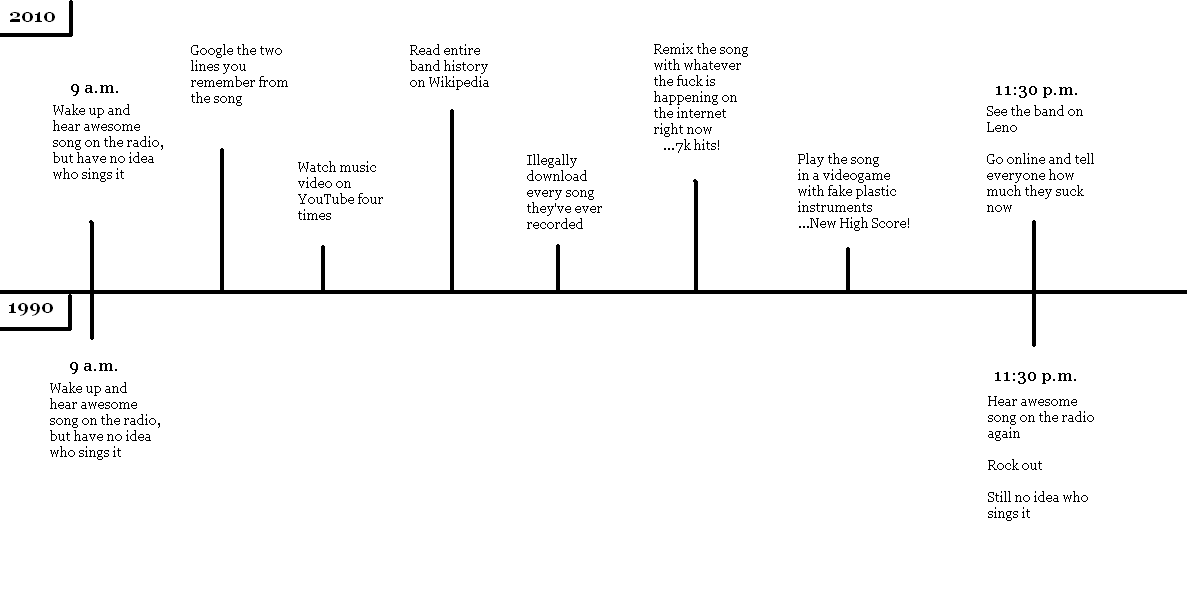
A nice way to illustrate the changes technology has wrought on the radio music experience over the last 20 years, with only a little exaggeration (click for big):

No Puzzle
According to the schedule of rotating absence, there’s no puzzle this week, but feel free to think about why we can’t walk in a straight line if you like.

Last Week’s Question
Last week I asked if anyone else had noticed a sudden surge in the misuse of “i.e.” and “e.g.”. Not many had, but a lot of people had something to say on the subject… probably enough for a whole post by itself, but I’ll attempt to quote in brief the different responses.

First, a few admitted to not being certain of the distinction themselves, even when they were sticklers in other areas, so I suppose that means I’ve done my bit to stem the tide somewhat.

The question on living vs prescribed language raised a few responses in itself. Maria noted:

The French spoken [in Montreal] is a pure and true form of ‘old’ french, ‘where for art thou’ for example. When Montrealers go to France their version of French is hardly understood which just goes to show that languages must and do evolve or we’d be speaking like players in a Shakespeare play.

Angela confessed that:

… I am afflicted and am involuntarily irritated by things like this that really should not be so irritating to me! The most frequent examples I can recall seeing include your i.e. / e.g.; everyday / every day; and unnecessary apostrophes e.g. potatoe’s, kid’s. In all cases I think that the incidence rate is increasing and we may well have passed a tipping point whereby ‘everyday’ will now mean both ‘everyday’ and ‘every day’ for ever more.

… and agreed that it’s better to let these things go, unless the error could lead to a misunderstanding, in which case it’s worth pointing out.

Rik provided a link to a tongue-in-cheek view on the book “Eats, Shoots and Leaves”, which among a lot of hyperbolic fuming makes the following point:

We are not computers which can be thrown off course by the insertion of a full stop here or a rogue hyphen there. We have a deeper understanding of meaning which you can check out for yourself by a quick reading of Chomskys writings on transformational grammar.

Simon identified a potential underlying factor behind rising misuse:

Latin stopped being taught in UK state schools during the 60s. At approximately the same time, English grammar died out as a subject because people thought it harked back to a redundant time. […] With the loss of learning through grammatical structure we have moved as a society from having a right way of doing something to adopting what society does. […] A case of crede quod habes – et habes if ever there was one.

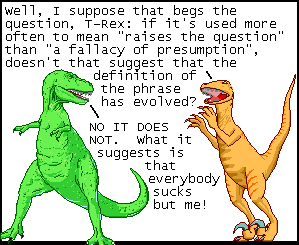
Miranda gave further endorsement to the importance of Latin by nothing that in the case of “i.e.” and “e.g.” anyone lucky enough to have learned the language at school can easily remember which is which by recalling what the abbreviations stand for. She also pointed out that Dinosaur Comics recently addressed the issue of prescriptivism:

Finally, Xuan asks

Anyways, why did we start using e.g. and i.e. in the first place? Didn’t the Romans bugger off around 400AD?

Incidentally, in an attempt to find evidence that fewer people cared about the distinction between “i.e.” and “e.g.” I turned, as usual, to Google Insights for Search, only to find results that suggest the trend is going the other way. Alternatively, technological changes mean more is being written down by more people than ever before, so there’s more of both.

Categories
New

Things 91: Dresden Codak, i.e., Paths of Flight

Link
In Things 48 (not yet blogged) I linked to an Aaron Diaz’s Dresden Codak update featuring 42 sharply observed 3rd-act plot twists, but recently realised that this may have misrepresented his work, which instead usually consists of astonishingly deft single-page stories revolving around simple but brilliant ideas.

Here’s 3 of my favourites to give you a much better idea of Diaz’s oeuvre:

Lantern Season:

Fabulous Prizes:

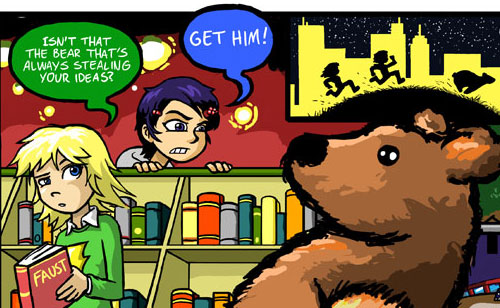
Girl vs Bear:

His blog on comic art theory is also well worth checking out if you are remotely interested in the art form.

Quote
During a characteristically interesting and varied conversation with Adam a few days ago, he suddenly revealed the following:

That reminds me of a really interesting thing I read in the Metro today – something like: 30,000 people… something. I can’t remember what it was, but it was really amazing.

Question
Sometimes I want to ask things in Things that are even more obviously not what people might call Puzzles than usual, so in these cases I’m going to be more direct and call a question a Question. So here is a Question.

When it comes to arguments about the English Language I tend to side with the people saying “most people say it this way so that’s now correct” against those saying “this is the way some Victorian guy wrote in a book that it should be said so everyone doing otherwise is wrong”, but I do admit that some distinctions are worth holding against a tide of misuse, one example being that I would correct instances of “i.e.” and “e.g.” being used in one another’s stead where polite and possible.

Fortunately, this didn’t come up very often.

Then in 2010 something terrible happened. About 95% of all instances of “i.e.” that I read were incorrect and should have been “e.g.”, which is particularly silly as it reads as if the author believes a set of many elements (e.g. social networks) consists of only one (e.g. “i.e. Facebook”).

So my question is this: have you also noticed such a sudden rise in “i.e.” misuse, or have I just been unlucky and/or suffered from confirmation bias?

Video
A while ago I realised you could collage time lapse photography of a flight path to obtain an image of a string of planes; I then realised you could do the same thing with video, but recognised that this was beyond my means to produce. Conveniently, GE have now done this:

httpv://www.youtube.com/watch?v=kN9otwGPND4

Categories
New

Things 90: Inception Diagram, Clay Shirky on Wikileaks, United States of Autocomplete

Tim Link
After a lot of research and a second viewing with a lot of note-taking, I felt like I had got to the bottom of Inception. My diagram and explanation of what I think is really going on can be found on Tower of the Octopus.

Link
Clay Shirky’s view of the Wikileaks situation seems much more balanced and reasonable than anything else I’ve read on it.

Also, see the Wikipedia article on the Streisand Effect.

Quote
I can’t actually find who said this first on Twitter:

Pissing off 4chan: free. Botnet hire: $1000/month. For everything else, there’s Mast– oh, wait, not any more there isn’t.

Puzzle
We are told that your ears go ‘pop’ in a plane after take-off because of the air pressure changing with altitude. But we also know that the cabin has to be airtight, as if air could get out the pressure would equalise and above 17,000 feet everyone would die. So why does the air pressure change in the cabin at all?

Picture
From Dorothy ‘Cat and Girl’ Gambrell’s visualisation site Very Small Array, the United States of Autocomplete gives Google’s autocompleted suggestion of what should come after each state name (note results are regional, we’ll get different results from the UK) (click for full size):

Last Week’s Puzzle
Last week I asked “why does the perceived attractiveness of any given individual vary so much depending on who you ask?”, which provoked quite a bit of discussion on the CC list.

Thomas points out:

It’s not enough for both parents to have ‘good” genes, but they should have “good” genes that are sufficiently different that any child will have the maximum possible genetic advantages.

Or as Xuan put it:

Attractiveness: Relative to your genes and where you want them to go.

Simon adds a practical consideration:

… people of similar levels of attractiveness find each other attractive (because your genes have the best chance of survival if you can maximise some function of beauty x propensity to shag me)

Phil counters:

So many couples look very similar though! Perhaps that is somewhat due to acquired mannerisms, but I’d have thought there’s a strong trend to find people similar to yourself attractive, to help similar genes survive

My summary of the situation was this:

To have the best chance of promoting themselves, your genes want to help others with similar genes (and procreating with them is pretty helpful), but also combine themselves with complementary genes. With both of these pressures in effect, and a distorting lens of nurture on top of the nature, we can’t be too surprised that people disagree on attractiveness.

Finally, Matt raises the logical next question – how to genes actually do this:

I think we may be giving too much credit to genes abilites to recognise similar genes and indeed complementary genes here. And after all, there are a lot of different genes with a vested interest here. I would posit that we decide who would be a good catch based on a set of genes (and so on) that try to recognise success in any form – one of the primary indicators surely being perceived social standing, but also apparent health, virility etc. So, regardless of precise genes, recognising good stuff.
I find the idea of encoding a DNA sequence that will give rise to a brain that will perceive the outside world and detect optimal reproductive opportunities almost completely mindboggling.