Categories
New

Things 90: Inception Diagram, Clay Shirky on Wikileaks, United States of Autocomplete

Tim Link
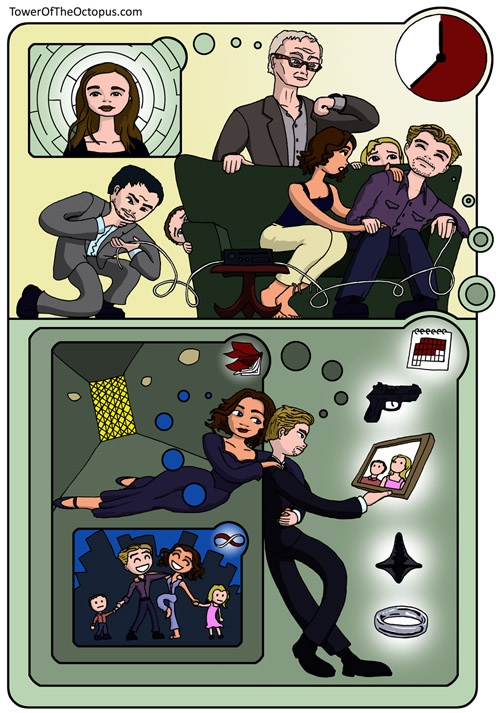
After a lot of research and a second viewing with a lot of note-taking, I felt like I had got to the bottom of Inception. My diagram and explanation of what I think is really going on can be found on Tower of the Octopus.
Link
Clay Shirky’s view of the Wikileaks situation seems much more balanced and reasonable than anything else I’ve read on it.

Also, see the Wikipedia article on the Streisand Effect.

Quote
I can’t actually find who said this first on Twitter:

Pissing off 4chan: free. Botnet hire: $1000/month. For everything else, there’s Mast– oh, wait, not any more there isn’t.

Puzzle
We are told that your ears go ‘pop’ in a plane after take-off because of the air pressure changing with altitude. But we also know that the cabin has to be airtight, as if air could get out the pressure would equalise and above 17,000 feet everyone would die. So why does the air pressure change in the cabin at all?

Picture
From Dorothy ‘Cat and Girl’ Gambrell’s visualisation site Very Small Array, the United States of Autocomplete gives Google’s autocompleted suggestion of what should come after each state name (note results are regional, we’ll get different results from the UK) (click for full size):

Last Week’s Puzzle
Last week I asked “why does the perceived attractiveness of any given individual vary so much depending on who you ask?”, which provoked quite a bit of discussion on the CC list.

Thomas points out:

It’s not enough for both parents to have ‘good” genes, but they should have “good” genes that are sufficiently different that any child will have the maximum possible genetic advantages.

Or as Xuan put it:

Attractiveness: Relative to your genes and where you want them to go.

Simon adds a practical consideration:

… people of similar levels of attractiveness find each other attractive (because your genes have the best chance of survival if you can maximise some function of beauty x propensity to shag me)

Phil counters:

So many couples look very similar though! Perhaps that is somewhat due to acquired mannerisms, but I’d have thought there’s a strong trend to find people similar to yourself attractive, to help similar genes survive

My summary of the situation was this:

To have the best chance of promoting themselves, your genes want to help others with similar genes (and procreating with them is pretty helpful), but also combine themselves with complementary genes. With both of these pressures in effect, and a distorting lens of nurture on top of the nature, we can’t be too surprised that people disagree on attractiveness.

Finally, Matt raises the logical next question – how to genes actually do this:

I think we may be giving too much credit to genes abilites to recognise similar genes and indeed complementary genes here. And after all, there are a lot of different genes with a vested interest here. I would posit that we decide who would be a good catch based on a set of genes (and so on) that try to recognise success in any form – one of the primary indicators surely being perceived social standing, but also apparent health, virility etc. So, regardless of precise genes, recognising good stuff.
I find the idea of encoding a DNA sequence that will give rise to a brain that will perceive the outside world and detect optimal reproductive opportunities almost completely mindboggling.
Categories
New

Things 89: Human Towers, Retroactive Prayer, Local Universe Map

Trailer
I saw Monsters at the Edinburgh International Film Festival, and it’s now on general release. As I said back in my big EIFF review post:

What: Low budget yet well-realised alien invasion as setting for semi-romantic road movie
Good: Beautifully shot, atmospheric, with an incredibly realistic-feel for its budget and a beautifully understated soundtrack from Jon Hopkins. And giant alien octopi.
Bad: Weakness in the development of the female character betrays a male gaze bias, undermining the main dynamic of the film
Conclusion: Essential viewing for anyone interested in what can be achieved on a budget, giant alien octopi, or Whitney Able’s legs

Trailer:

httpv://www.youtube.com/watch?v=njeofv4dr9Q

Video
Human Towers, some of which alarmingly do fall down:

Casteller from Mike Randolph on Vimeo.

Quote
Martin Bland, paraphrased by Peter Norvig in an excellent article on the shortcomings of evidence for prayer healing:

An ethical study proving the efficacy of retroactive prayer is logically impossible.

Puzzle
Since physical attractiveness has at least some part to play in our evolution, why does the perceived attractiveness of any given individual vary so much depending on who you ask?

Picture
I had previously wondered what the ‘local’ area of the universe looked like, for varying values of ‘local’, but some idle Googling didn’t produce an answer at the time. Just recently I came across a really nice image on Wikipedia giving the answer across some interesting different scales. Check out the file on Wikipedia, where you can also download a 7MB, not-very-compressed jpg of the image. (If that’s gone for some reason I’ve put a slightly more compressed version (2.5MB) of the image here).

Here’s a snapshot of just part of it:

Last Week’s Puzzle
Last week I asked why bedsprings make a ‘pyoing’ noise out of nowhere. Either this was too easy, too hard, or no one had any idea what I was talking about, because nobody had an answer. Consequently I turned to my not-very-secret research alter ego and asked the internet, as I did before on the shampoo question. The internet said springs get squinched down sometimes and will later pop back up. If that was the case, I would expect to usually hear these noises very soon after getting off a bed, with just a few rare occasions when it was released later. I remain unsure.

Categories
New

Things 88: Out of Sight Animation, The Past of Advertising, Ultimate Blackboard

Video
A great concept, brilliantly executed, well worth carving 5 minutes out of your day for. For the impatient among you, you need to stick with it at least until 1’26” when the magic really starts.

httpv://www.youtube.com/watch?v=4qCbiCxBd2M

Link(s)
Fast Company published an article on The Future of Advertising, which combined with AdLab’s curation of 15 similarly-positioned Fast Company articles from 1995-2005 raises the question of when a revolution actually starts. Given that you can spin a plausible-sounding article just by gathering together a few examples of something (and disingenuously cite economically driven contraction of traditional players as evidence of change), this kind of historical perspective is very useful for reminding us that in reality you can rarely pin down a single revolutionary moment.

I got an even greater sense of perspective taking a look at Hide and Seek’s highlights of a large collection of ‘cinema advertising tricks from the 1920s’, which include such techniques as interactive cinema, conversation-seeding, and ARGs.

Puzzle
Why do bedsprings occasionally make a ‘poing’ noise, seemingly without provocation?

Picture
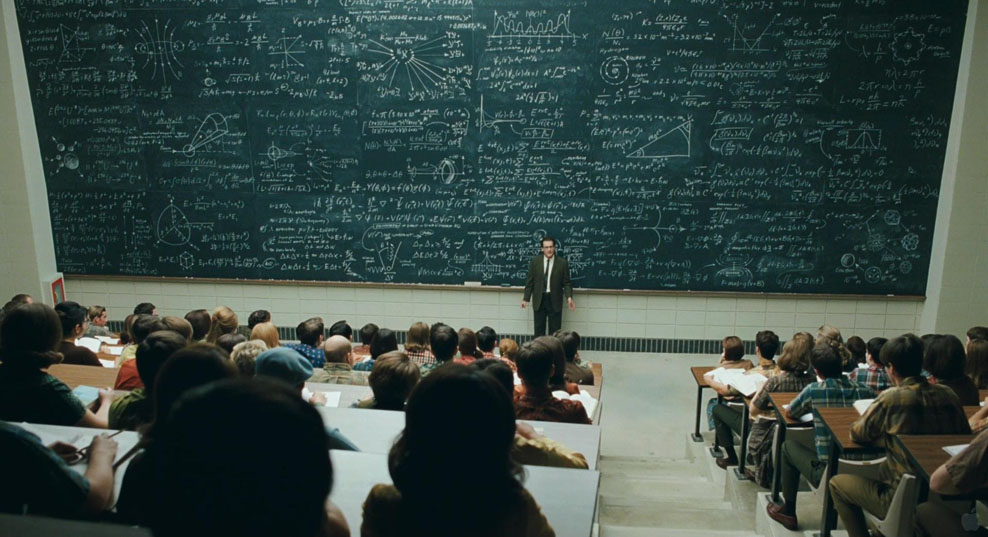
A great screenshot from The film A Serious Man. I’m proud to say I attended lectures that looked a bit like this by the end, although never with so many diagrams so well executed. (Click for full, use-in-a-presentation size)

Last Week’s Puzzle
Last week I asked why people playing Tomb Raider felt compelled to direct Lara to jump from a great height after they had saved their game. Doug suggested the following (numbering mine):

1) Because the game has just spent the whole playing time frustrating you as you fly off the ledge. Flinging yourself of the ledge then turning off is reassertion that it’s you in control, not the game.
OR
2) It’s nice to do something easy with gusto as relief to hours of trying to do something difficult and complex through careful control and concentration.
Either way it’s got something to do with liberation.

I think both of these no doubt play a part, but similar factors are at work in many other games, so the results only manifest thanks to at least two other additional factors that are at work here:

3) Jumping from a great height itself has a mysterious, mesmerising appeal.
Standing on a precipice, I’ve had to resist the nagging thought that jumping off is an action available to me, and it might be quite interesting, at least for a short time; others I’ve spoken to have had similar thoughts in similar situations. As videogames let us try things out in a risk-free way, it makes sense that we play out this urge in that environment.

Supporting this idea is a personal observation that once I’ve completed a game and am no longer concerned about death, if on a replay I find my character in a precipitous situation that I didn’t fall victim to before, I will often have them jump off just to see what it is like.

4) The architecture of the game and the save mechanism.
Games that have save points typically ensure they can only be used far from danger, presumably to avoid a player saving while in an unsurvivable situation. Tomb Raider had very few such scenarios and so permitted saving at any point. At the same time, death-by-falling was a near ever-present threat. As such, any given moment in which you saved the game was likely to be very close to just such an opportunity.

The icing on the cake was that through an undocumented combination of controls, you could execute an elegant swallow dive.

Categories
New

Things 87: Hacked Kinect, Technology vs Poverty, Robot Kid

Video
Now that the Xbox Kinect is out, people are playing with it (a $3,000 prize was offered for the first person to provide an open source driver, and it’s gone crazy from there) and doing a lot of cool stuff. Here’s my favourite so far (stick with it to 42′ when crazy stuff starts happening):
httpv://www.youtube.com/watch?v=7QrnwoO1-8A

Link
Can technology end poverty? An article by Kentaro Toyama, a man with years of experience in the field, points out that:

“Technology—no matter how well designed—is only a magnifier of human intent and capacity. It is not a substitute.”

Since people in developed nations already have a great deal of intent and capacity, we tend to overestimate the absolute benefit of technology and get overexcited about the field of Information and Communication Technologies for Development, which ultimately fails to deliver on its promise. Well worth a read.

Quote
In relation to the above article, over on BoingBoing, commenter dragonfrog observes:

A quote from Bruce Schneier I think is applicable here:

“If you think technology can solve your security problems, then you don’t understand the problems, and you don’t understand the technology.”

If you leave out the word “security” I think it remains just as valid.”

Puzzle
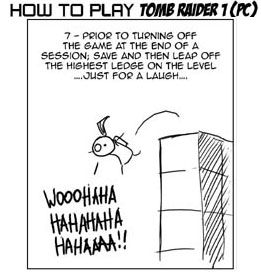
15 years ago I was playing Tomb Raider (the 21st game I ever completed, according to my records. Current count: 103. More on that later). Years later, I read one of Jollyjack’s observational-comedy-style ‘How To Play’ comics on DeviantArt, and while all his observations strike home, one thing in particular was unexpected:

This was something I did frequently, without really knowing why, and some of the comments said the same.

The question is, why do people playing Tomb Raider (and no other game that I’m aware of) feel driven to do this?

Picture
If I was a parent and I could make this kind of thing come about, I definitely would:

Tim Link
The above image is the first one I posted to a new Tumblr I’ve created to queue up images to draw every day, Now Draw This. My attempts then appear on Sleep or Draw. As mentioned in Things 84, I’m mainly saying this here to reinforce my perceived obligation to stick to the schedule, which seems to be working so far.