Categories
New

Things 99: Rules for Stories, Sci-Fi Map, Movie Bar Codes

Video
When an important character first appears in a movie, it’s generally good practice to have the first few things they do give a strong indication of what kind of person they are. I think this is why people get so upset about the “Han shot first” debacle, since it was such a character-defining moment.

Occasionally, real life can give us the same speedy insight into a person, such as these 14 seconds:

httpv://www.youtube.com/watch?v=DoYpJqFNj40

Quote
In screenwriter Todd Alcott‘s series of insightful and fascinating posts analysing The Shining and how it fits the standard three-act structure set against a driving need of the protagonist, provided that you consider the hotel itself to be the protagonist (which is actually quite a compelling argument; read it in full in parts 1, 2, 3, 4, 5, 6, 7), he has the following aside:

[I]n order for a protagonist/antagonist dyad to work dramatically, the protagonist must be aware that the antagonist exists, and is acting upon things, and vice versa. This is why […] fantasy stories always have magical characters who can see the future and know what’s going on in distant lands – because otherwise, the protagonist and antagonist would never know that the other exists.  If Gandalf is just some guy who tells Frodo to throw the ring into a volcano and Frodo says “okay” and sets out, there is no drama to Lord of the Rings.  It must be that Gandalf is a wizard and that Frodo can have visions when he puts on the ring and that Sarumon has a magic ball that sees things, or else everybody is just kind of doing things.

I wasn’t so sure about that when I first read it, but ever since then I’ve seen it more and more. I think it’s actually more the case that when a writer has a story in mind it’s very difficult for them to separate their omniscient knowledge of events from the far more limited knowledge held by the individual characters. If you have some kind of fantasy setting, it’s almost irresistably tempting to get around this by including some kind of magical information transfer. Harry Potter leans on this story crutch particularly heavily (although to be fair Rowling does fold the implications back into the narrative).

Picture
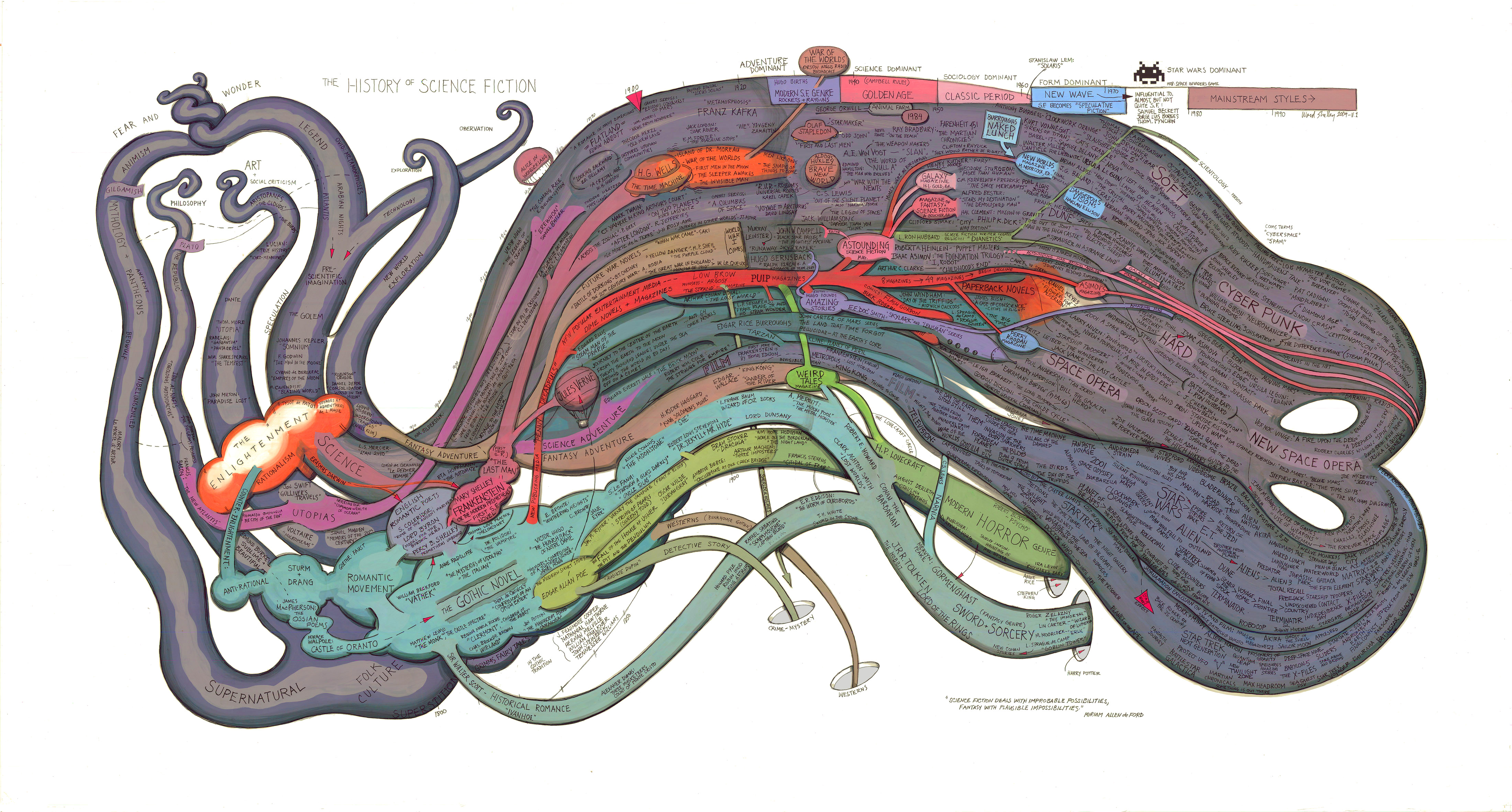
Ward Shelley’s History of Science Fiction, originally posted at scimaps.org:
(click for big)

Puzzle
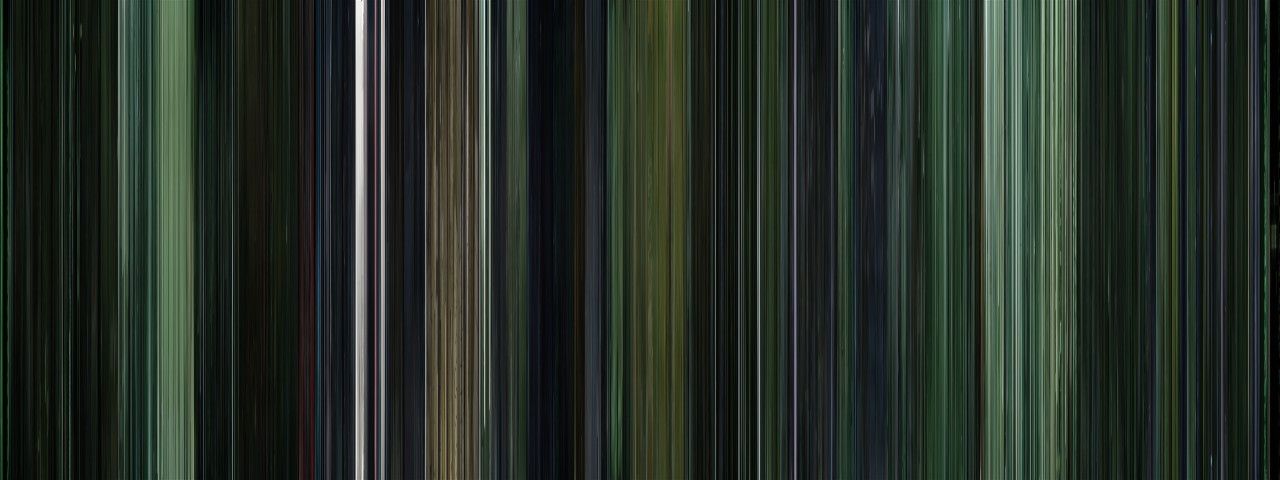
Imagine taking a frame from a movie, and squashing it horizontally to produce a thin vertical line. Now imagine doing that to every frame of the movie, and putting those lines next to one another in sequence. While I’m not sure of the precise transformation used, this is what Movie Barcodes essentially does.

For many movies, this will tend to produce a set of incomprehensible stripes that show little more than the general color grading of the film. The Matrix is a perfect example (click for big on this or any of the others in this post):

Films using distinctive palettes at different times reveal their underlying pattern, for example the distinct striations of Hero:

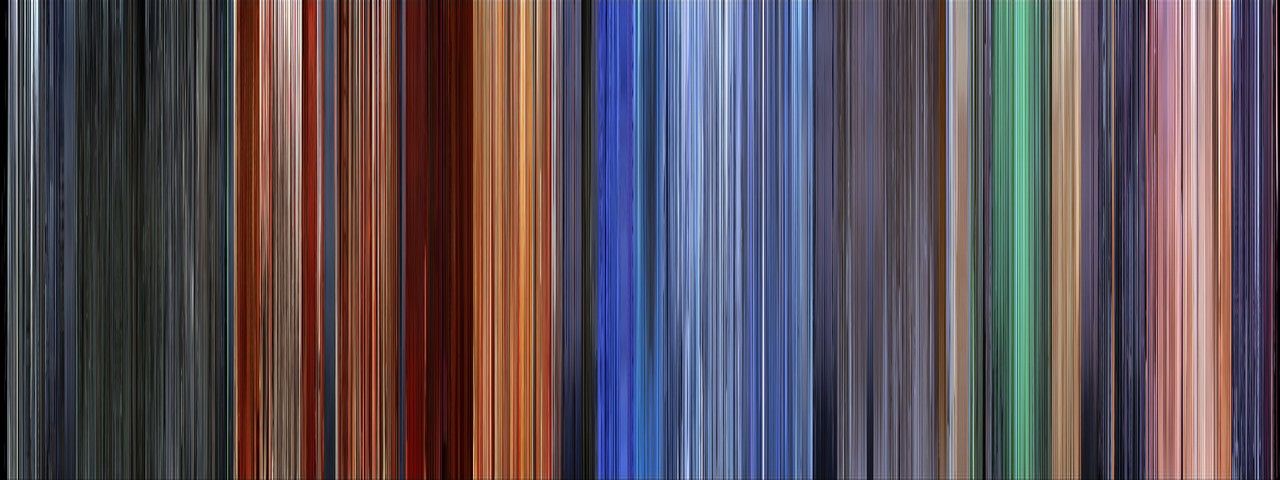
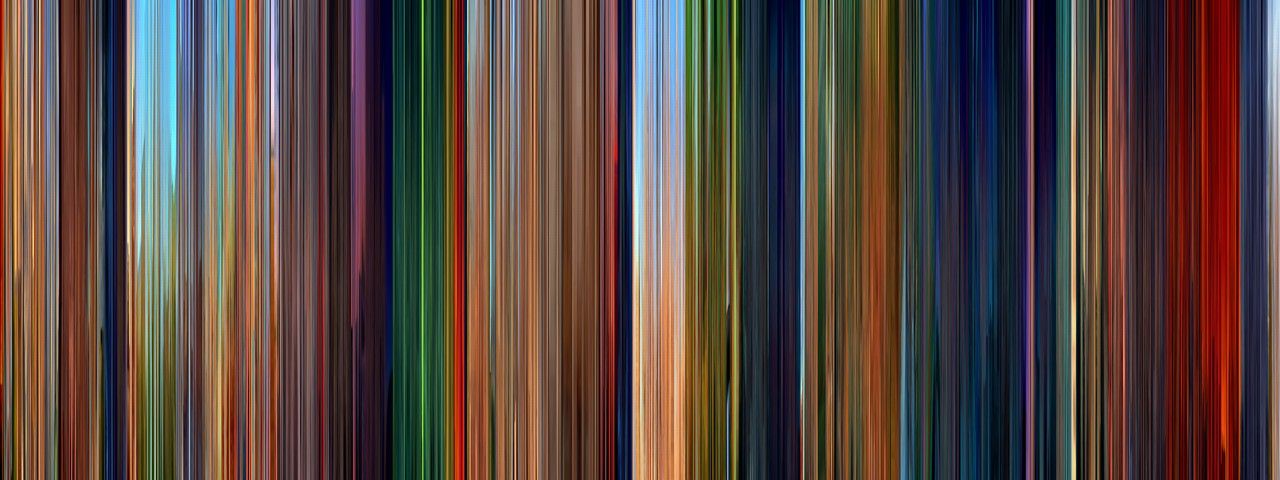
This begs the question: are there any movies which you could recognise from their “bar code” alone? I suspect this is only reasonable if you’re given a subset of movies to guess from, or if the movie is particularly distinctive. So for this week’s Things, see if you can guess the following movies (the answers are in the filenames of the images):

A famous Disney movie:

Another famous Disney movie:

A film I like:

New movies are regularly added to the Movie Barcode Tumblr, and most excellently they sell a variety of prints of some of the most popular!

Categories
Old

Things 44: Celebrations Results, Cat vs Squirrel, Procrastination Flowchart

(Originally sent April 2009)

Movies
This week I chose to see a film with Nicolas Cage in it instead of Slumdog Millionaire at the cinema, and I did not regret it. Insane big-budget B-movies like Knowing are the best thing to see on a big screen.

My review:

httpv://www.youtube.com/watch?v=uevBawlFZ1g

Blog
A rare event – I updated my blog, with the results from my Celebrations experiment.

Link
A reference for April Fool’s websites in 2009.

Quote
As referenced by my flatmate in the review of Knowing – Donald Rumsfeld, 2003, making a good point badly:

“Reports that say that something hasn’t happened are always interesting to me, because as we know, there are known knowns; there are things we know we know. We also know there are known unknowns; that is to say we know there are some things we do not know. But there are also unknown unknowns – the ones we don’t know we don’t know.”

Followed up by:

“I believe what I said yesterday. I don’t know what I said, but I know what I think… and I assume it’s what I said.”

Last Week’s Puzzle
Last week I asked about the 3rd most abundant element in the universe – it turns out to be Oxygen.

Puzzle
This week: a puzzle I don’t think I am quite able to set with sufficient precision, but will try anyway. You can buy some things in packets/tins/boxes and they list the number of items they contain, such as 6 eggs, 12 spoons, 52 playing cards. With a budget of £5, what would you buy to get the largest possible value for this number?

Video
Squirrel vs cat:

httpv://www.youtube.com/watch?v=RNhbTmKqQOE

Picture
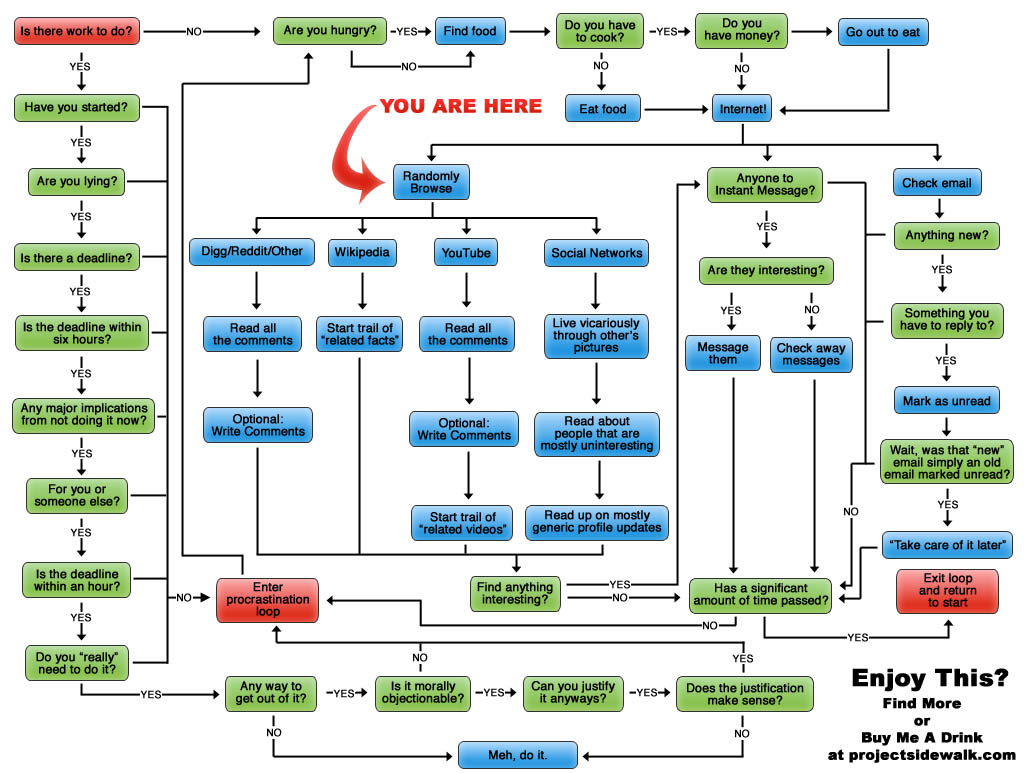
A procrastination flow chart (click for big):

Categories
Old

Things 43: Indian Superman, Pub Quiz Physics, Star Wars Collection

(Originally sent March 2009)

Video
The joy of cultural differences – Indian Superman (sound essential for when they get to the musical number):

(Note that their superman does not wear red pants on the outside – clearly they thought that would just be silly)

Link
A link to the non-text bit of another video, also showing the joy of cultural differences – a hard-hitting realistic portrayal of modern warfare featuring large-headed anthropomorphised animals, with a dramatically incongruous title:

http://www.youtube.com/watch?v=Gr4QBZfjtqs

[Video has been removed – try this link and make a cup of tea or something while the 90s pre-roll advert happens – T.M. 16/4/11]

[That video was removed too, try this search on Youtube – T.M. 17/5/22]

Quote

H. G. Wells: “History is the race between education and catastrophe.”

Last Week’s Puzzle
Last week
I asked how much longer a string stretched around the earth’s equator would need to be if it were to be raised by one meter (or indeed metre). Since the circumference of a circle is 2*pi*r, the new circumference would be 2*pi*(r+1) = 2*pi*r + 2*pi*1, i.e. 2*pi longer – under 7 metres.

This is counterintuitive since it seems very small, and it also doesn’t depend on what the radius of the earth is. A way to comprehend this intuitively is to imagine a square instead of a circle – to extend a string wrapped around a square of any size by one metre would always need two metres of string to be added at each corner.

Puzzle
This week
: pub quiz physics. The most abundant element in the universe is Hydrogen which has 1 proton. The next most abundant is Helium with 2 protons. What is the third most abundant element in the universe?

Picture
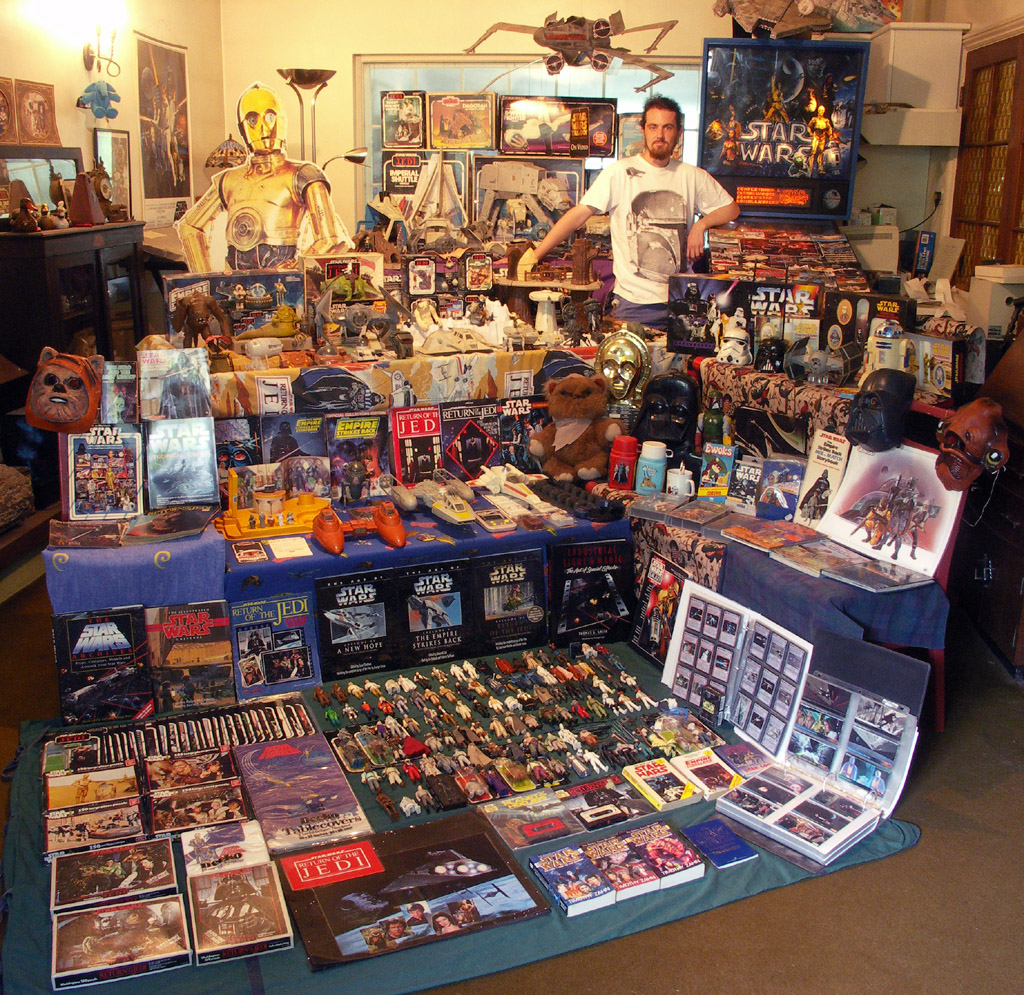
Apparently some people didn’t know about my Star Wars collection. Here it is – click to view full size:

Categories
New

Things 98: Weakest Link Puppets, GPS Doom, Visual Metaphors

Video
I really like The Weakest Link Puppets Special. There’s something about the way these worlds collide that just keeps me smiling as I watch – childish responses to adult questions, adult responses to childish questions, and a wonderful willingness of all concerned to make what’s ultimately one of the simplest illusions going really work. If you want to see the rest of the episode, YouTube will show you the way.
httpv://www.youtube.com/watch?v=fGlBDdsxeUQ

Link
A New Scientist article on how a surprising amount of our technological world is reliant on GPS.

Puzzle
After last week’s question on old-stuff-on-the-internet, I was looking back at my old Geocities site (now living on my own domain after Geocities shut down) and came upon my old Alternative Newsletters. I like to think of these as precursors to the Things email, but they’re really completely different, so I probably shouldn’t.

Anyway, one of them had the following quiz, which I thought I’d adapt for Things:

1) Is the answer to this question yes?
2) Is the answer to this question no?
3) Is the answer to question 4 maybe?
4) Are most of the answers yes in this quiz?
5) Have you stopped worrying about logical yes/no question traps?
6) If you answered maybe to questions 1-5, ask yourself another question in place of this one: If you cyclically rotate ‘maybe’, ‘no’ and ‘yes’ forwards through the alphabet, then answer questions 3 and 5 again, does this change whether or not you have to answer this question?
7) Answer this question last: What is the answer to question 8?
8) Is the answer to this different in comparison with the answer to the last question?

You don’t need answers, you know how many you got right.
Scoring:
0-2 questions correct: congratulations, you could be sane.
3-5 questions correct: bonus question! Did you get more than 3 correct? Answer, mark, and re-score.
6-8 questions correct: you do not need my congratulations, getting this many correct is its own reward (and punishment)
9+ questions correct: See Me.

Picture
A periodic table (actually not really periodic) of metaphors:
(click for big)

Last Week’s Question
Last Week I asked “What is the oldest evidence of your own activity on the internet you can still provide a live link to now”.

For me personally, it’s this review on Amazon dated 24th September 2001. I was active in a few other places before that, but they’re all dead now. Let this serve as a reminder to back up any data you hold dear.

Richard beats this by a long distance, with his usenet post dated 4th February 1992. Nearly 20 years ago! That’s a long time in the world of the internet.

By the way, the natural conclusion of this little game would be to try to find a link to the oldest thing on the internet. I’d have no idea where to begin, but let me know if you do.