Categories
Old

Things 56: Robot Hand, Earth and Moon, Magical Ground Squirrel Puzzle

(Originally sent August 2009)

Quote

“Most problems are side effects of solutions to other problems.” – Eskil Steenberg

Video
Once you have built a machine or robot that can do something, the really cool part is you can then see how fast it can do that thing. In the case of this astoundingly dextrous robot hand, the answer is: alarmingly fast.

Picture
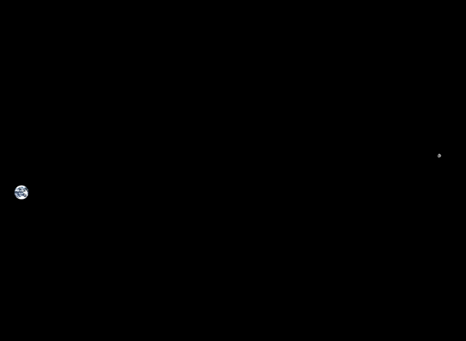
A simple idea – a picture representing the earth, the moon, and the distance between them, in the correct proportion.

(Click for description and links to bigger versions):

Last Week’s puzzle
Why are ~10% of people left-handed?

Implicitly, the question is really why 10% instead of 50% or 100%, either of which would be intuitively more obvious (although you’d still wonder why it was one out of those two).

A frequently given answer is that in combat there is an advantage to having a handedness that most others don’t have, since you will be practiced at fighting opposite-handers whereas most of the competition will be practiced against fighting same-handers. An increased number of left-handed players succeeding in adversarial sports such as tennis is cited as evidence.

What’s fascinating about this argument is that it manages to sound convincing but it cannot possibly be the whole answer. If there was an advantage to being in the minority, and if that trait is genetic, then we would expect that over evolutionary time-scales a 50/50 split would emerge. (If fewer are left-handed and have a survival advantage by this argument, then more of the next generation will be left-handed, and so on until no advantage remains).

For the theory to work, there would need to be an evolutionary pressure that goes the opposite way, making left-handedness disadvantageous in some way, with the net effect of the two pressures to be a 10% incidence rate.

As it turns out, it seems we don’t have a definitive answer, but surveying the various theories and research presented in this wikipedia article below it seems to be connected to asymmetry in brain development (a deeper question in itself), with cultural effects (such as fighting) giving an additional skew in the short term.

This Week’s puzzle
There’s a very nice puzzle in quantum information theory. This is my attempt to set the same puzzle in less specialist terminology, and although it ends up being quite long, it does involve a magical ground squirrel.

There is an island in the centre of a large lake.

On the island is the entrance to a tunnel that goes deep underground to the imp underground city.

To the North and South of the lake are two evil imp warrior training centres.

To the East and West of the lake are two good imp warrior training centres.

There has recently been an imp general election, and they will either have elected a good leader or an evil one. 1,000 imp warriors will now be allocated a training centre, with exactly 500 allocated to each one. So, if an evil leader has been elected, 500 imp warriors will be assigned to the North training centre, and 500 the South training centre. If a good leader has been elected, 500 imp warriors will be assigned to the West training centre, and 500 to the East training centre.

You are a magical ground squirrel that lives on the island.

A pair of bridges connect the island to the lake shore in opposite directions.

Your magical power is exactly this: you can rotate the pair of bridges so they lie in any direction from the island, so long as they remain directly opposite one another. So you could choose to have one bridge head directly North and one directly South, or one directly North-West and the other directly South-East, and so on. However, you must never use your magic when an imp is on the island or a bridge, as they will notice and put you in their magical animal zoo.

The 1,000 imp warriors are about to be sent out, one each hour, to go to their respective training centres. Imps are highly random creatures, and they also have a pretty amazing sense of direction. They will be coming out in a random order, and they will head along the bridge that most closely matches the direction of their training centre. If the bridges seem to be perpendicular to the direction they want to go (for example, if the bridges lie East and West and the imp wants to go North) then the imp will pick a bridge at random.

Using only your magical ground squirrel powers, what is the best way to work out whether the imps have elected a good or evil leader?

(Note: this is not intended as a lateral thinking puzzle! You just have to decide how to rotate the bridges and interpret the resulting imp behaviour. But I suppose you could try solving it laterally as well. P.S. Imps can cross a bridge in under half an hour).

Categories
New

Things 106: Best at Chess, Art of Science, Crowdfunding

Tim Link – Competitive Sandwich Making
Last week Clare and I ran a game based on tessellating pieces of cheese to make the best sandwich for the Hide&Seek Sandpit event. You can read about it and see the photos on my project blog, Tower of the Octopus.

Puzzle
In a chess tournament in which anyone can use any means available to them to come up with their moves, who would win? Some possible answers to give an idea of what kind of thing I’m talking about here:

  • A high-ranking chess Grandmaster
  • A really good chess-playing supercomputer
  • A huge team of moderately skilled players with some method of combining their ideas
  • A moderately skilled player with access to a moderately good computer that can run some basic chess calculations

(I had wondered about this in an abstract way before, but recently found out that has actually been done. I’ll relate what happened in that event next week, but you could of course try to Google as well as guess the answer if you wanted).

Video
(Via Phil): Art out of Science:
(Two views of the same thing. If your browser is up to it, you could try watching both videos simultaneously – start the bottom one 20s after the top):

Links
Kickstarter is one of my favourite things on the internet: people with an idea for something get a platform from which to shout about it, and to collect pre-orders or donations from people that like the idea. If there’s enough interest, the project can go ahead, and everybody wins.

So far I’ve helped fund two comics, the Wormworld Saga app (which saw so much success the creator, Daniel Lieske, decided he could give up his day job), and I’m currently backing The Endangered Alphabets Project, which is the kind of thing I like to imagine in a vague way is going on in the world, but I now have the opportunity to facilitate it directly (also, it’s only just on track to hit target, so do go check it out).

You can follow Kickstarter on Twitter, or go to their home page and scroll to the bottom to sign up for the weekly newsletter which highlights the most interesting projects.

IndieGoGo is similar but for reasons I can’t really pin down doesn’t work as well for me.

Crowdfunder is a UK version which I don’t tend to find as inspiring, but would probably be the best one for someone in the UK to create a project with (since Kickstarter requires a US bank account).

Quote
Overheard in the maths common room when I was studying for my PhD at Royal Holloway:

But nobody knows what probability is! Probability is defined in terms of randomness, and randomness is defined in terms of probability!

Answers to Monty Hall and the Two Envelopes
Last week I asked about the Monty Hall problem, which I should have introduced before the Two Envelopes problem I set two weeks ago.

The Monty Hall problem has a nice Wikipedia page, the most helpful part of which is probably the decision tree showing all possible outcomes.

In brief, the answer is that you should switch after Monty shows you an incorrect door, but certain misguided instincts steer most people away from that choice. The Endowment Effect and Loss Aversion mean that regardless of probability, people fear they would regret “giving up” their first choice more than sticking with it if they end up losing.

The more subtle effect is an instinctive (or partially trained?) feeling that the choices of others have no effect on the probabilities of our own choices in these kind of contexts. This is true when the other person has just as much information as you, but that is not the case here – Monty knows where the car is, and uses that information to ensure that he always opens a door with a goat behind it. So he has more information than you, and when you see his choice you gain some information.

Or to give an answer that might go with the grain of instinct for some people, consider this: there is a 2/3 chance that the car is behind one of the doors you don’t pick. Monty shows you that it definitely isn’t behind one of them. So there’s still a 2/3 chance the car is behind the other one, and a 1/3 chance it’s behind the one you first chose.

As for the Two Envelopes, it turns out this is more difficult than I originally remembered. Again, there’s a great Wikipedia page on the subject, which has quite a lot of detail.

As Thomas noted, a key phrase missing from the subtly specious argument for swapping is “Without Loss of Generality” (WLOG), which one must always be careful to check whenever substituting a variable (in this case, the amount in the envelope) with a specific figure (£10 in the example I gave).

Is it true that the reasoning I gave based on having £10 in the envelope truly retains the generality of the problem – would the reasoning also hold for any other amount? In short, no. For example, there could be 1p in the envelope, or any odd number of pence, in which case we would have to conclude that we had the lesser envelope (although this still means you should swap). More dramatically (here we imagine the envelopes contain cheques, and that these cheques are totally reliable), your envelope could theoretically contain over half of all the money in the world, in which case you can be sure the other envelope contains less. More realistically, it could contain more than 1/3 the amount of money you expect the person filling the envelopes to be willing to give away, in which case you would strongly suspect the other envelope to contain the lesser amount.

If you’re interested, do read the full Wikipedia article, and meanwhile, remember to watch out for unjustifiable WLOGs.

Categories
Old

Things 55: Cancer, Pentatonics, Handedness and the Police

(Originally sent July 2009)

Films
I saw Moon, which was a very nice bit of old-school sci-fi with a few nice ‘ah-ha!’ moments.

I saw G-Force 3D, and was amazed at how special effects clearly follow some kind of Moore’s law, while good writing remains a nearly insurmountable challenge.

Link
There’s a few sites out there attempting to keep up with what’s referred to as the Daily Mail’s “ongoing effort to classify every inanimate object into those that cause cancer and those that prevent it.” I like the way this one is helpfully laid out.

Of course, what would be nicer would be to use the research papers as a basis for such a project rather than the Daily Mail, at which point you’d probably need better risk-assessment functionality.

For example, I read a proposal to break global warming down to an individual scale – so if collective human actions increase the average temperature by 0.5 degrees over several decades, we could create an approximation for the temperature increase due to the production of any given product or action, and even though it would be tiny it would come to have meaning – e.g. this laptop causes a 23 picokelvin rise, but this one caused 573.

In practice, we’ve seen Carbon labelling, which is I suppose somewhat more accurate and tangible.

Unfortunately risk factors are really too complicated to be distilled to a single number for a single food item.

Video
Bobby McFerrin with a nice demonstration about how intuitive the Pentatonic scale is:

Last week’s puzzle
Why is gravity 37% that of Earth’s on Mars, even though Mars only has 11% of the Earth’s mass? Clearly there are Laws Of Physics at work, and we can’t fairly expect to have an intuitive understanding of how strong gravity ‘ought’ to be on planetary scales.

That said, there are two factors clearly at work:

– Density: Mars is slightly less dense than the earth – 3.9g/cm^3 vs 5.5 g/cm^3, or 71%

– Radius: Mars’ radius is 53% that of Earth’s. If you were somehow standing on a platform one earth radius away from the centre of Mars, the gravity you feel would certainly be weaker than the 37% that you would experience on the surface.

(Side note: if earth (or indeed any planet) were hollow, there would be no gravity on the inside, as the gravitational pull due to the outer shell cancels out no matter where you are in the interior!)


This week’s puzzle

Why are about 10% of people left-handed?


Quote

The Week
is a weekly summary of “everything you need to know about everything that matters”, expertly editing together coverage of the main stories of the week into coherent, balanced, and concise summaries.

Here’s a cut down version of their concise version of a story from Germany, which as well as cutting all the fluff from a story that could probably be expanded to a movie adaptation I also liked because it’s a wonderful case of reversing the usual fiction trope that ‘Police are Useless’

“Germany’s wealthiest woman, Susanne Klatten hit the headlines last year when her former lover was arrested for trying to extort €49m from her. He told Klatten that he had made a secret video of them having sex and threatened to make it public unless his demands were met. But Klatten went to the police and he was arrested.

“Last month, three men wrote a letter to Klatten in which they claimed to have a copy of the sex video and demanded €800,000 and a BMW car for its return. Once again Klatten called the police and the three were arrested.”

Okay, it probably wouldn’t make a very good movie.

Categories
New

Things 105: Pervasive Game Event, Monty Hall, American Politics

Upcoming Event, Thursday August 4th
People that like Things are very likely to like this. On Thursday August 4th from 7pm-10pm, Hide & Seek are running a Sandpit gaming event at the Southbank Centre. In practice this means you get to turn up and play lots of interesting games (for adults) for free. Having been to quite a few of these in the past, I highly recommend it as the games are always fascinating and inspiring. I’m particularly excited about this one because Clare and I will be running a game ourselves, one based on the age-old problem of tessellating pieces of cheese to make a perfect sandwich.

More details of the event can be found here, and the official Facebook event is here. Let me know if you think you can make it!

Puzzle – Monty Hall
After talking to some people about last week’s Two Envelopes puzzle, I realised that many Things readers may not be familiar with the Monty Hall Problem, which one should really understand before tackling the Two Envelopes. So I’ll state that here, then go through the answers to both in the following Things.

In the Monty Hall problem, you are in a gameshow presented by the eponymous Monty. You are asked to choose one of three closed doors. Behind one of the doors is a nice car that you apparently want to win. Behind the other two doors are goats. If you choose the door with the car behind it, you win the car. If you choose a door with a goat behind it, I don’t think you win a goat, but you definitely don’t win the car. Basically the goats are there just for comedic effect.

So you choose a door, pretty much at random. At this point Monty (who knows where the car is) opens one of the remaining two doors to reveal a goat. He does this in every episode of the show – whichever door the contestant chooses, Monty will always then open one of the remaining doors to reveal a goat. He then offers you the chance to switch from your first choice to the other unopened door. The question is: should you switch?

Link
Sometimes The Onion packs a headline with so much satire it barely needs the accompanying article. Most recently I was impressed by American People Hire High-Powered Lobbyist To Push Interests In Congress.

Quote
From Jon Stewart’s speech at the “Rally to Restore Santiy”:

The press can hold its magnifying up to our problems bringing them into focus, illuminating issues heretofore unseen or they can use that magnifying glass to light ants on fire and then perhaps host a week of shows on the sudden, unexpected dangerous flaming ant epidemic.

Picture
This National Geographic healthcare data visualisation achieves a rare feat: showing the data in an unconventional way that nonetheless actually tells a story with the data quite well. Charlie Park has some great commentary on why a scatter plot of this data isn’t actually as useful in his general discussion of slopegraphs.

Click for big: