Video
While not perhaps the best way to view the data (using time to represent time always feels strangely inefficient, although it’s difficult when you also want to present geographical data), this video might nonetheless be a good way to actually take in the data:
Quote
John Hodgman “A stopped clock is correct twice a day, but a sundial can be used to stab someone, even at nighttime.”
Puzzle
I’m sometimes called upon to help people with their children’s maths homework, and I found this problem particularly hard.
The solving method is explained as follows:
When you are working out a sum with more than one operation (eg 8 + 2 x 3), follow the BODMAS rule. Without these rules you could have more than one right answer, so getting the order of operation correct is important. You should calculate in this order;
Brackets
Order (powers/square numbers)
Division
Multiplication
Addition
Subtraction
The first problem in the ‘level 1’ set of problems is simply this:
2 + 4 — 3 + 5
What answer would earn you a tick from the teacher?
You can see the original problem sheet here, and the level 2 and level 3 problems here.
Picture
This curvy tube map is rather nice (although the full-size version doesn’t seem to be available any more):
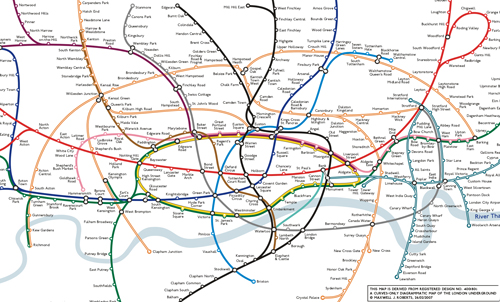
Some of you may recall the scale tube map from Things 18.
Last Week’s Puzzle
Last week I asked about Trigger’s Broom (also known as the Ship of Theseus problem): the broom has had both head and handle replaced many times, so we might ask “Is Trigger’s broom still the same broom? If so why, if not why not?” This question has stimulated debate and discussion for centuries and Things recipients were no exception. I’m going to paraphrase people’s responses here to prevent this issue of Things becoming even longer.
Both John and Laurence point out that the Sugababes present a similar problem (as does the Wikipedia article, which is an excellent starting point for anyone that has not delved into this subject before)(naturally “as does” could refer to both “point out” and “present a similar problem”).
Thomas makes the distinction “There are two questions: “Is it the same?” and “Is it the same broom?”,” pointing out that the former question is trivial, but for the latter “we don’t insist on new labels, new identities for every subtle change in an object … so things like the functions it performs and who possess it as better ways to identify them”.
Laurence counters “what if these heads/handles were replaced when they started to show wear, but were still functioning. If I rescue Head_1 and Handle_1 from the bin at different times and join them, what do I have?”
As Angela noted in her original setting of the question: “based on the fact that none of the cells in your body now are the same as they were when you were born, are you actually you??”
This was touched on in the puzzle from Things 41 (yet to appear in blog form), which went:
A famous bit of trivia that has been passed around for years holds that over the course of 7 years, every cell in your body will have been replaced with a new one. Are there any simple ways to disprove this?
To which there are some interesting answers.
Without diving down that rabbit hole too deeply, I first note my original answer to Angela on the personal identity issues raised by Trigger’s Broom:
Identity is a convenient fiction that we are hard-wired to believe in.
Second, I highly recommend making time for this cartoon which sheds some light on the subject, which I saw many years ago and Laurence managed to find on YouTube:
http://www.youtube.com/watch?v=pdxucpPq6Lc
A famous bit of trivia that has been passed around for years holds that over the course of 7 years, every cell in your body will have been replaced with a new one. Are there any simple ways to disprove this?