Categories
New

Things 81: the TV show, Spotify Poetry, Mad Scientists

Video
Laurence correctly identified that this is exactly the kind of multi-level high-speed animated insanity that I enjoy (and am currently wondering if I can design an infographic for):

Link
Share a Spotify playlist, make poetry. A nice little art form. I like this one:

Don’t Look Back Into The Sun
Choose
The Whole Of The Moon
Instead
It Won’t Hurt
Too Much
I Don’t Know Why
But It’s Better If You Do
Wish Upon A Star
Just
Not The Sun
It’s Too Hot For Words
Think About It
Be Careful
Remember
Everybody’s Free (To Wear Sunscreen)

Quote
I’ve wanted to post this quote for a while, but couldn’t remember it well enough to find it. Here it is courtesy of The Week, via The Times:

Max Planck: “A new scientific truth does not triumph by convincing its opponents and making them see the light, but rather because its opponents eventually die, and a new generation grows up familiar with it.”

Picture
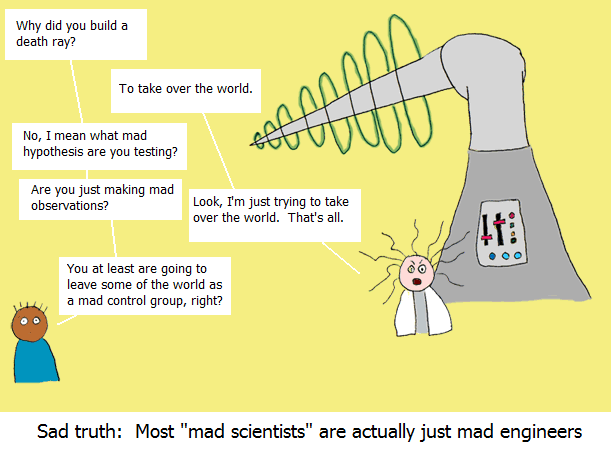
An excellent observation from the webcomic Cowbirds in Love, as conveniently recommended to me by the futuristic magical curation power of Google Reader Play (click to view full size on their site):

Last Week’s Puzzle
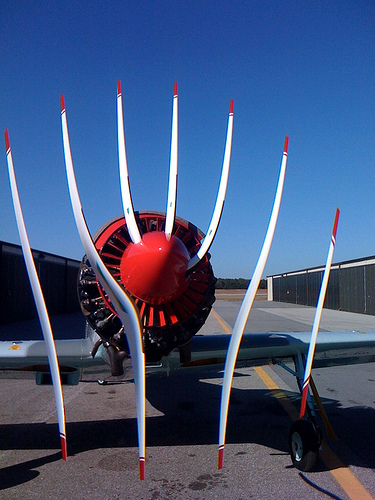
Last week I asked how a very strange photo of a physically impossible propeller was achieved. The answer is simply this, and you can see more examples here.

Puzzle
Each week a different section of Things is skipped in order to cut down the length. This week there is no puzzle. This is not a trick. There is no puzzle.

Categories
New

Things 80: Underwater, 3D, Propeller Puzzle

Video
A simple idea, but no less amazing for it:

Read more about this here.

Link
As soon as 3D cinema started to see regular releases, many of us wondered if there was a market for designer 3D glasses, or at least nicer ones than the pairs you get at the cinema. I suspect with the advent of 3D TV using the same technology, the market becomes viable, and so the product duly emerges.

Quote
Marvellously surreal, but also interpretable as a variation on carpe diem:

Bill Murray as Phil in Groundhog day: “Well, what if there is no tomorrow? There wasn’t one today!”

Puzzle
Given that no Photoshop is involved, how was this photo achieved?

Photo credit (and by its context, answer to the puzzle) is here.

Categories
New

Things 79: Stickers, Paulstretch, The Past In Colour

Tim Link
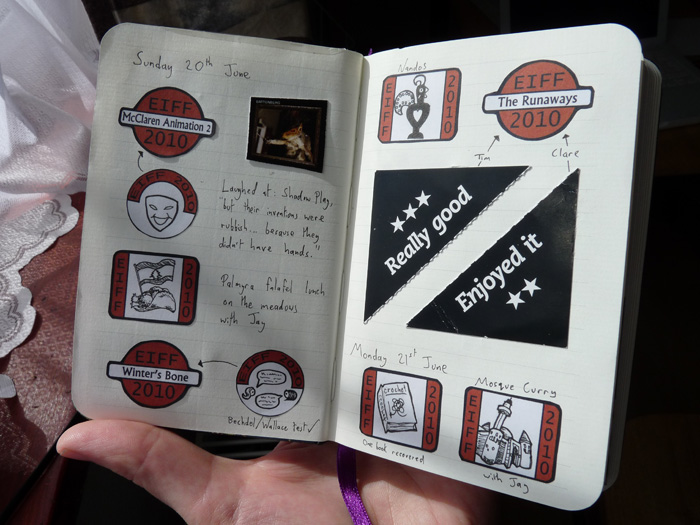
I inaugurated my personal blog (as opposed to my analysis type blog, Tower of the Octopus) with a write-up of how implementing a personal ‘achievement’ system (as in XBox achievements) with stickers made me have more fun on my holiday in Edinburgh:

Stickers Make Me Have More Fun
Link
PaulStretch is an amazing application that takes music and applies “extreme stretching” with minimal distortion (and does a few other things as well). Although it has been around for years, it suddenly garnered widespread attention when Shamantis posted a stretched-out 35 minute version of Justin Bieber’s “U Smile”, which works extremely well:

J. BIEBZ – U SMILE 800% SLOWER by Shamantis

I tried PaulStretch out on some other tracks and got similarly nice results, but “U Smile” does have qualities that work particularly well in this form.

I’ve been listening to it while watching extreme slow motion videos, such as this one.

Pictures
We are used to seeing certain time periods only in black and white just because of the timeline of colour photography development. However, pioneers of colour photography were active, and seeing their results is a strange experience.

1939- 1944 in colour

1909-1912 Russia in colour

Quote
Dorothy Gambrell (in Cat and Girl) has a line which sums up my feeling on looking at the above images:

“The past is just the present with different technology and funny clothes.”

Puzzle
An old classic this week.

There is a room with one light bulb in it, currently switched off. Outside the room you can’t tell if the light is on or off, and there are three light switches, only one of which operates the bulb: the basic challenge is to work out which one. In theory, you could flick a switch, go into the room to see if it worked, and if not come back out and flip the next switch, and so on. The challenge is to come up with a strategy in which you only need to enter the room once.

If that’s too easy, how about if there were four switches?

If you can manage that, how about if there were five? (I don’t know how to do that one, although Laurence claims it is possible. It may be that his setting of the puzzle is subtly different though…)

Last Week’s Puzzle
Last week I asked what answer to 2 + 4 — 3 + 5 would get you a tick from the teacher if you had just learned the BODMAS rule.

As Richard points out, BODMAS isn’t really consistent with the way we canonically parse equations (so the teacher would probably expect the answer 8, although strict application of BODMAS would yield -2), and there are better ways to teach it, as addressed in this Wikipedia entry.

The Week Before That’s Puzzle Again
Laurence supplies this excellent postscript to the Trigger’s Broom / Ship of Theseus problem set in Things 77:

“It has occurred to me that this could equally be applied to most armies,
governments, countries, football teams, religious cults, families, and
hell, humanity as a whole. At least one of these is the cause for things
like the situation in Northern Ireland, so I think if you could solve
Trigger’s Broom, then it could well go towards solving some larger
issues. (Albeit, possibly presenting people with some radically new ones
in the process!)”
Categories
New

Things 78: Nuclear, BODMAS, Curvy tube map

Video
While not perhaps the best way to view the data (using time to represent time always feels strangely inefficient, although it’s difficult when you also want to present geographical data), this video might nonetheless be a good way to actually take in the data:

Quote
John Hodgman “A stopped clock is correct twice a day, but a sundial can be used to stab someone, even at nighttime.”

Puzzle
I’m sometimes called upon to help people with their children’s maths homework, and I found this problem particularly hard.

The solving method is explained as follows:

When you are working out a sum with more than one operation (eg 8 + 2 x 3), follow the BODMAS rule. Without these rules you could have more than one right answer, so getting the order of operation correct is important. You should calculate in this order;
Brackets
Order (powers/square numbers)
Division
Multiplication
Addition
Subtraction

The first problem in the ‘level 1’ set of problems is simply this:

2 + 4 — 3 + 5

What answer would earn you a tick from the teacher?

You can see the original problem sheet here, and the level 2 and level 3 problems here.

Picture
This curvy tube map is rather nice (although the full-size version doesn’t seem to be available any more):

Some of you may recall the scale tube map from Things 18.

Last Week’s Puzzle
Last week I asked about Trigger’s Broom (also known as the Ship of Theseus problem): the broom has had both head and handle replaced many times, so we might ask “Is Trigger’s broom still the same broom? If so why, if not why not?” This question has stimulated debate and discussion for centuries and Things recipients were no exception. I’m going to paraphrase people’s responses here to prevent this issue of Things becoming even longer.

Both John and Laurence point out that the Sugababes present a similar problem (as does the Wikipedia article, which is an excellent starting point for anyone that has not delved into this subject before)(naturally “as does” could refer to both “point out” and “present a similar problem”).

Thomas makes the distinction “There are two questions: “Is it the same?” and “Is it the same broom?”,” pointing out that the former question is trivial, but for the latter “we don’t insist on new labels, new identities for every subtle change in an object … so things like the functions it performs and who possess it as better ways to identify them”.

Laurence counters “what if these heads/handles were replaced when they started to show wear, but were still functioning. If I rescue Head_1 and Handle_1 from the bin at different times and join them, what do I have?”

As Angela noted in her original setting of the question: “based on the fact that none of the cells in your body now are the same as they were when you were born, are you actually you??”

This was touched on in the puzzle from Things 41 (yet to appear in blog form), which went:

A famous bit of trivia that has been passed around for years holds that over the course of 7 years, every cell in your body will have been replaced with a new one. Are there any simple ways to disprove this?

To which there are some interesting answers.

Without diving down that rabbit hole too deeply, I first note my original answer to Angela on the personal identity issues raised by Trigger’s Broom:

Identity is a convenient fiction that we are hard-wired to believe in.

Second, I highly recommend making time for this cartoon which sheds some light on the subject, which I saw many years ago and Laurence managed to find on YouTube:

http://www.youtube.com/watch?v=pdxucpPq6Lc

A famous bit of trivia that has been passed around for years holds that over the course of 7 years, every cell in your body will have been replaced with a new one. Are there any simple ways to disprove this?