Categories
New

Things 73: 5 seconds, Mamet Memo, Choose a Typeface

Video
The top 20 entries in a 5-second video contest – another great example of creativity out of limitation, as discussed in the Things Art Special (contains some scenes likely to offend, although only briefly):

httpv://www.youtube.com/watch?v=saqO_ZqX6uY

Quote
David Mamet’s extraordinary memo/rant/lecture on writing good scripts, packed with excessive capitalisation, fractured grammar and other weird errors, all of which only serve to reinforce the passion with which he is trying to improve the world, can be read here.

If you don’t have time for 1,099 words, here’s a synecdochic exceprt:

EVERY SCENE MUST BE DRAMATIC. THAT MEANS: THE MAIN CHARACTER MUST HAVE A SIMPLE, STRAIGHTFORWARD, PRESSING NEED WHICH IMPELS HIM OR HER TO SHOW UP IN THE SCENE.THIS NEED IS WHY THEY CAME. IT IS WHAT THE SCENE IS ABOUT. THEIR ATTEMPT TO GET THIS NEED MET WILL LEAD, AT THE END OF THE SCENE,TO FAILURE – THIS IS HOW THE SCENE IS OVER. IT, THIS FAILURE, WILL, THEN, OF NECESSITY, PROPEL US INTO THE NEXT SCENE.

ALL THESE ATTEMPTS, TAKEN TOGETHER, WILL, OVER THE COURSE OF THE EPISODE, CONSTITUTE THE PLOT.

Puzzle
Some of you may remember cassettes, small mechanical devices about eight times the size of an mp3 player, with 90 minutes or so of music physically encoded on a piece of wound tape, designed to spool and respool through a larger mechanical device which would ‘read’ the tape and produce the appropriate noises.

The tape had two ‘sides’, and you would play the other side of the tape by literally turning the cassette over.

The puzzle is this: no matter which side up you turned the cassette, the same physical side of the wound tape would face outwards. So how did the machine know which ‘side’ to play?

Picture
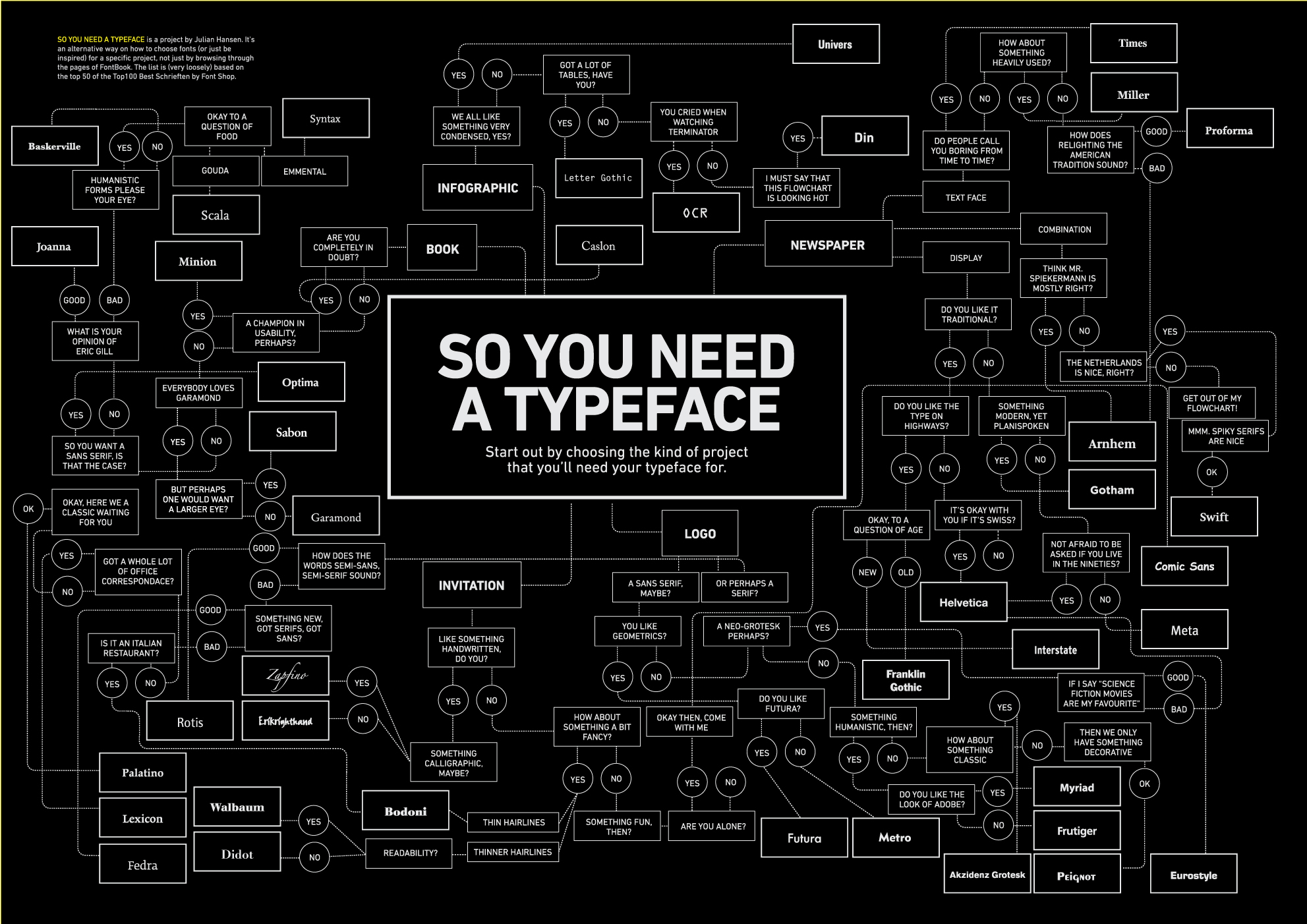
A well-thought-out flow chart to help you choose a font for any occasion:

Categories
New

Things 72: Art

Quotes
Flaubert: “Art is born of restraint and dies of freedom”

Dorothy Gambrell (Cat and Girl): “Great stuff is usually made within very set boundaries […] the importance of a medium lies in its limitations.” (link)

Antony Gormley: “A lot of public art is gunge, an excuse which says, ‘we’re terribly sorry to have built this senseless glass and steel tower but here is this 20-foot bronze cat'”

Link
Kanji that transform into the animal they represent. A brilliant example of art within tight boundaries.

See the rest of the series here (although beware potentially NSFW imagery at the bottom of the page, after the polls, depending on what they have posted recently).

Video
Here’s a really amazing example of art vs limitations: using only the ramblings of a reluctant drunk man for the audio, make a video about the story of a historical figure. Somehow, moderately famous actors are involved in the project. The result is fascinating (although does contain moments of the more unpleasant consequences of drunkenness):
Drunk History – Nicola Tesla
httpv://www.youtube.com/watch?v=1T5gQHa2pq4

Pictures
Putting captions on pictures of cats is an emerging art form I have been monitoring for some time. I previously put together my top 10 cats from 2007 and 2008; here, belatedly, are my top 10 cat images spotted in the first half of 2009.

Question
Roger Ebert asserts that “Video games can never be art” Why is he wrong?
(See these posts on Penny Arcade for context and their own responses).

Last week’s Puzzle
Last week I asked what would be the best thing I could buy that would maximise hours saved per pound spent. This produced a wide range of responses, largely depending on which assumptions people chose to question.

  • Yasmin suggests Red Bull (and similar) to save time by needing less sleep.
  • Alam suggests a clone of myself
  • Xuan suggests slaves and a washing machine.
  • Angela suggests two books that could improve one’s efficiency and so save time – The Miracle of Mindfulness and Making Time. (Funnily enough I already own the latter… but I haven’t found time to read it yet).
  • John suggests grated cheese.
  • Phil points out anything free that saves any time would maximise the metric, such as DropBox. This technically lies outside the “buy” requirement. He also suggests a combi-microwave and a smartphone, and then finally a device to prevent time-wasting by cutting off internet access between certain hours.
  • Simon specifically attempted to address the “I” part of the question by recommending an iPad as being a particularly good purchase for me, by switching to digital goods (music, movies, comics, books); “Imagine all that time not wasted, going to shops, ordering physical products online and searching for things you can’t find.” I don’t exactly agree, but that’s a huge discussion for another time.

Finally, Laurence suggests a Time Machine, and insightfully adds:

The inevitable complexity of all the proposed solutions reminds me of
the following quote:

“If you want to make an apple pie from scratch, you must first create
the universe.”
– Carl Sagan

I had planned to make simple estimates for the “hours saved per pound spent” for each answer and declare a winner, but due to the range and complexity of answers this now falls out of the remit of Things and will instead be posted over on my analytical blog, Tower of the Octopus (which now has its own domain) once I find time to make such estimates.

Categories
New

Things 71: Stadium Destruction, Book Length, Time for Money

Video
I first posted one of Immersive Media look-around-as-you-play-it videos in Things 62 (not yet on the blog). I like this one even more, because it achieves something artistically that a static video can’t.

Link
I’m interested in the way form influences content. As part of a longer series explaining what actually goes on between someone writing a book and someone else buying it, Charlie Stross explains why books are the length they are.

Puzzle
You can’t buy time (and I note that the world would actually be pretty scary if you could), but you can spend money on things that save you time. In terms of maximising hours saved per pound spent, what would be the best thing I could buy?

Pictures
Monsters are distilled fears. New fears demand new monsters. So here’s some Google Monsters, courtesy of Super Punch:

Categories
New

Things 70: Spiral, Parking, Rats

Link
When looking at animal intelligence (or indeed artificial intelligence) we tend to set arbitrary high bars for what we consider to qualify as ‘true’ intelligence (recall Roger Puffin’s rebuttal of Artificial Flight). That said, I’m not actually convinced that this experiment, in which rats play the Prisoner’s Dilemma, can be interpreted as demonstrating anything other than understanding a basic set of rules and causal connections. It’s still interesting though.

Quote
Phil: Doing stupid things can have certain positive beneficial effects.

Picture
In December 2009, a fascinating phenomenon was observed in Norway. If you’ve not already seen it, see if you can guess what caused it before reading more.

Video
Actually just an animated GIF:


Last Week’s Puzzle

Last week I asked why my mobile might need to recharge more frequently after I’ve moved house.

Tarim pointed out that phones monitor available signal strength and adjust power output accordingly, so if my new house has worse reception the phone will boost its power and so run out of charge more quickly. Miranda pointed out that changing who you live with might have an effect on who you phone regularly, so changing how much you use the phone from day to day. Xuan, Alam and Yasmin all independently suggested that the new house might not have a landline and so I would use my mobile more often. Xuan also suggests the phone’s battery may happened to fall “terminally ill” at the same time as the move and there was nothing causal about it. An impressive range of plausible answers!

However, signal strength is about the same in my new place, I have a landline, the battery is as good as ever, and although my use of the phone did increase due to the new flatmate situation, there was a bigger effect (which Tarim later guessed): commuting via the tube instead of walking. This results in an extremely acute version of the low-signal-causes-power-boost feature Tarim had described. If I switch my phone off before going underground and on when I re-emerge, one charge lasts about as long as it ever did.

(This might seem a pretty obscure answer to the problem, but I suspect it’s quite relevant to people living in London, particularly those with power-hungry smartphones).