Categories
New

Things 96: Rocket Path-Dependency, Lipstick Animals, 3D Doesn’t Work

Link
When speculating on the subject of extraterrestrial space-faring life, it’s all too easy to forget the many development factors that are likely to be local to us, and to assume that too much of what we have done will generalise to other life forms out there. This article puts forward a compelling argument that our rocket-based space-faring only arose because of certain very specific and not particularly likely events.

Quote
While I don’t think it could be objectively assessed, I rather like Arthur Koestler’s observation on originality:

The more original a discovery, the more obvious it seems afterwards.

Picture
This is one of the things that makes me think of that Arthur Koestler quote: lipstick animals.
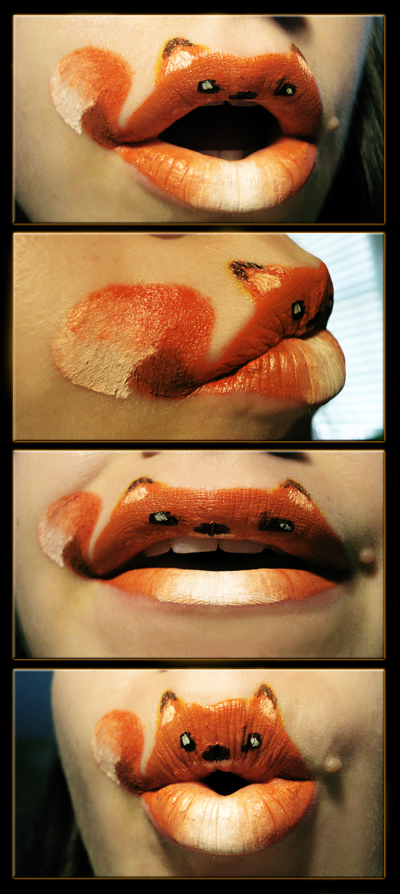
Lots more here.

Question
Why 3D doesn’t work and never will. Case closed.”
Roger Ebert quotes Walter Merch, as a Man Who Knows What He’s Talking About, who presents several arguments as to why 3D cinema can never work.

I’ve heard a lot of bad arguments on both sides of this debate, so it’s nice to see someone with a deep understanding of the medium draw out their arguments clearly. My question is, is he right?

Previous Puzzle
Last time I asked how a mouse could fall any distance and survive.

As Phil pointed out, the statement is strictly false: “a mouse certainly can’t fall further than the size of the universe, for example.” So instead we restrict ourselves to consider mice falling off things that are attached to the earth, and no higher than the point at which the atmosphere becomes too thin for a mouse to breathe, and that the survivability criterion is assessed upon landing, and that the landing area itself is not deadly to mice.

First we must address the idea some people recall from school that all objects fall at the same speed, as per Galileo’s thought experiment and his apocryphal dropping-objects-from-the-tower-of-Pisa experiment. This is clearly false as a feather falls more slowly than a hammer, and the confounding factor is air resistance. Rather excellently, the hammer-feather experiment was conducted on the moon to show that in the absence of significant air resistance, they will actually fall at the same speed:

httpv://www.youtube.com/watch?v=PE81zGhnb0w

When air resistance is introduced the shape and particularly the downward-facing area dimensions of the falling objects matter, and although it’s hard to have a good intuitive feel for this when comparing such random objects as animals, I find it’s much easier to imagine a kind-of equivalent parachute with a weight attached.

A small parachute with a big bag of hammers attached will be pulled down more quickly than the same parachute with a feather attached. Alternatively, if two parachutes have equal weights attached, but one parachute is much bigger than the other, it’s easy to imagine that the bigger parachute has greater air resistance and so will fall slower.

Now if we imagine a parachute the size of a mouse, with a weight attached that is the same weight as a mouse, we can imagine it will fall pretty slowly, particularly compared to a parachute the size of an elephant with a weight attached the same weight as an elephant. So we can intuitively understand that the mouse survives.

Or perhaps we can’t? I realise that wasn’t very scientific, but I tend to prefer thought experiments of this kind as they seem to help most people grok ideas better than formulae.

This article over at Everything2 also has some concise words to say on the subject of falling animals.
Categories
Old

Things 36: Amara’s Law, Wondermark, hahahahah

(Originally sent December 2008)

The ‘Things’ email has existed in one form or another for over a year now. The fact that this is number 36 and not 52 shows that I clearly take too many Fridays off. (Actually it was mainly due to a big hiatus). Anyway, I have this Friday off, but have decided that that is not a good enough excuse.

Owing to the popularity of the chicken video last week and the sort-of anniversary of Things and the approaching of Christmas and the addition of more people to the list over the year, I thought it might be an idea to have a ‘Best of Things’ roundup next week.

So please reply and nominate your favourite items that have ever appeared in Things, and I will use these to compile a top 5, or something. I guess the people that just joined in the most recent wave don’t really have enough to go on, sorry! [Note, not a live question, this was sent in December 2008! – T.M. 22/1/11]

Quote
Roy Amara
:

We tend to overestimate the effect of a technology in the short run and underestimate the effect in the long run.”

Link
Wondermark
is a webcomic that is also a really great example of the value of copyright expiry. David Malki takes images from the 1800s (sourced from the public domain or his own collection of rare books), does a bit of photoshop and then adds speech bubbles.

He’s actually not bad at drawing either, but his writing is really very good, and this enables him to focus on that.

My personal favourite strip is a great example of how he makes humour out of philosophy:
http://wondermark.com/413/

My favourite sequence consists of four strips about getting rich, or not, which begins here:
http://wondermark.com/383/

A good example of his skill as a writer can be found in the following strip, in which there is a well-argued, thoughtful and erudite argument against the advertising for Shrek the Third, in about 60 words:
http://wondermark.com/298/

Puzzle
Last week we wondered why a chicken holds it’s head so still. A bit of Googling didn’t prove it immediately, but I am pretty confident that the reason is this: their vision, or processing of vision, is either movement-based or strongly prioritises movement. A bit like the dinosaurs in Jurassic Park.

This week a bit of estimation for you. In the UK, are there more households with dogs, or more with cats?

A Video (or two)
This video was brought to my attention by Richard. Alan Watts was a dude who knew what he was talking about, and said some wise things. The South Park guys did some animations that went with those things. Here is my favourite:

httpv://www.youtube.com/watch?v=ERbvKrH-GC4

For you cat/Roomba fans, here’s another video of a cat riding a Roomba – this time the Roomba is behaving normally rather than being remote controlled. It gets a bit repetitive but do skip to the end if you get bored, as Something Happens:

httpv://www.youtube.com/watch?v=MIjE8BVV-VI

Picture
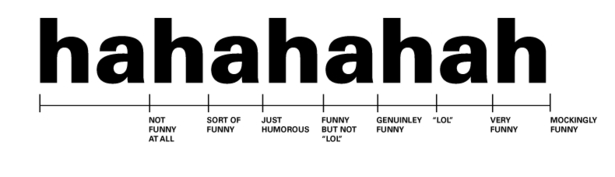
A shrewd linguistic analysis of laughter:

Not really a picture I suppose, but best expressed as one.

Categories
Old

Things 35: Lovefilm, People of the Screen, Chicken Head

(Originally sent December 2008)

I joined LoveFilm last week, mainly so I would know what I was talking about when giving a presentation to them on what I think they should be doing. It turns out they already do a lot of what I had first thought of so I knew to leave that out, and during the presentation I found out that they are planning to do a lot of the stuff I thought of too.

In other words, they do a lot of stuff that I think is good, and are going to do more. My name is Tim Mannveille and I endorse this message.

My Lovefilm profile is here so you can see what I’m doing with the service, and here is my referral link that gives you a 1 month free trial and me a referral bonus!

Films
So, I still don’t have time to see enough films for a Cineworld Unlimited card to be worth it, but the LoveFilm £3.99/month for 2 DVDs is about right. So this week I saw The City of Lost Children, by much the same team as Delicatessen and Amelie. It was visually incredible, inventive and dreamlike, as expected.

IMDb: 7.8/10
RT: 82%

Trailer viewable over at Lovefilm.

A link
While researching quite what is possible in terms of tracking mobile phones, I stumbled upon a bit of real life drama on Google Answers. “I’m trying to locate a friend who has gone missing and may be in a lot of trouble…”

A [long] Quote:
Kevin Kelly knows what he is talking about, and wrote an understated but amazing piece for the NY Times recently. A choice excerpt:

“When technology shifts, it bends the culture. Once, long ago, culture revolved around the spoken word. The oral skills of memorization, recitation and rhetoric instilled in societies a reverence for the past, the ambiguous, the ornate and the subjective.

Then, about 500 years ago, orality was overthrown by technology. […] The distribution-and-display device that we call printing instilled in society a reverence for precision (of black ink on white paper), an appreciation for linear logic (in a sentence), a passion for objectivity (of printed fact) and an allegiance to authority (via authors), whose truth was as fixed and final as a book. In the West, we became people of the book.

Now invention is again overthrowing the dominant media. A new distribution-and-display technology is nudging the book aside and catapulting images, and especially moving images, to the center of the culture. We are becoming people of the screen.”

A Video
Well, this week’s Things has been very serious so far, so it’s time for a video of someone moving a chicken around while the chicken holds its head incredibly still:

httpv://www.youtube.com/watch?v=_dPlkFPowCc

A Puzzle
Last week I asked people to guess why the search term ‘uncertainty’ showed such an odd annual trend. The most likely explanation seems to be students searching for Heisenberg’s uncertainty principle – if you put other terms students might be looking up into Google trends, you see the same annual trend cropping up. [Google Insights for Search also helps as it reveals what people tend to actually be looking for when searching for a given search term – T.M. 2/1/11]

This week, the question is: why do chickens keep their heads so still?

Pictures
It still feels like I’m taking Things too seriously, so here’s an article with pictures of loos with the best views.

Categories
New

Things 92: Walk Straight, Marmite Looks, One Day Music Experience Timeline

Video
A nice bit of rotoscope animation that asks the question “Why can’t we walk straight?”

Link
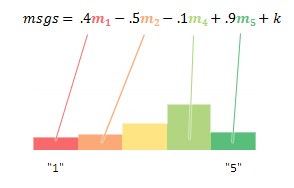
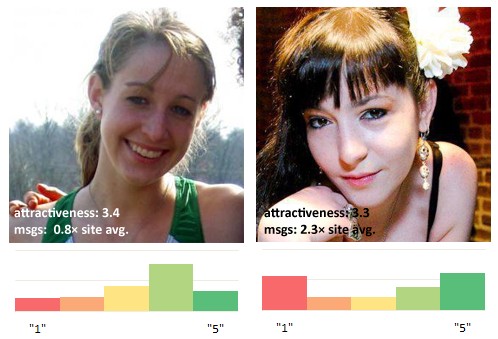
As an intriguing to follow-up to the question in Things 89 on why perceptions of attractiveness vary, OK Cupid have posted a related result: greater variation in attractiveness rating scores tends to generate more messages on the service.

The fact they say “men will get their turn under the microscope” might mean that the same result does not hold true for men, or they might just not have checked yet.

Tip
I’ve recently been enjoying a handy little shortcut in Firefox that lets me jump straight to search results on certain sites without reaching for the mouse.

Start by clicking the dropdown option against the search box, and click ‘manage search engines’:

From this menu, pick a search engine you commonly use and click ‘edit keyword’, I recommend something very short:

You can then query your chosen search engine by jumping to the location bar (Ctrl + L) then preceeding your search with your chosen keyword. For example, I can type “Ctrl + L” and then “wa how old was pat morita when karate kid came out”, press enter, and get straight to the answer without any clicks of the mouse.

(Rotten Tomatoes doesn’t seem to have this option, but there’s a Firefox add-on which is a slight improvement).

Picture
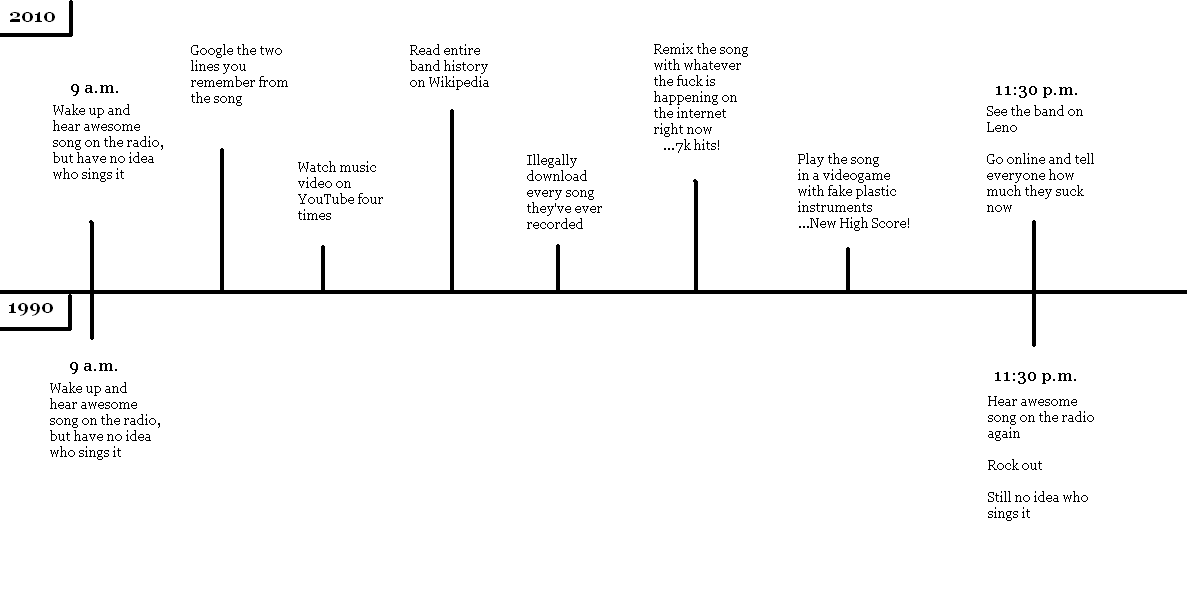
A nice way to illustrate the changes technology has wrought on the radio music experience over the last 20 years, with only a little exaggeration (click for big):

No Puzzle
According to the schedule of rotating absence, there’s no puzzle this week, but feel free to think about why we can’t walk in a straight line if you like.

Last Week’s Question
Last week I asked if anyone else had noticed a sudden surge in the misuse of “i.e.” and “e.g.”. Not many had, but a lot of people had something to say on the subject… probably enough for a whole post by itself, but I’ll attempt to quote in brief the different responses.

First, a few admitted to not being certain of the distinction themselves, even when they were sticklers in other areas, so I suppose that means I’ve done my bit to stem the tide somewhat.

The question on living vs prescribed language raised a few responses in itself. Maria noted:

The French spoken [in Montreal] is a pure and true form of ‘old’ french, ‘where for art thou’ for example. When Montrealers go to France their version of French is hardly understood which just goes to show that languages must and do evolve or we’d be speaking like players in a Shakespeare play.

Angela confessed that:

… I am afflicted and am involuntarily irritated by things like this that really should not be so irritating to me! The most frequent examples I can recall seeing include your i.e. / e.g.; everyday / every day; and unnecessary apostrophes e.g. potatoe’s, kid’s. In all cases I think that the incidence rate is increasing and we may well have passed a tipping point whereby ‘everyday’ will now mean both ‘everyday’ and ‘every day’ for ever more.

… and agreed that it’s better to let these things go, unless the error could lead to a misunderstanding, in which case it’s worth pointing out.

Rik provided a link to a tongue-in-cheek view on the book “Eats, Shoots and Leaves”, which among a lot of hyperbolic fuming makes the following point:

We are not computers which can be thrown off course by the insertion of a full stop here or a rogue hyphen there. We have a deeper understanding of meaning which you can check out for yourself by a quick reading of Chomskys writings on transformational grammar.

Simon identified a potential underlying factor behind rising misuse:

Latin stopped being taught in UK state schools during the 60s. At approximately the same time, English grammar died out as a subject because people thought it harked back to a redundant time. […] With the loss of learning through grammatical structure we have moved as a society from having a right way of doing something to adopting what society does. […] A case of crede quod habes – et habes if ever there was one.

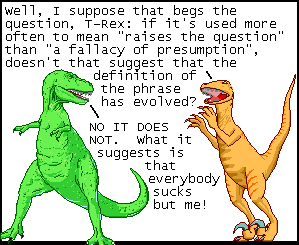
Miranda gave further endorsement to the importance of Latin by nothing that in the case of “i.e.” and “e.g.” anyone lucky enough to have learned the language at school can easily remember which is which by recalling what the abbreviations stand for. She also pointed out that Dinosaur Comics recently addressed the issue of prescriptivism:

Finally, Xuan asks

Anyways, why did we start using e.g. and i.e. in the first place? Didn’t the Romans bugger off around 400AD?

Incidentally, in an attempt to find evidence that fewer people cared about the distinction between “i.e.” and “e.g.” I turned, as usual, to Google Insights for Search, only to find results that suggest the trend is going the other way. Alternatively, technological changes mean more is being written down by more people than ever before, so there’s more of both.