Categories
Uncategorized

Why I love the ‘Up All Night’ music video

I previously wrote in passing about how the internet can encourage toxic discussion, partly because people are more likely to post about something when it makes them angry. A good way to respond to this observation is to march in the opposite direction: write about things you love!

To that end, let me tell you about one of my all-time favourite music videos. The song is Beck’s ‘Up All Night’, the video is by CANADA (the creative production company, not the country), and you should just watch the whole thing first:

Wow, so what was that! Let’s break it down. Note, I’ll be using the actor’s names, as character names are not given.

The opening

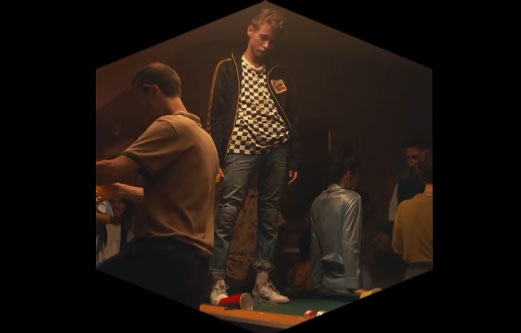
We begin in a hexagonal frame – a visual motif for Beck’s album, Colors – bringing us in to a party. Right away, we see this party is long past its peak: there’s an unsettling discordant strumming, and while our attention is on Pedro Attemborough falling into a drunken faint, we subconsciously pick up on someone stepping over debris, and on the right a woman forcefully pushes back a man after he draws uncomfortably close. We read the environment as inebriated and ambiently hostile, particularly for women.

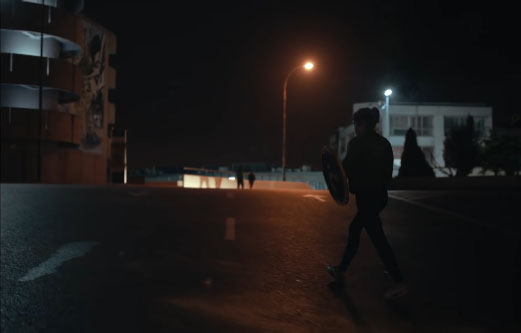
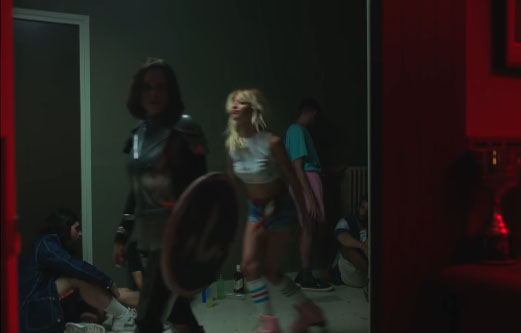
The very first edit demands our attention. First, Pedro hits the ground with a strange metallic sound. Then, as soon as we register that as strange, we cut to Solene Rigot, and immediately understand that the sound was actually her kicking a street sign. Further kicks are synchronised with the credits, and then in a dreamlike transition that skips what must surely be a difficult process, Solene is now walking off with the sign as an ersatz shield.

Having drawn our attention to the synchronisation of image and sound, we enter an eerie silence as she marches into the night, right into the path of a tall man(?) dressed as Snow White, smoking, staggering, clearly leaving the party we just saw. Perhaps expecting a woman to defer to his path, he is surprised as she off-handedly clips past him – and that exact moment of conflict is punctuated with the opening guitar stabs of the song, finally kicking in, 30 seconds into the video.

So tacitly we identify with Solene, familiar as we all are with the rudeness of those that won’t even slightly move to let us by, the music telling us to feel triumphant that she came out the better from the borderline violent exchange.

Now perhaps it seems like I’m digging into too much detail here, but I think it’s important to appreciate that this quiet introduction has been packed with synaesthetic interest and detail, setting the stage for a conflict, and getting us to root for our protagonist – all with no dialogue. There’s a party, a man in trouble (we assume she’s headed for him), a vaguely misogynistic atmosphere, and a woman fully prepared to plunge into it to get what she wants.

The approach

A brief cut back to Pedro confirms him as her destination, then we return to Solene approaching the next level of the patriarchal gauntlet: a group of young men chatting and laughing. Superficially benevolent, it doesn’t take much life experience to recognise this as a potential threat to a young woman alone at night. This fear is immediately subverted as Solene again takes the role of aggressor: without breaking stride she grabs a bag off a shoulder, sharply unzips it, does – something? – then throws the bag off the walkway. The strange tension of wondering what she did with the bag is then resolved with a cut to her holding a doughnut in her mouth, before her hand reaches up to yank it out as she takes a bite, still marching.

To be clear, this is kind of a dick move, and the fact it inverts the patterns of a society that routinely disempowers women does not make it okay – but as Drew McWeeny noted in the 3rd episode of Voir, a protagonist doesn’t have to be likable for us to care about them or be invested in their journey. This simply tells us she will do whatever it takes to see this ambiguous mission through.

She pauses a moment as Beck’s lyrics tell her to “pull yourself together” and “it’s time to go”. She pulls out an inhaler and takes an assisted breath (a sudden moment of vulnerability) and we cut to Pedro apparently leaking urine, kind of disgusting, but raising the stakes of the quest: he needs her help.

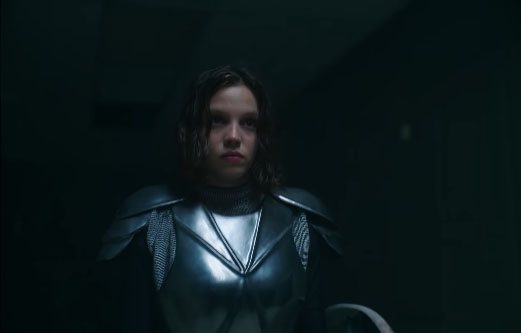
In the video’s first moment of magical realism, Solene pivots on the spot, and with nothing but a simple cut is now armoured; we understand she has quite literally steeled herself.

She discards the inhaler, another dick move, but hey – armour doesn’t have pockets. She starts running, and eight cuts at different angles (timed to hand-claps) build the tension to the next key moment: the song bursts into the chorus and she bursts into the party itself.

The party

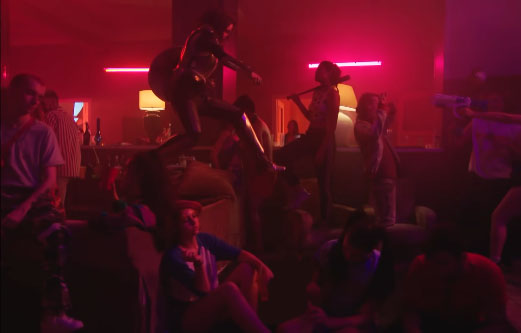
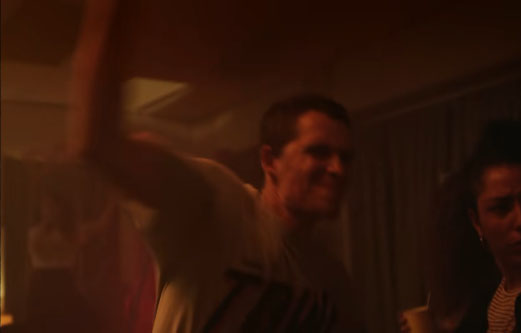
Through a few quick shots in slow motion we see the party as we feared: debauched, uncomfortably packed, hazardous to human health. Solene’s progress seems almost miraculously smooth, but at this point we’re not surprised.

As she makes it from the red-lit room to the orange, the stakes rise: a fight between men dressed as nuns (a scene I have, bizarrely, personally witnessed at a stag do on the streets of Portsmouth), and an unfortunate collision between Solene and a woman triggers the moment of male aggression we feared would come.

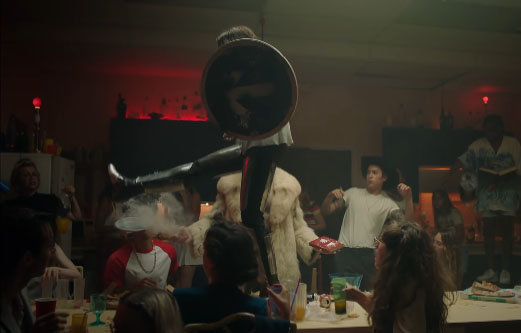
Instantly enraged, the man flings a bottle at our protagonist; her first response is to grab a hookah (why?), before turning to deflect the shattering bottle with Chekhov’s shield, and smoothly using that turn as a wind-up to lob the hookah back. We are taken aback – she has been a bit rude so far, sure, but this violent response doesn’t seem right – only to find that it’s simply to knock the cans off a comatose man’s forehead. Weird but delightful!

She knocks the door down to the kitchen: drug central. Wilfully destroying the drug paraphernalia as she progresses, it seems the hookah throw wasn’t an afterthought; she appears to actively despise drugs and all they stand for.

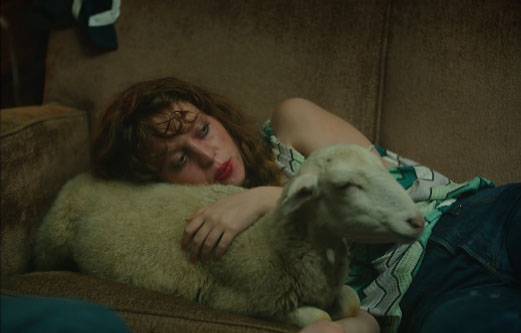
If we were in any doubt as to how bad this party has become, the surprise sheep lets us know.

Things now take a turn for the weird as trophies in a red-lit room tremble in Solene’s presence; she notes it but appears to move on, as a roller-blading blonde in hot-pants twirls to punctuate the moment. This is notable as the only part of the video that veers towards the male gaze, which otherwise has been surprisingly avoided, particularly in our protagonist’s outfits – although perhaps the shot is there to make that contrast clear?

She steps more carefully through the heavy petting room, affection and love more worthy of her respect, but the weirdness returns as a necklace rises towards her inexplicably. Matching the rhythm of the syncopated vocals, metal objects attach themselves to her armour. Something is wrong.

Perhaps there’s a clever metaphor I’m missing here, but it seems that our protagonist has become too emotionally ‘charged’ by the events so far to pass through unscathed. If she’s to make it to the heart of the party, she must shed the part of herself that is holding her back.

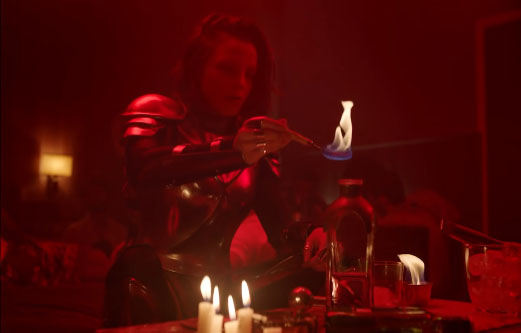
In what reads like a time-twist, it seems as if she did in fact enter that red room with the trophies, and we now flash back to it, to discover her smoking and preparing some kind of cocktail. Having previously seen her antipathy towards intoxicants, this seems strange. Perhaps the party life was once hers, and her attitude is not that of a pious outsider, but rather one who has been through her own struggles, but emerged on the other side. Perhaps she wants to save Pedro as she once was saved (or as seems more likely, saved herself), and accepts as the price that she must, with care, use an aspect of herself that she had previously closed off.

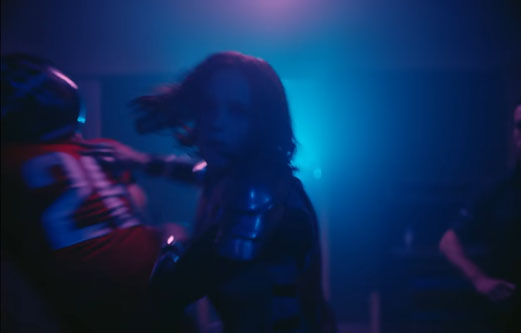
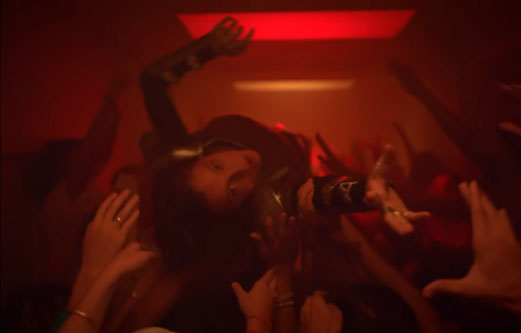
Two quick scenes that follow endorse this idea. In blue light (read: earlier) she struggles to evade the most potent patriarchal symbol yet: a drunken football team. Then in red – presumably after imbibing – she is crowd-surfing an otherwise impassably packed corridor, the party accepting her as one of their own.

Fighting through plants (a cannabis farm?), bleary, she is perhaps paying the price for this power. But now flashing back again to the red room, we learn something more powerful took place there: magical realism escalating, the chrome drink coats her insides and appears to transform her armoured form into a chrome ’73 Corvette C3 Stingray: impeccably cool and worthy of respect from the revellers. Also it makes no sense! But that’s fine!

The climax

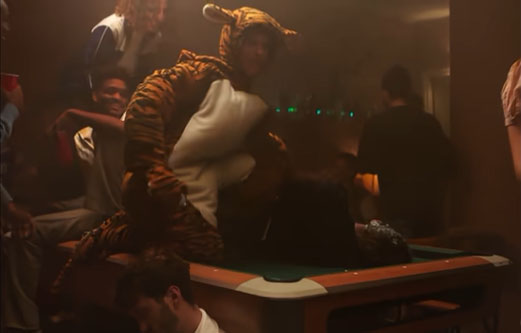
She finally reaches her goal: Pedro, even now having toothpaste applied to his comatose form by a man in an ill-fitting tiger onesie, representing the pure Freudian id of Tigger.

In a perfectly acted moment, Solene sighs – a combination of relief, disappointment, and simultaneously anger, crystallising into action.

The Corvette burns intimidating doughnuts, and she is left alone by Tigger and the revellers to save Pedro.

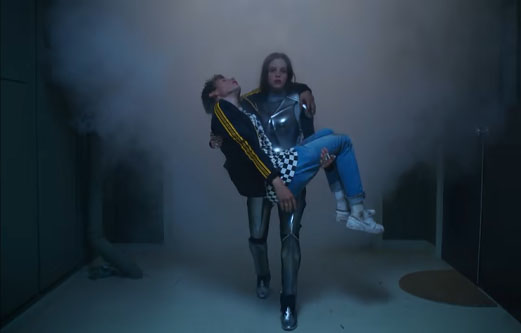
In an image that sums up the whole story, the still-armoured Solene emerges from smoke, carrying Pedro, gazing upon him with a combination of relief and love. The song is over.

But there’s one final, surreal twist. In the early morning light we see Pedro surfing atop the chrome Corvette (driverless of course, because it is in fact Solene). We quietly hear what sounds like an outtake from the string section used on the track, and the hexagon closes us out as they drive, presumably, towards a better future.

The dynamic at play here, though, is uncomfortable. Pedro affects an unearned coolness, literally riding atop Solene’s efforts as if he were the hero. How does she feel about this? Where is their relationship really headed? It feels to me like the default patriarchal order is being reasserted, and from what we’ve seen, she will not tolerate this for long. What she has gained from this ordeal is not a partner, but confidence and strength. That will last.

I don’t think Pedro will.

Conclusion

For me, the video evokes my time back at university: the parties, the intensity of every experience, and the romantic idea of being “Up all night with you” – but also of realising that you don’t have to conform, that these relationships may not last, and most importantly your own character is coming into focus.

And that’s why it’s one of my favourite music videos.

Transmission ends

Categories
Uncategorized

Beginnings and Endings in public performances

Knowing how to start and stop

If you have to give a public performance of some kind – from a wedding speech, to a presentation at work, all the way up to a play or musical performance – I would suggest that starting and stopping are the very hardest bits to get right.

It sounds simple in theory, but there’s really a lot going on!

Beginnings

The beginning is the most important part of the work.

Plato

The ritual of starting a public performance of any kind has two challenges: people turning up late, and drawing attention to the starting moment. This applies to a speech or presentation, but also to a gig or play, a sporting performance, or even a pre-recorded work such as a film at the cinema.

Latecomers

For the ‘turning up late’ problem, the default strategy is to deploy some form of less consequential entertainment, for a duration in proportion to how late people are likely to be.

With scheduled TV programming (which is still apparently a thing), people are likely to be pretty much on time, so a 30s-60s opening sequence works just great. It has a distinctive soundtrack so other people in the house who might want to watch can also hear it starting and rush to the sofa.

For a film at the cinema, people have to travel to get there so are likely to arrive later than planned, and then realise they really need the toilet, or find the queue for the popcorn is longer than they anticipated. So there’s quite a margin of error; a 15-25 minute period of adverts and trailers is about right, and of course has other benefits to the theatre.

For a gig, the calculus gets blurrier still: the venue wants to make money from drinks, and the performers want a full, warmed-up crowd, so a warm-up act of some kind about an hour before the main performance is perfect.

There are two areas where I feel like society has not happened upon an adequate solution. First, attending a theatrical performance has the same challenges as the cinema, but I’ve never seen that liminal time between arrival and performance filled well. Second, and of more direct interest to me, in a work presentation – and especially an online one – there’s an awkward period of 2-5 minutes between the first arrivals and the latecomers.

Back when we still went in to offices, I solved this problem for a particular weekly meeting by using the TV method: I played a ‘theme tune’. This had the nice effect of raising the energy level, and also signalling to those elsewhere in the office that the meeting was about to start so they should get a move on – precisely the same benefits as a TV show, but a 2-3 minute song is about right instead of 30s-60s.

Now that these meetings take place remotely, we still have that same space of time, but a theme tune does not work well at all. There’s no ambient way of reminding those who haven’t joined yet, and the music would stifle any conversation between early attendees. I still don’t know how to solve this. My very partial solution is to set my video background to something I’ve been interested recently as a soft cue for small talk!

Calling attention for the start of the performance

Since we have a gap between the early arrivals and the latecomers, we then have the second problem: signalling the true start of the main performance.

Indoor public venues have a great cue for this: lighting. Dimming the lights is instantly noticeable and clearly signifies the audience to pay attention to the stage. At the Brussels Puppet Theatre I saw a particularly powerful version of this idea: you hear three quick, sharp knocks (which quickly silences almost all of the audience), followed by three slower knocks, each of which is precisely synchronised with some, then most, then all of the house lights going out. Attention is rapidly and tightly focused!

Cinemas have a harder time deploying the lighting trick as they have generally already engaged ‘movie mode’ to show the adverts and trailers. Some will transition from partial house lights to darkness (not a particularly dramatic change), and in some European cinemas an automatic curtain draws closed over the screen and then re-opens to mark the change – kind of pointless, but effective! In other cinemas, more notably, they play a very distinctive and loud descending run of three chimes, reminiscent of the puppet theatre’s three taps.

Without those tricks, the opening moments of the film itself can also do the job. In the UK at least, after the near-continual sound from the trailers, the moment of silence while the age certification is displayed forms part of the ‘things are starting’ signal. The animated logos of production companies do the final part of focusing attention, especially when accompanied by significant sounds – 20th Century Fox’s fanfare being particularly effective.

Occasionally films may deviate from the logo pattern, at their own risk. Dancer in the Dark (2000) was intended to open with the Overture playing while curtains remained drawn across the screen; in the UK and US, where auditoriums generally lack such curtains, it instead plays out over a black screen, to the confusion of the audience.

(Side-note: for Things readers interested in all things ‘meta’, Dancer in the Dark is notable for tacitly inviting the audience to leave before the film ends. Although I consider it an excellent film, I fear everyone will experience some form of regret whichever choice they make.)

More recently Dune (2021) forces audiences to sit up and pay attention by opening immediately with a (subtitled) quote in an alien tongue; very effective in the screening I attended because the volume was so loud!

Returning to the office setting, cueing the start is another problematic area. There is at least a well-defined approach for a more formal presentation, in which a host of some sort introduces the speaker, but there is one crucial rule such hosts must know: audiences are primed to clap after hearing a name. A successful introduction therefore follows the pattern: “Please welcome serial victim, unknown assailant, and universal stand-in, the enigmatic… John Doe” <applause>.

I frequently see hosts destroy this moment simply by reversing the order: “Please welcome John Doe” <scattered uncertain claps>, “who needs no introduction” <disconcerted silence>.

For a single presenter, there does not seem to be a universal method of kicking things off, which is unfortunate. They simply have to try interrupting everyone with a generic opening remark like “May I have your attention please”.

In less formal and more raucous settings, I was introduced to a fantastically effective alternative by – I think – Tim Sheppard: you say “If you can hear me, clap” – and then you clap. You repeat this a second time, and now roughly half the audience should join you in the clap. This gets the attention of the rest of the audience, so on the third repetition, everyone joins in, and is instantly giving you their full attention. I note this also echoes the rule-of-three seen earlier with the puppet theatre’s knocks, or the cinema’s chimes.

Endings

The end is important in all things

Yamamoto Tsunetomo, Hagakure: The Book of the Samurai

Endings are a little easier: there’s only problem to address and that is the ambiguity of whether or not the show is over. But perhaps because it is less problematic, this can end up less decisive in many contexts.

In film and TV, the end-credits can make this very clear – although this is currently opening up into a battleground for new norms, as streaming services lean in to automatic credit-skipping (to the delight of some and horror of others), and as the Marvel Cinematic Universe in particular is normalising the idea of the mid- or post-credits scene.

The theatre can make wonderful use of their curtain, and there’s a delight to be had in the ritual of the actors coming out to take a bow – but after that, the audience and actors both have the difficult problem of judging whether continued applause can or should be deployed to bring on further rounds of bows.

Musical performances such as a gig are very neatly divided into individual songs; the ambiguity then becomes about judging which song is the last. The level of enthusiasm an audience is likely to display is also a little too much for a band to feel comfortable standing there and accepting. Both these problems are resolved with the odd but completely accepted ritual of the band leaving the stage, then after judging the performatively correct length of applause, returning for an encore. Any real ambiguity is ultimately resolved by the raising of the house lights, which signals the ‘true end’.

I have seen this defied just once, in Björk’s 2016 performance at the Royal Albert Hall (written up nicely here). Despite performing the standard encore ritual with a radically re-worked version of Pluto, the crowd was not satisfied, I suspect because unlike other London performances, at no time had Björk addressed the crowd directly.

Despite the universal signal of house lights returning, the applause continued, and from the stalls the crowd began to sing the repeated, unresolving five-note refrain from Pluto, the song they had just heard. The singing spread through the crowd and sustained, as the Uncut article notes, “a demonstration so overwhelming that it forces Björk back out of her dressing room to offer further benedictions and thanks.”

Ending a talk or presentation, like beginning one, is much more difficult. Just as introducing a speaker by name creates a perfect moment for an audience to welcome them with applause, the audience is similarly primed to applaud at the end – but the cues are far less well-defined.

One obvious pattern to avoid: do not smoothly segue into a Q&A section. By explicitly asking the audience for something other than applause, you deny almost any chance of it!

The guiding principle to end satisfyingly is simply to ensure the audience is confident you have reached the end. If you can pull that off, and have performed well enough, a small silence while maintaining eye-contact can cue the applause. My favourite way to signify the end is to make a callback to something you mentioned at the very start; that and other ideas are nicely summarised here.

A much more overt method is to symbolically bringing your own hands together, as you deliver your concluding remark, as if clapping yourself. I saw this used by a guest-speaker in a talk about giving talks (a meta-talk); the second guest-speaker completely destroyed the applause-cueing effect by launching into a question before the applause could begin! (That guest-speaker received their comeuppance at the end of their own talk, when the first speaker vindictively deployed the very same trick).

Finally, in an online presentation, as with beginnings, endings are even more difficult than the real-life version, notably because applause simply does not function. The audience is deprived of that cathartic acknowledgement. I’m not sure there can be any substitute for it, so you must instead figure out how to reasonably wrap up and cue the audience to leave the call. Even this is not trivial to do well.

In a Google Meet call, I had some success with a radical method: since participants can kick one another off the call, I invited everyone to play an impromptu form of battle royale by kicking off as many other participants as they could, until only one remained. Precise rules and their enforcement are difficult in such a game, but it seems to work well enough – the only problem is I fear it’s so intense and interesting in its own right that the participant’s feelings about the talk itself risk being lost entirely.

Conclusions for online presentations

Despite not being my intention when I started to gather these thoughts, this leads me to a very significant conclusion: in an age where remote work seems likely to become the new norm, we really need to solve the problems of beginning and ending in online presentations!

So I’m going to propose some ideas, inspired by what works elsewhere, and will try them out myself when the opportunity next arises. I suspect that over time manual solutions will emerge, and that these will ultimately be implemented by the platforms that host online calls themselves.

Waiting for latecomers in an online presentation

While one could deploy a song or video at this point, the way it eliminates any chance for banter among early arrivals is a big problem. But I’ve not seen group call service that can neatly accommodate multiple people talking at once, so you really have to lean into that.

  • Welcome each new joiner (even if you’ve already started!)
  • Engage arrivals in some light banter. This is of course the default option, but can be hard to pull off, especially for a less confident or outgoing presenter. So…
  • … you could explicitly have someone with a suitable personality act as the host, welcoming everyone in, leading the conversation, and cuing the main presenter when the time comes
  • … or you can use my trick of setting your background to something interesting to deliberately provoke small-talk
  • More radical options: you could tell a story one word at a time; each new arrival must add a new word, and everyone can give a recap of the story so far by saying their own words in turn. Sounds fun, but probably doesn’t work at small or large scales… and possibly nowhere in between either?
  • Challenge arrivals to name something (e.g. an animal that begins with ‘P’) that nobody else has so far said. This tacitly encourages early arrival and penalises latecomers, possibly a good thing. Again, may not work at small or large scales, but a middle-ground where this works is a bit more plausible.
  • Hold an informal vote on something low-stakes and binary; ask each member their vote as they arrive and keep a tally (e.g. “Cats vs dogs” or “Time is endless vs Time is finite”)
  • Sing a song that works in rounds; each new participant can join in at the right moment. Probably requires a very specific group of people for this to work, but perhaps if you established it as a routine…
  • Somehow have people arrive directly into small break-out rooms; then with a timed warning bring them back to the main room and begin!

Signalling the start of an online presentation

Depending on which method was chosen above, this may become easier… or harder. Given the way attention is divided, I think an audio cue is most likely to work.

  • Deploy the rule of three. Clapping or knocking seems too aggressive; playing a recorded three-note chime could work (like this). Judging the volume level correctly may be a challenge, but perhaps you test that out with the very first arrivals?
  • A more elaborate version of this would be to deploy an actual (brief) musical intro, probably more in the style of a Radio Jingle. This again has the volume challenge, and also requires more manual preparation – but perhaps for a meeting that repeats every week it could work well
  • You could deploy a ‘manual jingle’ – by singing something sweet and short! Sure to gain attention, but not an approach that would work for everyone.
  • Try to replicate the ‘if you can hear me, clap’ trick… replicating it exactly may or may not work; perhaps something more like ‘if you can hear me, touch your nose’ would be better? It depends on the default visual layout of the call, I suppose.
  • Failing all these, one could perhaps develop a very specific introductory sentence, long enough that any excess banter could be shut down, but banal enough that it doesn’t matter if you miss the first half of it. I’m not sure there’s a way to do this that wouldn’t come across as rude though. Perhaps something like “I’m going to begin the presentation in 8 seconds, in 7 seconds, in 6 seconds, in 5 seconds I’m going to begin the presentation, 3, 2, 1, now. Hello!”

Signalling the end of an online presentation

Other than notes on how to end a talk in general, the key problems here are to replace applause, and to cue the final end of the call.

  • If you started with a short musical cue, perhaps you could also signal the end the same way
  • “So, if you learned something from this presentation, please show that by waving at the camera – but if you’re still wondering about something I said, instead please stroke your chin and say ‘hmmmm'” (this gives a ritualised group activity and also segues nicely into Q&A)
  • Lean into the format and just say “mike drop!” and leave the call abruptly – either by walking off, or hanging up. Maybe re-join 5 seconds later for Q&A.
  • “That’s the end! Please show your appreciation by rapidly turning your video feed on and off”
  • Not repeatable, but for fun you could look off to one side and say “that looks like smoke…” under your breath, then deliver your final line in a slightly hurried way with an unconvinced smile before running off camera.

Closing notes

Ed pointed out to me that streamers address these problems online in a few interesting ways – running other videos as warm-up entertainment, or conducting text-based games for the waiting/arriving audience. However, these are quite specific to the streaming set-up, and I don’t think they can easily be used for the online work meetings I’m trying to solve for.

A new and much harder the challenge is also becoming more common: presentations where the audience a mix of those physically present and others joining online. In the absence of good online solutions, I don’t know where to start with solving the start and end of these meetings.

Finally, a side observation: arriving late to online meetings doesn’t feel as bad as arriving later to a physical one. However, the irritation at someone arriving late to your meeting is just as bad either way.

Consider arriving for online meetings early!

Transmission ends

Categories
Uncategorized

One Thing at a Time

This blog began as an email newsletter, collecting a few links to things I found interesting that week. As my commentary on these links lengthened, it made more sense as a blog (as well as a newsletter).

Like a fantasy author in the late stages of a series of books, updates are getting both longer and further apart, and now that 2 years have passed since the last update, it’s clearly time for a change.

So, a simple rule: from now on, One Thing at a Time.

After a (currently undefined) period of time or number of Things, I’ll aggregate them in a newsletter for the usual recipients and possibly a post. Let’s see how that goes!

Categories
New

Things July 2019: Bias, Co-operation, Location, Video Games

Extremely Generic Questions

In earlier iterations of Things I would often set readers a puzzle or ask a tricky question, with answers reviewed in the next edition. I’d like to start a new series of these that I’m calling Extremely Generic Questions: questions often asked, but not very specific or even necessarily well-defined. The puzzle is not only to try to find the best answer to a question, but also to understand why it is so often asked.

So, the first question: what is wrong with young people today?

Subconscious bias

If you want to make optimal decisions, and also just be a decent person, I think subconscious bias is a very important factor to be aware of. Many people believe their judgement of aptitude is not influenced by gender (or any other unrelated characteristic), but data suggests this is not be the case.

Anecdotally but compellingly, there’s the email signature swap story, in which a male and female colleague swap their email signatures for a week and observe radical differences in how clients interact with them. Pleasingly, you can read the accounts of this from each side.

Auditions for an orchestra have the advantage that they can be conducted in a thoroughly meritocratic manner without ever actually seeing the candidates. It turns out that blind orchestra auditions improved women’s chances of success by 50%.

Similarly, scientific proposals for time using the Hubble Space telescope tried going partially blind; the results again showed women benefited from a more meritocratic process.

As I am sometimes involved with hiring people for work, I tried a version of this by making sure names were removed from CV’s before I reviewed them. Of course, I don’t have any large scale data to compare results, but the feeling of trying to assess a nameless CV was alarmingly transformative! It became very clear that as soon as I saw a name, I would start to construct a mental image based on (irrelevant) associations I had with people similarly named, and would then build on that image as I read the rest of the CV. Without a name as a starting point, the process of evaluation immediately felt like harder work, but also a lot more objective. Based on this and the above findings, I highly recommend it.

Thinking, Fast And Slow

After many years of seeing it recommended, I finally read Daniel Kahneman’s “Thinking, Fast and Slow”, which covers a lot of the biases I’ve been fascinated by for so long from essentially the very coal-face of that research.

I found it fascinating throughout and can see why so many recommended it, although I didn’t always agree with the interpretations. Given that I’m just some guy who studied maths/physics and read a few things, and the author is a Nobel prize winner with decades in the field, I have to recognise that my position on this is likely tenuous, but at least as far as maths go I feel I can comment.

Here’s my brief highlights.

Probability Problems
There is a strange and fuzzy line between not understanding what a question means, and not getting the answer right. I could ask people what 3 χ 4 is, and if they think it’s 12, that doesn’t mean they’re mysteriously misguided, it more likely means they just don’t know chi-notation*.  In many of the studies, participants were shown to give incorrect answers to statements involving probability, but one could just as well argue that participants didn’t really understand the statement and so were guessing. To be fair, the book goes on to show how phrasing probability questions differently (to my mind, more clearly) helps people reach more accurate results.

This is what I talked about in Things 122 on the topic of the Linda Problem / Conjunction Fallacy.

Forecasting and regression to the mean
I have to do quite a bit of forecasting at work, and I was surprised I had never come across this excellent rubric for anticipating a certain amount of regression to the mean.

Briefly: if you evaluate, say, fifty people on a task that involves some luck as well as skill, like accurately throwing something, then the people who did the very best (or the very worst) on their first attempt are unlikely to do as well (or badly) on a second attempt; their results were probably mostly flukes, and they will tend to ‘regress to the mean’.

If I am evaluating 12 different marketing campaigns and trying to forecast how well they do in future, the same kind of rule applies. The one that did very best was at least partially ‘lucky’, so will not necessarily be the best in future.

The rubric is as follows:
a) If the measure you want to predict has zero correlation with their future values (which you can figure out by viewing historical data), then you should predict that regardless of how they did, they will all perform averagely in future.

b) If the measure you want to predict perfectly correlates with the future, so whatever is the best now will be the best in future, then obviously you should predict that.

c) If the correlation between the present and the future is x%, then you should forecast any present deviation from average performance will decrease by (1-x)%!

That’s the terse version, you can read more about it here.

Evaluation of experiences
How much you liked or disliked an experience would intuitively be based on how long it was, and how much you were liking or disliking it at the time. Something that was unpleasant for 10 minutes should surely be ranked as worse than something that was unpleasant for only 5 minutes.

In practice, this isn’t how we evaluate things at all. We very highly weight our peak enjoyment (or discomfort), and how happy (or unhappy) we were at the very end of the experience, and a little bit the beginning; the absolute duration plays only a small part.

This probably means you should take fewer, shorter holidays, but it also depends on how you weight the importance of what Kahneman calls the “experiencing self” and the “remembering self”, which is quite a tricky philosophical problem.

Life is like an Iterated Prisoner’s Dilemma, except different

As a student I was very interested in the Prisoner’s Dilemma, and the iterated version, in which one must choose to Co-operate with (C) or Defect against (D) another player making the same choice, knowing that you will come out best (and they worst) if you D while they C, but you will both do terribly if you both choose D.

One critical element: you can’t communicate with the other player. In the iterated version, the choice of C and D is effectively the method by which you communicate.

Meanwhile in real life, most of the time, the thing most likely to help you is another human, and the thing most likely to do you harm is also another human, which means interacting with other humans is a pretty crucial business. In particular it’s good to be able to figure out – and influence – who is likely to co-operate (C) with you and who is likely to try to take advantage of (D) you.

I studied maths and physics as a student, but struggled to understand human behaviour. By studying subjects where exam answers were simply right or wrong, and doing quite well at those, I (and I suspect many others in the same situation) thought that I must be quite clever, and the reason I can’t understand human behaviour is because other people are just acting irrationally.

Now, it is true that people act irrationally a lot of the time (see the last Things), but that also includes me, and a lot of the things I couldn’t understand eventually made more sense when I realised that life was like an iterated Prisoner’s Dilemma, except that rounds aren’t discrete or simultaneous and there are multiple and varying pay-off matrices in play all the time.

For example, I noticed people asked “How are you?” but didn’t actually want to know, which seemed irrational. This was laid bare for me in a dentist’s waiting room when one elderly person entered and recognised another, and the following exchange took place:

A: Oh, hello there! How are you?
B: I’m fine, how are you?
A: I’m fine thanks. So [short pause] how are you then?
B: Well, I’ve been having this awful pain in my side, so I went to the doctor last week …

Similarly, as a marketing grad I was sent out with a cameraman to stop people on the street and get their opinions on climate change for a vox pop montage. I would walk up to people and ask them right away, and nobody stopped to answer. The cameraman, who had done this before, told me I should ask them how they were first. This seemed ridiculous, as a person approaching you with a microphone and film camera obviously doesn’t care how you are, they just want to film you saying something. But I tried asking anyway, and suddenly just about everyone was then happy to give their opinion on climate change for the camera.

I realised the whole “How are you” bit is like a tiny move in an iterated Prisoner’s Dilemma in which you are really communicating “I will co-operate with you”, and the other person can demonstrate a reciprocal intention by asking you the same thing back. This then sets the scene for further and deeper co-operation.

Moves aren’t just made in speech either. I thought buttoned shirts were ridiculous in comparison with t-shirts: uncomfortable, more time-consuming to put on and remove, and harder to clean. Why would anyone choose to wear one? But it turns out clothing is a widely understood opening move in our co-operation dialogues. We learn that we can estimate by someone’s clothes how likely they are to co-operate with or benefit us in certain ways; uniforms do this in an overt way, but even a slight deviation from your company’s dress code sends a signal.

Cat and girl covered this, of course.

More generally, these kinds of behaviours make a society cohesive – by doing what everyone else does, you tacitly signal that you are a good co-operator in your society. At the same time it can make society conservative, as anyone deviating from locally normal behaviour (even for rational reasons) might be read as less co-operative, and so they will encounter more friction.

Location Encoding

What3Words (W3W) assigns each 3m x 3m square on Earth a three word designation (e.g. Each.Useful.Shark). This makes it fantastic for real-world treasure hunts, so long as the participants can use the mobile app, and I’ve made a couple of events that leveraged it to (I thought) rather fun effect.

However, Richard brought to my attention that among people interested in the general problem of addressing, W3W is viewed very negatively. Why is that?

Reading up on the subject (this post was particularly useful), it seems like W3W lacks some attributes a truly general Location Encoding system should really have. But what really annoys people who understand this area well is that W3W tends to put out PR that claims to be strong in the areas it is weak. In brief:

  • W3W is a private company (probably hoping to be acquired by another one). Location/address is something that works best when it’s a standard, and having a private company own a standard leads to conflicts of interest. (See the Microsoft ‘Embrace, Extend, and Extinguish’ strategy for an example of how private companies fight public standards).
  • W3W is not a good solution for emergency situations (calling an ambulance to your location; calling a Fire Engine to a location you see on fire).
  • W3W is not error tolerant and has no hierarchy (e.g. one mis-spelt/mis-remembered character has very little chance of being corrected, in contrast with traditional addresses, where post accurately addressed apart from saying “Brighton” instead of “Hove” still successfully gets to Hove with the word Brighton angrily crossed out and corrected).

Still, I do think W3W has some value, and it would be unreasonable to discard it entirely because it can’t do everything – indeed, no address system can meet all the requirements we might ask of it.

Google Maps’ location-sharing functionality covers many options, and has the benefit of being already available in many people’s pockets, but I recently had a situation where both intuitive addressing and Google failed: meeting at the “Joe’s Café in Soho” does not specify a unique location, and the inaccuracy of GPS meant a shared Google location didn’t resolve the matter either. W3W is actually pretty excellent for this sort of spontaneous meeting. All things considered though, the best thing about it really does seem to be the opportunities for Treasure Hunts.

Video Games

I’ve played some games since the last Things, some of which I recommend, and some of which I don’t!

Baba Is You (Steam, Humble store, itch.io, Switch)

The mostly instantly-gettable trailer seems to be in this tweet:

https://twitter.com/NotableReleases/status/1106254438841401344

For Things readers partial to self-referentiality and all things meta (and I know there are a bunch of you), this is certainly worth a look. As the above video shows, the game is played by pushing things around, including words that define the rules of the game.

In practice it’s even more mind-boggling than I expected, but not actually as much fun as I had hoped.

Celeste (Steam, itch.io, Switch, PS4, Xbox One, Pico-8 prototype)
If you want a platform game with puzzle elements and enjoy dying repeatedly while you slowly get better at doing difficult things, this is extremely the thing for you. The soundtrack is quite lovely too.

My save file, 44 hours, 10,000+ deaths, is a review in itself (implicit spoilers split-by-level version is here):

Lovers in a Dangerous Space Time (Steam, Switch, PS4, Xbox One)
Looks exactly like what it is: a rather nice local co-op shooter in which you and some friends control characters running around a ship manning the helm/gun/shield/panic-button and rescuing animals in space.

Thomas Was Alone (Direct for Mac or PC, iOS, Android, Steam)
A kind of “self-aware” puzzle-platformer that everyone was going on about a few years ago; I finally tried it and found it dull and not at all as funny as it seemed to think it was, with frustratingly vague platforming physics.

The Legend of Zelda: Breath of the Wild (Switch and Wii U only)
An open world epic about saving the world which I tried – and failed – to enjoy for about 12 hours before giving up. Almost everything about it felt like a chore and I couldn’t understand how it gained such universal acclaim.

After a weirdly long time adventuring in my underwear, I finally found someone who would sell me clothes.

To pick one example, a complaint I had heard from some was that weapons could only be used a certain amount of time before they fell apart and had to be replaced. I thought this was just misguided resentment of a feature clearly designed to add strategy to battles, but then I spent the first hour of the game picking up and discarding 37 differently ineffectual sticks (you can only hold a few at a time) and fought about 5 monsters. It felt like I spent substantially more time managing my ineffectual stick inventory than having battles, and so the whole weapons feature then felt like busywork.

Loading screen tip: read loading screen tips. By definition, this is useful to nobody.

Perhaps the worst part is I still feel like I “should” give it more of a chance, or at least get more entertainment for my money, when rationally I know there must be more games out there like Celeste which were an order of magnitude more fun for a fraction of the price.

Horizon Zero Dawn (PS4 only)
Snakes on a Plane is a great title for a film because it perfectly sells the premise. Horizon Zero Dawn is a terrible name in that regard, but the promotional art sells the premise perfectly:

Tribal humans hunting robot dinosaurs! Which immediately looks like something I want to try, and also very quickly raises the question of just how such a scenario could even come about. It turns out the game is exactly about those two things: hunting robot dinosaurs while figuring out how this happened!

It certainly stands on the shoulders of giants in terms of the use of ‘Open World’ game conventions, but it adds a few interesting ideas and does just about everything you would hope to extremely well.

*I made up “chi-notation”, because I couldn’t think of a clearer example, it seemed funny, and illustrates the point just as well.

– Transmission finally ends