Link
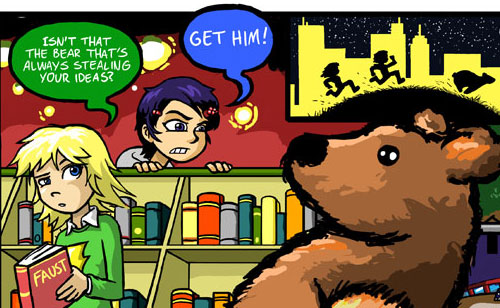
In Things 48 (not yet blogged) I linked to an Aaron Diaz’s Dresden Codak update featuring 42 sharply observed 3rd-act plot twists, but recently realised that this may have misrepresented his work, which instead usually consists of astonishingly deft single-page stories revolving around simple but brilliant ideas.
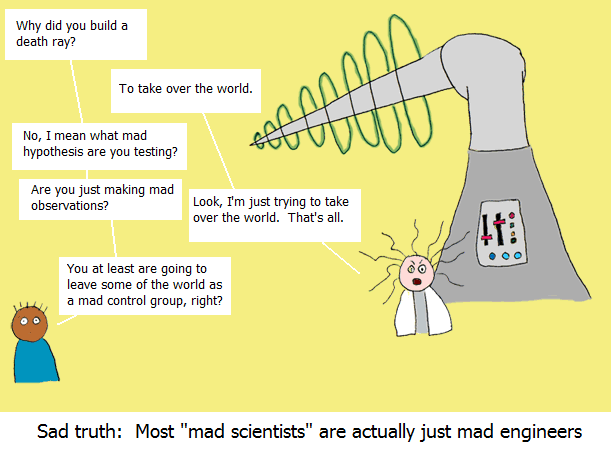
Here’s 3 of my favourites to give you a much better idea of Diaz’s oeuvre:
His blog on comic art theory is also well worth checking out if you are remotely interested in the art form.
Quote
During a characteristically interesting and varied conversation with Adam a few days ago, he suddenly revealed the following:
That reminds me of a really interesting thing I read in the Metro today – something like: 30,000 people… something. I can’t remember what it was, but it was really amazing.
Question
Sometimes I want to ask things in Things that are even more obviously not what people might call Puzzles than usual, so in these cases I’m going to be more direct and call a question a Question. So here is a Question.
When it comes to arguments about the English Language I tend to side with the people saying “most people say it this way so that’s now correct” against those saying “this is the way some Victorian guy wrote in a book that it should be said so everyone doing otherwise is wrong”, but I do admit that some distinctions are worth holding against a tide of misuse, one example being that I would correct instances of “i.e.” and “e.g.” being used in one another’s stead where polite and possible.
Fortunately, this didn’t come up very often.
Then in 2010 something terrible happened. About 95% of all instances of “i.e.” that I read were incorrect and should have been “e.g.”, which is particularly silly as it reads as if the author believes a set of many elements (e.g. social networks) consists of only one (e.g. “i.e. Facebook”).
So my question is this: have you also noticed such a sudden rise in “i.e.” misuse, or have I just been unlucky and/or suffered from confirmation bias?
Video
A while ago I realised you could collage time lapse photography of a flight path to obtain an image of a string of planes; I then realised you could do the same thing with video, but recognised that this was beyond my means to produce. Conveniently, GE have now done this:
The Things newsletter was sent throughout 2010, although I only started blogging it in April with Things 67. Here I’m going to pick out my favourite 3 Things from each of the main categories, including some from the pre-blogging era.
But first:
Tim Link
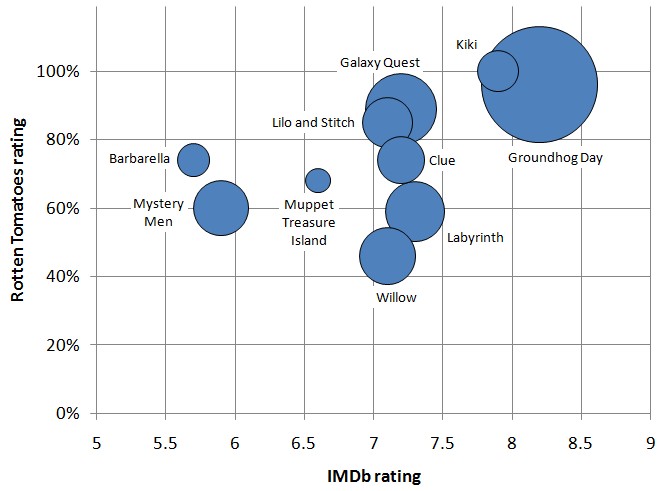
I compiled a list of my top 10 movies to watch at Christmas, not because they’re Christmassy but because they are perfect for the hazy lawless dreamlike days between Christmas and New Year’s Eve. Click through to see trailers, summaries, and other handy links, or if you just want to know what I chose, here’s how they stack up in terms of IMDb and Rotten Tomatoes ratings, with bubbles scaled by number of IMDb votes (as a proxy for famousness):
Last Week’s Puzzle Last week I asked why our ears ‘pop’ when a plane takes off or lands, given that the cabin should be airtight and thus immune to changes in pressure.
Richard pointed out that actually maintaining that pressure differential at altitude must take a lot of strength, and therefore weight, in terms of materials. By allowing the internal cabin pressure to reduce to still-tolerable levels, the pressure differential is reduced, less strength and therefore weight is needed, making the aeroplane more efficient. Makes sense to me.
Now, on to the Things of the year:
Videos
From Things 70, a perfectly self-explanatory animated gif:
In Things 85 I highlighted the growing trend of cat dubbing:
http://www.youtube.com/watch?v=9bTbAsmPOKo
Most recently, in Things 88 I highlighted this beautiful short animation:
dragonfrog, commenting on this Boing Boing post: A quote from Bruce Schneier I think is applicable here: “If you think technology can solve your security problems, then you don’t understand the problems, and you don’t understand the technology.” If you leave out the word “security” I think it remains just as valid.
Pictures
As featured in Things 66 (not yet blogged), from LukeSurl.com:
Finally, from Things 87, because this never gets old for me:
Open-ended Puzzles
1) In Things 71 I asked what would be the best thing I could buy that would maximise hours saved per pound spent. This produced a wide range of responses, largely depending on which assumptions people chose to question, which I posted in Things 72:
Yasmin suggests Red Bull (and similar) to save time by needing less sleep.
Alam suggests a clone of myself
Xuan suggests slaves and a washing machine.
Angela suggests two books that could improve one’s efficiency and so save time — The Miracle of Mindfulness and Making Time. (Funnily enough I already own the latter… and I’ve now read it, and have applied the principle of Mindfulness, which was its main point, to rather good effect. But that’s another story).
John suggests grated cheese.
Phil points out anything free that saves any time would maximise the metric, such as DropBox. This technically lies outside the “buy” requirement. He also suggests a combi-microwave and a smartphone, and then finally a device to prevent time-wasting by cutting off internet access between certain hours. (I since got a Smartphone via work, saving a lot of time with the DropBox and notepad apps, but wasting a lot of time with Angry Birds).
Simon specifically attempted to address the “I” part of the question by recommending an iPad as being a particularly good purchase for me, by switching to digital goods (music, movies, comics, books); “Imagine all that time not wasted, going to shops, ordering physical products online and searching for things you can’t find.” I don’t exactly agree, but that’s a huge discussion for another time.
Finally, Laurence suggests a Time Machine, and insightfully adds:
The inevitable complexity of all the proposed solutions reminds me of
the following quote:
“If you want to make an apple pie from scratch, you must first create
the universe.”
– Carl Sagan
2) In Things 77 at Angela’s suggestion I set the Trigger’s Broom / Theseus’ Ship problem. While there was some excellent discussion, which I summed up in Things 78, my favourite answer came from Laurence, which I posted in Things 79:
“It has occurred to me that this could equally be applied to most armies,
governments, countries, football teams, religious cults, families, and
hell, humanity as a whole. At least one of these is the cause for things
like the situation in Northern Ireland, so I think if you could solve
Trigger’s Broom, then it could well go towards solving some larger
issues. (Albeit, possibly presenting people with some radically new ones
in the process!)”
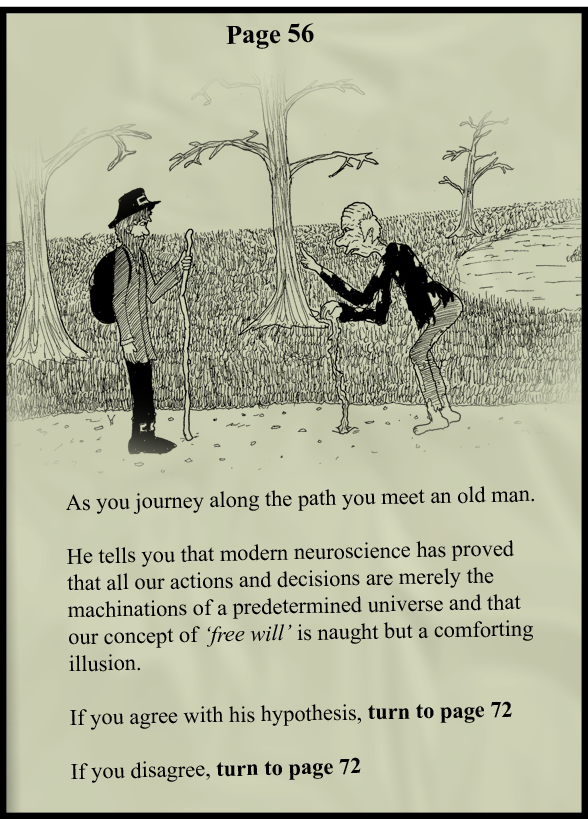
given an arbitrary budget, and any science-fiction technology you care to imagine, how would you devise a test to see if Free Will exists? Feel free to use any definition of Free Will you think might be useful.
Again, there was some interesting discussion summarised in Things 85, but I had one preferred response, from Tarim:
I cannot think of ANY definition of Free Will.
Which I thought was a fair point.
Puzzles that had good answers that I didn’t know
Richard deserves a special mention for supplying quick, detailed and accurate answers to many puzzles where I had no idea what the answer was at the time I asked. Here’s my favourite three examples.
1) In Things 74 I asked why walk-in freezers have doors that cannot be opened from inside. Richard pointed out the answer is that actually, they generally don’t.
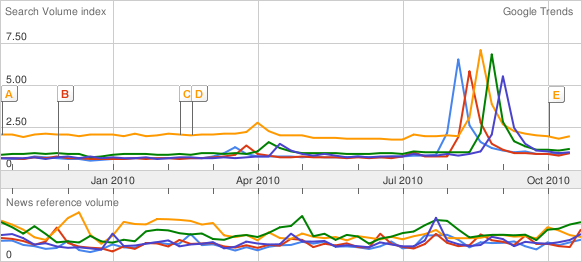
As I posted in Things 86, Richard worked out that it must be people search for the latest fansubbed episodes of the anime series Bleach, which is pretty much confirmed by checking the search terms associated with these numbers over on Google Insights for Search.
3) The ear popping problem, as was posted in this very edition of Things.
Films
I really enjoyed City of Ember, but I have to admit this is probably because I love films about things that are underground or the end of the world or mechanical contraptions, all of which it has.
I’m going to try to see Eagle Eye because it looks like it might hold my attention with a combination of a moderately creative idea and a lot of explosions.
Trailer:
httpv://www.youtube.com/watch?v=_wkqo_Rd3_Q
IMDb: 6.9/10
RT: 28%… but critics never like this sort of thing!
Also of course there’s Quantum of Solace which is out next Friday.
Puzzle from before
In Things 30 I asked why we look after the ‘least fit’ despite the fact that we evolved through ‘survival of the fittest’. A lot of people turn this around and use it as an argument that we shouldn’t look after the weak, which is ridiculous for a number of reasons, but most of all it is ridiculous because of the answer to this puzzle.
The trick is that evolution optimises for survival of genes, not individuals, and individuals tend to share a lot of genes. Helping the ‘least fit’ is nothing more than a strategy that evolution tried out and turns out to have been extremely successful. Anyone advocating the ‘kill the weak for survival of the fittest’ argument needs to explain how it is humans have managed to thrive across the entire planet by being nice to their fellow tribe-members.
This week’s puzzle
Last weekend I drove a hire car from Edinburgh to Cardiff. As it got dark, other drivers started flashing their lights at me, even though I had my lights on. I pulled over and checked the lights – they were all on, front and back. What was the problem?
A video
The stop/go cat I linked to in Things 30 has become a massive viral hit. Here’s another one – literal lyrics put to the legendary Take On Me music video:
Tim Link
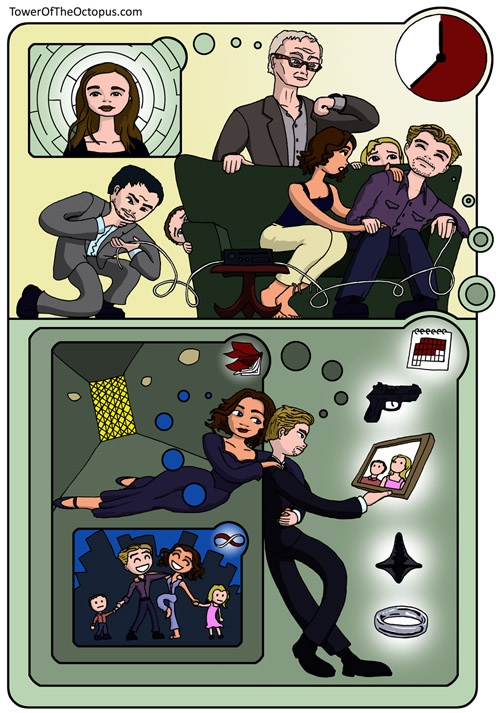
After a lot of research and a second viewing with a lot of note-taking, I felt like I had got to the bottom of Inception. My diagram and explanation of what I think is really going on can be found on Tower of the Octopus.
Quote
I can’t actually find who said this first on Twitter:
Pissing off 4chan: free. Botnet hire: $1000/month. For everything else, there’s Mast– oh, wait, not any more there isn’t.
Puzzle
We are told that your ears go ‘pop’ in a plane after take-off because of the air pressure changing with altitude. But we also know that the cabin has to be airtight, as if air could get out the pressure would equalise and above 17,000 feet everyone would die. So why does the air pressure change in the cabin at all?
Picture
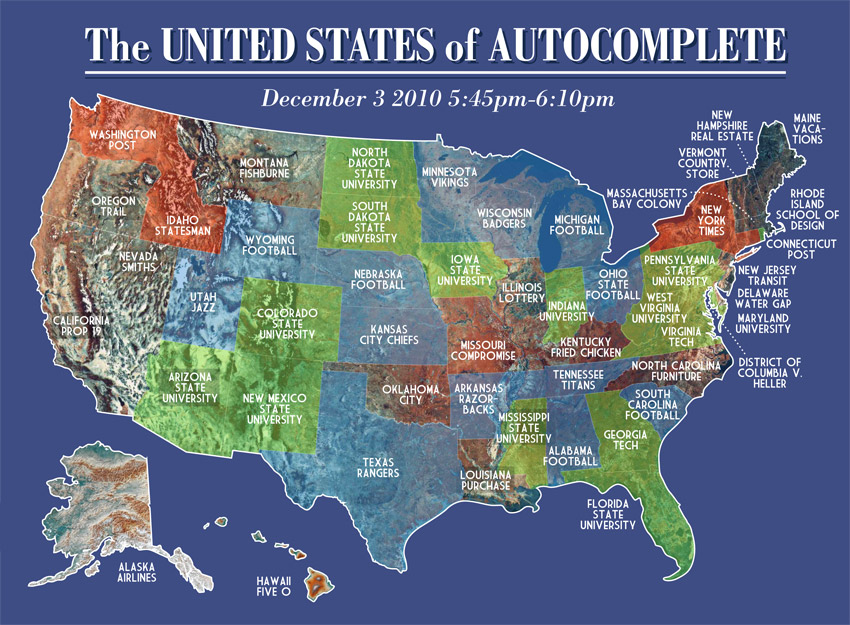
From Dorothy ‘Cat and Girl’ Gambrell’s visualisation site Very Small Array, the United States of Autocomplete gives Google’s autocompleted suggestion of what should come after each state name (note results are regional, we’ll get different results from the UK) (click for full size):
Last Week’s Puzzle
Last week I asked “why does the perceived attractiveness of any given individual vary so much depending on who you ask?”, which provoked quite a bit of discussion on the CC list.
Thomas points out:
It’s not enough for both parents to have ‘good” genes, but they should have “good” genes that are sufficiently different that any child will have the maximum possible genetic advantages.
Or as Xuan put it:
Attractiveness: Relative to your genes and where you want them to go.
Simon adds a practical consideration:
… people of similar levels of attractiveness find each other attractive (because your genes have the best chance of survival if you can maximise some function of beauty x propensity to shag me)
Phil counters:
So many couples look very similar though! Perhaps that is somewhat due to acquired mannerisms, but I’d have thought there’s a strong trend to find people similar to yourself attractive, to help similar genes survive
My summary of the situation was this:
To have the best chance of promoting themselves, your genes want to help others with similar genes (and procreating with them is pretty helpful), but also combine themselves with complementary genes. With both of these pressures in effect, and a distorting lens of nurture on top of the nature, we can’t be too surprised that people disagree on attractiveness.
Finally, Matt raises the logical next question – how to genes actually do this:
I think we may be giving too much credit to genes abilites to recognise similar genes and indeed complementary genes here. And after all, there are a lot of different genes with a vested interest here. I would posit that we decide who would be a good catch based on a set of genes (and so on) that try to recognise success in any form – one of the primary indicators surely being perceived social standing, but also apparent health, virility etc. So, regardless of precise genes, recognising good stuff.
I find the idea of encoding a DNA sequence that will give rise to a brain that will perceive the outside world and detect optimal reproductive opportunities almost completely mindboggling.